Eye on electricity
How accurate wind and solar forecasts and the new forecasting arrangement are crucial
- Generation
- Prices
Last year, the Authority introduced a hybrid forecasting arrangement and awarded DNV Services a contract to provide centralised wind and solar forecasting services. As of August 2025, all wind and solar generators must use centralised forecasts unless otherwise approved by the Authority. Currently, all except two wind generators are using DNV forecasts.
The hybrid forecasting arrangement aims to improve the accuracy of wind and solar generators’ offers. This should lead to improved accuracy of price signals and thereby contribute to the most efficient and lowest cost sources of generation being dispatched – reducing overall system costs.
Improved wind and solar forecast accuracy also benefit security of supply. It reduces uncertainty for generators with slow start units so they can make them available and ready to run when needed.1 Better forecasts also help avoid extreme situations like the electricity cuts on 9 August 2021 where inaccurate wind forecasts contributed to the system being short of capacity.
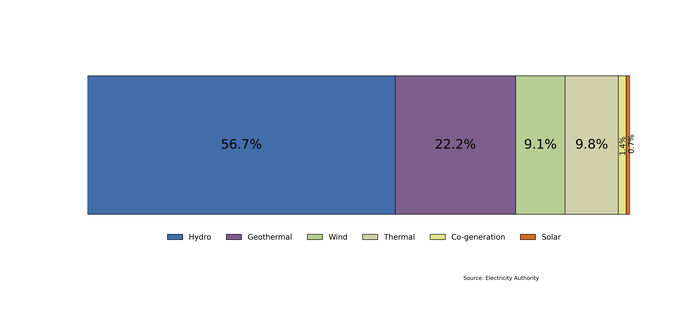
Wind and solar generation make up an increasing proportion of electricity generation in New Zealand, with more projects in the pipeline. Last year, wind and solar together contributed around 10% of total electricity generation (Figure 1). As wind and solar generation increases, accurate forecasts will become more important.
The importance of forecasts
Solar and wind are variable (or intermittent) generation sources that are reliant on the weather. Such variability can pose a challenge to the System Operator when managing grid stability and ensuring there is enough supply to meet demand at any time. The variability in wind and solar generation also increases uncertainty for other generators, such as thermal, on whether this more expensive generation will be needed.2, 3
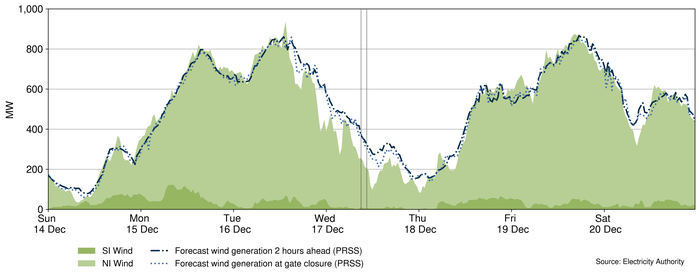
The Authority monitors the electricity market. Our reporting often shows that electricity price spikes are closely linked to sudden drops in wind generation that are not captured in wind forecasts.4 Figure 2 provides an example. On Wednesday 17 December 2025, wind generation was more than 100MW lower than forecast, contributing to the price spikes that day.
As forecast accuracy improves, there will be fewer instances where more expensive generation is unexpectedly needed, and more times where the most efficient and lowest cost sources of generation are dispatched.
For example, during the price spike of 17 December 2025, one of the Stratford thermal peakers started generating. If wind forecasts had been more accurate, other generators, owners of batteries making decisions on whether to charge or discharge, or consumers who can reduce demand, would have seen low wind was forecast with plenty of time to make more informed decisions, perhaps leading to a more efficient outcome.
Depending on market conditions, inaccurate forecasts can contribute to the inefficient dispatch of even more expensive units, such as the diesel-powered Whirinaki peaker, which usually has the highest short-run marginal cost compared to other generators.
Forecasts have improved under the hybrid intermittent forecast arrangement
Despite the hybrid forecasting arrangements still being relatively new, we are already seeing positive signs that forecast accuracy is improving, as shown in Figure 3.5
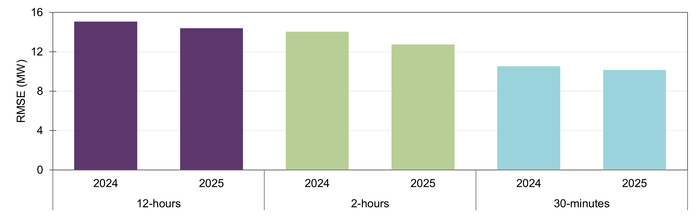
The results in Figure 3 show that the wind forecasting errors6 averaged over all wind farms in New Zealand decreased around 4 to 9% for the three relevant forecasting windows after the new arrangements were implemented, compared to the same time last year.7
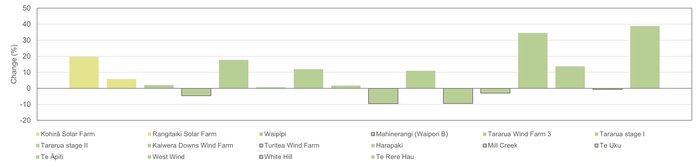
When looking at individual wind farms and the two solar farms that were operating in 2024, as shown in Figure 4 for 30 minutes-ahead forecasts, we can see that forecast improvements were not homogeneous; a few farms showed large decreases in errors (positive change in the chart) while some wind farms showed increases in forecasting errors (highlighted in purple).
The results we are seeing so far are positive but there is still room for improvement. The Authority is working to ensure that the accuracy of wind and solar forecasts continue improving by assisting the central forecast provider, making sure it has all resources needed to fine-tune its forecasting models and improve its results with time. We will also continue regularly monitoring this space.
1. Tuncar, E. A. et al. A review of short-term wind power generation forecasting methods in recent technological trends. Energy Reports 12 (2024): 197-209.
2. Holttinen, H. et al. Design and operation of energy systems with large amounts of variable generation: Final summary report, IEA Wind TCP Task 25, 2021.
3. IRENA. Innovation landscape brief: Advanced forecasting of variable renewable power generation. International Renewable Energy Agency, 2020.
4. Note that wind is one of the variables contributing to price spikes; it is not solely responsible for those spikes. Price spikes are usually due to a combination of two or more variables such as demand levels, changes in generation output, intermittent generation forecast inaccuracies, etc.
5. Wind and solar forecast information is publicly available on Authority’s Intermittent generation forecasts website.
6. We use the root mean squared error metric as it is commonly used as general-purpose error metric which severely punishes large errors. The goal is to minimise the value.
7. Only two solar farms were operating in 2024 versus 10 in 2025, so we have not included solar in Figure 3.
Related News
Deadline extended for non-discrimination obligations consultation
On 26 February, the Energy Competition Task Force launched a consultation on certain aspects of the proposed non-discrimination obligations, which are aimed at…
Next steps in our network pricing reform work
The Electricity Authority welcomes Transpower’s consultation for its operational review of the Transmission Pricing Methodology. Efficient network pricing is e…
Policy changes to strengthen dry year risk management
The Electricity Authority Te Mana Hiko has approved changes to the Security of Supply Forecasting and Information Policy to improve certainty and better suppor…