How to protect medically dependent consumers
Information for retailers
This helps you meet your obligations to identify, record and protect medically dependent consumers.
It explains when you should treat someone as potentially medically dependent, how to assess applications and when an application may be declined.
This information does not cover all retailer obligations relating to medically dependent consumers (for example, obligations related to distributors or contact detail requirements). It is important that you read this information alongside:
You must take a precautionary approach to meeting medically dependent consumer protections
If you have information suggesting a medically dependent consumer may live temporarily or permanently at a property, the protections in the Code immediately apply. This ensures consumer safeguards are in place while you gather information and act.
When are you deemed to know a medically dependent person is living at a property?
You are deemed to know a medically dependent person is living at a property when one of the following situations occurs.
- You have recorded medically dependent consumer status for a person living at the property.
- You have received an application, including a verbal application, for medically dependent consumer status and have not yet decided it.
- You become aware of information that a reasonable retailer would consider indicates a medically dependent consumer may be living at the property. You need to act on information that suggests possible medical dependency, even if it is incomplete or unconfirmed.
Once you ‘know’ a medically dependent consumer may be living at the property, you are prohibited from electrically disconnecting the property and all other protections in the Code apply.
The threshold for ‘becoming aware’ a medically dependent consumer may be living at a property is low
Focus on whether the available information reasonably indicates a resident may rely on electricity supply for medical purposes (rather than whether medical dependency has already been formally established).
If in doubt, err on the side of caution and flag the person as medically dependent. The process in the Code means that protections then apply while you gather more information, including from a health practitioner if needed.
You must be proactive and ask whether medically dependent consumers live at a property
You must ask about possible medical dependency when:
- First signing up a customer.
- Contacting a customer under clause 16 (the requirement to contact customers at least once a year to communicate specified information).
- Communicating with a customer who may be experiencing payment difficulties under clause 23.
- Before disconnecting premises for non-payment (using best endeavors) (clause 31(1)(e)).
Once aware, what actions must retailers take?
If you have information suggesting someone at the property may be medically dependent on power, you must start the medically dependent consumer process.
Information may come from the customer, another resident, any third party (for example a support agency or a health provider), customer service interactions, or hardship discussions, including when you ask about medical dependency at the times required by the Code.
The process below relates to assessing, declining or recording medically dependent consumer status. It does not cover all medically dependent consumer obligations (for example, relating to advice on emergency response plans, prepay, distributors or contact information requirements).
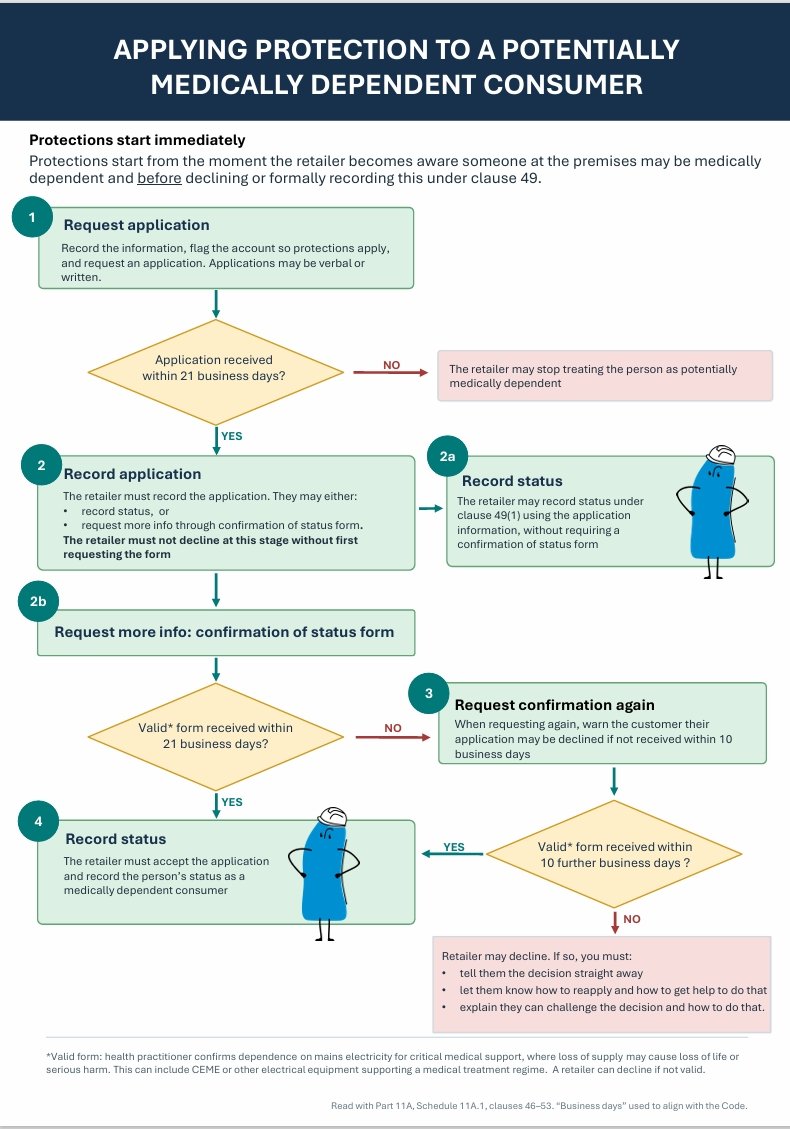
Key points to remember before making a final decision
- Protections apply while you ask for an application and gather information
- Once an application is received, it can’t be declined at that point without first asking for a confirmation of status form and following the required processes
- An application and a confirmation of status form are different steps and different requirements apply
- A confirmation of status form is a health practitioner certification that:
- the person is or remains a medically dependent consumer on the basis that they depend on mains electricity for critical medical support, such that loss of electricity may result in loss of life or serious harm.
- this includes a consumer who depends on a) critical electrical medical equipment (CEME); or b) other electrical equipment to support a medical treatment regime (which may include the use of a microwave to heat fluids for renal dialysis and similar use of electrical equipment).
When can you decline to record someone as medically dependent?
Once you are aware someone may be medically dependent on power, you may only decline medically dependent consumer status in the following situations.
The person does not live at the premises
You are not required to treat someone as a medically dependent consumer unless they live at the premises either temporarily or permanently. Where appropriate, you may take reasonable steps to confirm this.
The required information is not provided
- You do not receive an application within 21 business days of requesting it.
- You receive an application but there is no response to further questions and no other communication for at least 21 business days.
- You request a confirmation of status form but don’t not get a response within 21 business days, and then a further 10 business days after you send a reminder (31 business days in total).
The confirmation of status form is not valid
You receive a confirmation of status form but it is not valid. You may take reasonable steps to confirm validity, for example if you have reason to believe the health practitioner name or certification is false.
Medically dependent status no longer applies
This may happen, for example, where a temporary condition has resolved, critical electrically powered medical support is no longer required or a health practitioner confirms the criteria are no longer being met.
Where someone living at the property has a current confirmation of status form, you should not decline status unless they confirm that the medically dependent status no longer applies. You can also seek a review of the confirmation of status.
What must I do when an application for medically dependent consumer status is declined?
After declining an application (in accordance with the Consumer Care Obligations), you must:
- Tell the person of a decline decision straight away.
- Let them know how to reapply. This might include telling them what additional steps they would need to take (for example, if they were declined because they failed to respond to a request for a confirmation of status form) and who they can contact if they need help with the application process.
- Tell the person they can challenge the decision through a dispute resolution process (including the retailer’s internal disputes process or Utilities Disputes Limited) if they’re not happy with the decision.
You should give clear information on how to make a complaint, including relevant contact details and any supporting information that may be needed.
Continue protections while a dispute is being resolved
If someone makes a complaint and is engaging in good faith through the retailer's complaints process and/or the approved dispute resolution scheme, you must treat them as medically dependent until the dispute is resolved.
Can I review a person’s medically dependent status?
Once a person has been formally recorded as having medically dependent status, you may review this status but not more than once a year.
If you decide to carry out a review, you must first contact the medically dependent consumer and ask if they still live at the property and if they still consider themselves medically dependent. If the answer to both questions is yes, and you wish to proceed, you may either:
- Request a confirmation of status form following all applicable steps (where you have not previously been provided with a confirmation of status form).
- If the person has a current confirmation of status form, request a reconfirmation form – this should only be requested if reasonable and appropriate in the circumstances. If the medically dependent status is re-confirmed, you must meet the person’s reasonable costs (noting this cost requirement does not apply if the previous confirmation of status certification was for a fixed time and had expired).
You must tell the person of the outcome of the review, let them know how to reapply, advise them of the dispute resolution process that they may follow and provide them with two weeks’ notice before removing their medically dependent consumer status.
If someone makes a complaint and is engaging in good faith through the retailer's complaints process and/or the approved dispute resolution scheme, you must treat them as medically dependent until the dispute is resolved.
Reporting a disconnection of a medically dependent consumer
- Retailers must not disconnect post-pay premises if they know a medically dependent consumer may be living there, even if medically dependent consumer status has not been recorded.
- If this type of disconnection occurs, retailers must notify us as soon as they become aware of it. This should be done within minutes or hours at most, using the prescribed form.
- If a retailer is unsure whether it would be deemed to know about a medically dependent consumer, we recommend it errs on the side of caution and reports the disconnection to us.
- Retailers must reconnect supply without delay if a person at the premises has made an application for medically dependent consumer status, even if they do so after disconnection.
Becoming aware that a medically dependent consumer resides at a property after disconnection
Clause 37 of Schedule 11A.1 does not require a retailer to notify the Electricity Authority if the retailer did not know, at the time of disconnection, that a medically dependent consumer was living on the property.
If you discover a medically dependent consumer is living at the property after disconnection, do these things:
1. Reconnect immediately
Reconnect electrical supply without delay if a person at the premises is medically dependent or has applied for medically dependent status, even if they do so after being disconnected.
2. Start the medically dependent consumer process
Start the process and ask the customer to apply for medically dependent consumer status.
3. Assess your actions
Assess whether you have asked the right questions at the right time in accordance with the Consumer Care Obligations. Specifically, did you request information to identify whether there may be a medically dependent consumer living at the property when:
- First signing the customer up to a plan?
- Contacting the customer under clause 16 (the requirement to contact customers at least once a year to communicate specified information)?
- Communicating with a customer who may be experiencing payment difficulties under clause 23?
Before disconnecting the customer for non-payment of an invoice, use your best endeavours to satisfy yourself that there was no potential medically dependent consumer living at the property (31(1)(e)).
Requesting a confirmation of status form
You are entitled to ask someone applying for medically dependent consumer status to provide a confirmation of status form.
But before doing so, consider whether you already have sufficient information to confirm their status.
If you are aware the consumer may be experiencing financial hardship, check whether cost is an issue, particularly if they haven’t returned the form.