Eye on electricity
Eye on electricity: Battery performance in New Zealand
- Generation
- Wholesale
New Zealand is building more renewable electricity generation. However, renewable generation (like wind and solar) vary with the weather, so renewable electricity supply may not match up with demand. Grid scale batteries soak up excess renewable electricity and then release it back to the grid when needed. Some batteries also provide extra services like instantaneous reserves - spare capacity which can quickly respond in an unexpected event that causes a large drop in frequency.
Grid-scale batteries maximise the benefits of renewable energy and provide extra resilience during times of tight electricity supply. Additionally, these batteries, alongside more renewable generation, will help off-set the impacts of retirement of thermal generation and support New Zealand’s transition to a low-emissions economy.
At the moment there are three grid scale batteries the New Zealand electricity system: Rotohiko (35MW/35MWh), Ruakākā (100MW/200MWh) and Glenbrook-Ohurua (100MW/200MWh). Typically, a grid scale battery charges when prices are low and discharges energy back into the grid when prices are higher. This is called energy arbitrage.
Supplying both energy and instantaneous reserves
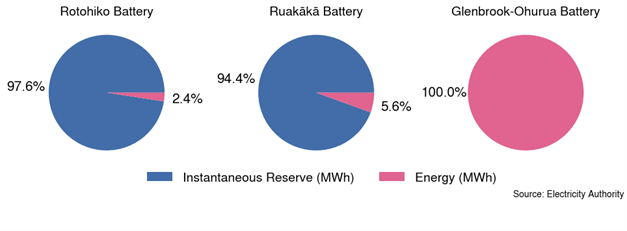
Grid-scale batteries can offer both energy and instantaneous reserve into the electricity market. Figure 1 shows the breakdown of batteries being dispatched for reserve vs energy. Note, instantaneous reserves are not necessarily supplying anything, that generation is just ‘earmarked’ for reserves if they are needed. Rotohiko and Ruakākā have dispatched more often for instantaneous reserves than energy since commissioning. Glenbrook-Ohurua battery has only recently commissioned and is not offering reserves but may do so in the future.
Batteries add more capacity, not more generation
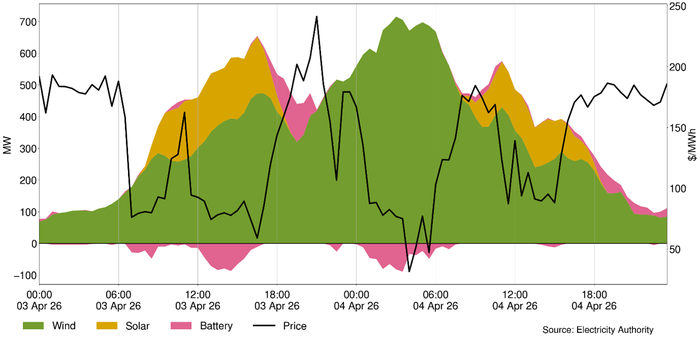
Batteries do not add new energy into the electricity system but instead add more capacity – by moving existing energy around. They can charge when renewable generation is high and spot prices are low, and then discharge that energy when prices are higher (and bring down those high prices). Figure 2 shows how the grid-scale batteries charge (negative values, pink) when renewable output is high and/or prices are low and then dispatch for energy when renewable generation drops or prices are high.
Another 100MW/200MWh battery is being built by Genesis at Huntly and is due to commission later this year. Contact Energy have another 200MW of battery capacity being added to their Glenbrook site in 2028. An additional 277MW of battery capacity is being actively pursued as per the Electricity Authority’s generation investment pipeline.
Market changes
As New Zealand transitions to a more variable power system, battery energy storage systems (BESS) will play a critical role in maintaining security and resilience. The Electricity Authority Te Mana Hiko is seeking feedback on regulations for battery systems and hybrid plants. We have two consultation papers open for feedback, both cover the aspects of our BESS/hybrid-related work programme.
We are releasing these papers as a package to give submitters the opportunity to comment on the projects together and to give better visibility of the BESS and hybrid work. These consultations are open for six weeks.
View consultations
Common quality and wholesale market arrangements for BESS and BESS-hybrids
Wholesale market arrangements for battery energy storage systems: Code amendment consultation
Related News
Code changes support potential FTR market development
The Electricity Authority Te Mana Hiko is amending the Electricity Industry Participation Code 2010 so that all loss and constraint excess is available to sett…
Feedback sought on improving incentives for long-duration firming
More renewable generation is helping to reduce the risk of electricity shortages when hydro lake levels are low. But we still need to ensure there is enough re…
Authority changes rules to boost battery flexibility
The Electricity Authority Te Mana Hiko is amending the Electricity Industry Participation Code to remove barriers to battery energy storage systems playing a b…
Subscribe to Market Brief
Get the latest news, updates and market insights from the Electricity Authority direct to your inbox.