Eye on electricity
New generation projects flowing through the investment pipeline
- Generation
- Innovation
New electricity generation projects are expected to significantly boost New Zealand’s energy system over the next two years.
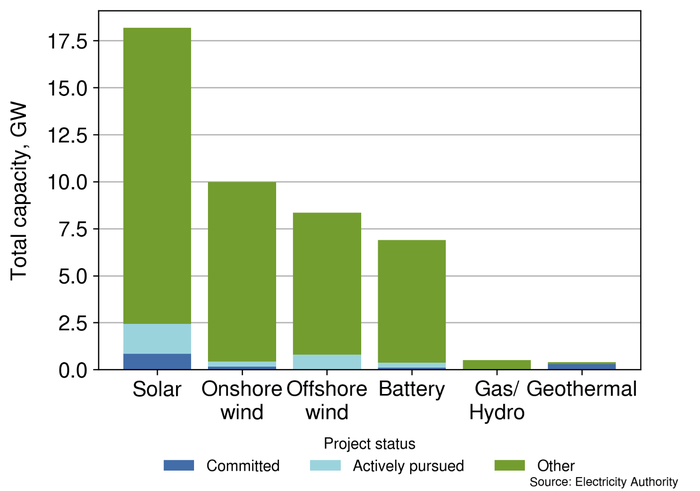
As at October 2025, there were 288 projects in the pipeline, with a combined total capacity of 44.3GW. This comes from a range of generation types (Figure 1), with most committed generation being solar and geothermal.
‘Committed’ projects are those where a final investment decision has been made. There is now 1,380MW of committed projects, up from 1,000MW in June 2025. You can find more information, including project locations and expected commissioning dates, in our generation investment pipeline dashboard.
Major developments in the pipeline
A total of 1,415MW of generation is currently under construction and expected to be completed over the next 18-24 months. More than half of this (787MW) is solar. Figure 2 shows the estimated commissioning dates of these projects.
Not all these projects are signalled as ‘committed’ in our generation investment pipeline dashboard. This is because some developers have not yet told Transpower that a final investment decision has been made or because the project is connected to distribution networks, which means Transpower may not receive the information. If we include these projects as committed, the total increases by 670MW to 2,050MW.
These projects joined Transpower’s connection queue on average about three and a half years ago. The average time from joining the queue to completion is about four and a half years. Smaller projects do not appear to have shorter completion times. The two battery projects have the shortest estimated timelines, likely because they are being built near existing industrial sites or generation facilities, making some development steps easier or unnecessary.
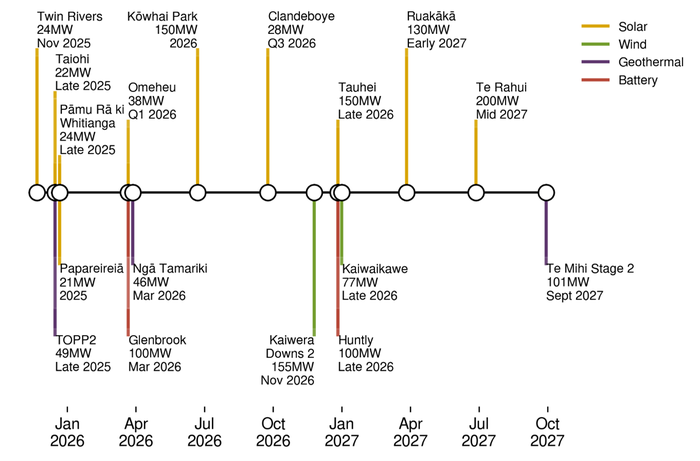
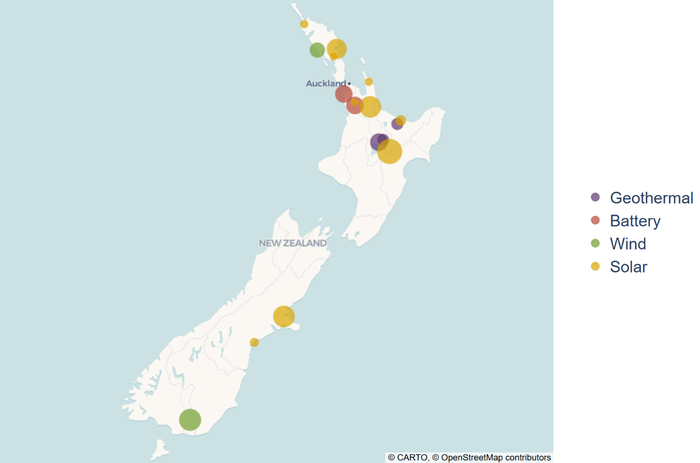
Figure 3 shows where projects under construction are located. Fourteen are in the North Island, and the South Island has one wind farm and two solar farms under construction.
Unlocking the benefits of large batteries
Our April 2025 survey on barriers to developing new electricity generation identified factors that delay projects or stop them from proceeding to construction. Developers noted that battery projects, being an emerging technology in New Zealand, requires further exploration.
We are seeking feedback until 23 December 2025 on proposed changes to improve wholesale market arrangements for utility-scale batteries. This includes proposed Code changes to reduce barriers for utility-scale batteries to enter the market.
Improving electricity generation pipeline information
The Authority’s current information collection is limited to grid-connected generation and load projects. We have recently consulted on collecting, aggregating and publishing information about significant generation and load connecting to distribution networks.
Making this information publicly available would help ensure the right investment in new generation happens at the right time and in the right place. It would also give us a more complete view of electricity supply and demand, helping inform policy decisions and industry efforts to ensure security of supply.
We use publicly available information, including data sourced from RenewMap, to cross-check the grid-connected pipeline information Transpower receives from developers. In future, we aim to include information from these public announcements in our dashboard quickly. However, public announcements don’t always cover every project milestone. It’s important developers provide Transpower with updates as soon as possible. This ensures all developers, industry and others using the dashboard have the most up-to-date information.
Related News
Deadline extended for non-discrimination obligations consultation
On 26 February, the Energy Competition Task Force launched a consultation on certain aspects of the proposed non-discrimination obligations, which are aimed at…
Policy changes to strengthen dry year risk management
The Electricity Authority Te Mana Hiko has approved changes to the Security of Supply Forecasting and Information Policy to improve certainty and better suppor…
Electricity Authority launches new consultation on non-discrimination obligations
The Electricity Authority Te Mana Hiko has launched a further consultation on certain aspects of the proposed non-discrimination obligations, which are aimed a…