Eye on electricity
Understanding transmission pricing and benefit-based charges
An efficient and reliable transmission network is essential to New Zealand's electricity future. As electricity demand grows and more renewable generation connects to the system, investment in the national grid helps ensure electricity is available where and when New Zealanders need it.
The Transmission Pricing Methodology (TPM) determines how the costs of transmission investments are allocated among customers. Since the current TPM was introduced in 2023, some customers have experienced significant changes in transmission charges. This article explains how the TPM works, why transmission charges are increasing and why some customers have seen larger changes than others.
How transmission costs are recovered
The Commerce Commission determines how much Transpower can recover from customers to operate, maintain and invest in the transmission network under Part 4 of the Commerce Act. The TPM sets out how Transpower must allocate those costs among customers. The TPM is part of the Electricity Industry Participation Code 2010 which the Electricity Authority administers.
The TPM allocates Transpower's approved revenue across three types of transmission charges:
- Benefit-based charges - recover the costs of transmission investments from the customers expected to benefit from them
- Connection charges - recover the costs of assets that connect customers to the grid from those customers
- Residual charges - recover costs not allocated through other charges by sharing those costs across all lines companies and large industrial consumers.
This article focuses on benefit-based charges (BBCs), because they are one of the key drivers of changes in transmission charges for some customers.
BBCs allocate the costs of transmission investments to the customers expected to benefit from them. Benefits can include access to cheaper electricity, more reliable supply throughout the year, or greater resilience to bad weather or other hazards.
BBCs support efficient transmission investment, because they encourage affected customers to seek the most cost-effective way to address a transmission constraint or reliability issue, whether that is a grid investment or an alternative option. Customers who may bear some of the costs of a transmission investment through BBCs have an incentive to participate in Transpower's planning and investment approval processes and factor transmission costs into decisions about where to locate.
For example, a business may choose to locate close to a renewable energy resource, but further away from its customers. In this case, it may pay lower BBCs because it benefits less from the transmission network, but face higher freight costs to get its products to market. The business needs to weigh up all these costs to make the best decision.
In this way, benefit-based charging supports more efficient investment in, and use of, the transmission grid over time.
Growth in transmission investment and costs
Transmission customers recently experienced significant increases in charges, primarily due to higher regulated revenues approved for Transpower's 2025-30 regulatory period.
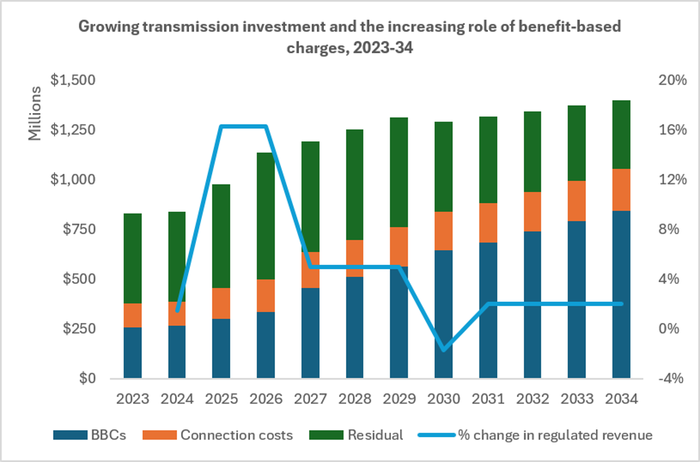
The Commerce Commission approved substantial increases in Transpower’s regulated revenues, including annual increases in revenue of over 16% in 2025 and 2026, followed by increases of 5% per year to 2030.
Around half of this increase reflects higher costs, including a higher cost of capital and inflation. The rest of this increase is due to increased investment in transmission, with Transpower’s average annual capital expenditure rising from around $334 million between 2021 and 2024 to around $600 million between 2025 and 2030.1
These increases are then reflected in transmission customers’ charges.
The chart below2 shows how Transpower's regulated revenue is expected to increase over time, with a growing share of these costs recovered through BBCs.
What is driving changes in benefit-based charges?
While increases in regulated revenue explain much of the increase in transmission charges, some customers have experienced larger increases in BBCs than the increase in regulated revenue might suggest.
One reason is that BBCs were introduced in 2023 and initially recovered only a small share of transmission costs. As more transmission investment becomes subject to BBCs, the amount recovered through these charges increases.
Most new transmission investment is recovered through BBCs. However, BBCs still make up only around 30% of total transmission charges. Because BBCs started from a low base, even modest increases in costs can result in large percentage increases in BBCs. This effect will lessen over time as a greater share of transmission costs are recovered through BBCs and the share recovered through residual charges decreases.
Changes in BBCs can also vary between customers. Customers in areas that benefit from transmission investments to maintain, replace or upgrade local assets may experience larger changes in charges than customers elsewhere. However, once such an investment is made, charges may remain relatively stable for some years before further investment is required.
Future BBCs and investment signals
Many of the factors influencing future BBCs are known well in advance. These include planned transmission investments and external factors, such as input cost inflation and the cost of capital, that determine Transpower's regulated revenue.
BBCs will increase from April 2027, partly to recover the cost of recent transmission investments, and partly because of the jump in the cost of capital which determines Transpower’s regulated revenue from 2025 and starts being applied to BBCs in 2027. The Authority has consulted on removing this two-year lag and will soon publish its decision.
Transpower signals major transmission investments in advance through its planning processes and annual transmission planning reports. Transmission customers typically have early visibility of proposed investments and their potential implications, although the final scope, timing and cost of an investment may change. (See Transpower's annual transmission planning reports.)
For lower-value investments under $30m, customer charges are based on predetermined allocators. Many of these investments involve replacing or refurbishing existing transmission assets that are reaching the end of their useful life. Asset condition is monitored regularly and informs Transpower's asset management planning.
Transpower’s Asset Management Plan can provide customers with information about likely replacement and refurbishment requirements over the next 10 years. While the timing, scope and cost of individual projects may be uncertain, potential investment can often be signalled to customers well in advance.
Improving transparency and predictability
The Authority has previously indicated that customers would benefit from clearer forward signals about future BBCs, including better visibility of the factors driving projected changes in charges.
While customers receive information about proposed transmission investments through Transpower's planning processes, there may be opportunities to improve forecasting and communication of the likely charging impacts of those investments. Greater transparency could help customers better understand and plan for future changes.
The Authority is continuing to work alongside Transpower through its TPM Operational Review and expects this work to consider opportunities to improve forecasting, transparency and forward signalling. As part of this review, Transpower is consulting on a problem statement for benefit-based charges until 11 December 2026. The Authority will also shortly publish decisions on targeted amendments to the TPM that are intended to improve its operation.
Signals from the market
BBCs can change over time as they reflect changing transmission costs and investment needs. While market participants value certainty and predictability, the Authority has not seen evidence that challenges in predicting BBCs are materially affecting investment decisions. The Authority's Generation Investment Pipeline continues to show a large number of proposed generation projects, and the latest Generation Investment Survey did not identify transmission pricing as a significant barrier to investment.
Proposed new electricity demand also remains strong. Transpower continues to report substantial interest in new grid connections from large electricity users, including data centres and dairy processing facilities.
Over the long term, benefit-based charging supports more efficient investment decisions and helps ensure transmission costs are allocated to the customers expected to benefit from the transmission investments that give rise to those costs. This helps promote efficient use of the transmission network and supports a reliable electricity system at lowest cost to consumers.
1. Source: Electricity Authority calculations, base and major capex data from Transpower’s Individual Price-Quality Path for RCP4 revenue model.
2. Estimates of Transpower’s regulated revenue are sourced from Transpower's published 10-year forecast prepared for the 2025-2030 regulatory control period (RCP4). Beyond 2030, the forecast assumes revenue growth of 2% per year.
Related News
Baseload market making changes from March 2027
From 1 March 2027, market makers must provide quotes for quarterly baseload electricity futures on the ASX out to five years ahead, up from three years at pres…
Survey highlights opportunity to help more consumers find better power deals
The Electricity Authority Te Mana Hiko's latest Residential Consumer Sentiment Survey highlights the importance of making it easy for consumers to compare opti…
New members for Distribution Connection Pricing Technical Group
We’re pleased to announce the 13 appointees to the ‘Distribution Connections Pricing Technical Group’, following our recent call for nominations. The independe…
Subscribe to Market Brief
Get the latest news, updates and market insights from the Electricity Authority direct to your inbox.