Electricity Industry Participation Code 2010
Part 8—Common quality
History Notes
8.1
Contents of this Part
- This Part relates to common quality. In particular, this Part concerns the performance obligations of the system operator, the performance obligations of asset owners, arrangements concerning ancillary services, and technical codes.
Compare: Electricity Governance Rules 2003 rule 1 section I part C
Clause 8.1: amended, on 7 August 2014, by clause 5 of the Electricity Industry Participation Code Amendment (Extended Reserve) 2014.
Clause 8.1: amended, on 21 December 2021, by clause 6 of the Electricity Industry Participation Code Amendment (Automatic Under-Frequency Load Shedding Systems) 2021.
8.1A
[Revoked]
Clause 8.1A: inserted, on 19 January 2017, by clause 4 of the Electricity Industry Participation Code Amendment (Extended Reserve) 2016.
Clause 8.1A: revoked, on 21 December 2021, by clause 7 of the Electricity Industry Participation Code Amendment (Automatic Under-Frequency Load Shedding Systems) 2021.
8.1B
Application of this Part to energy storage systems
- (1) For the purposes of this Part, the owner or operator of an energy storage system with a capacity equal to or greater than the threshold in clause 8.21(1), in relation to that energy storage system, is required to comply only with the obligations under this Part that apply to a generator or embedded generator, regardless of whether the energy storage system is discharging or charging.
- (2) For the avoidance of doubt, the thresholds in clauses 8.21(1) and 8.21(2) apply to an energy storage system as if the energy storage system is a generator.
Clause 8.1B: inserted, on 1 May 2025, by clause 5 of the Electricity Industry Participation Code Amendment (Common Quality Related Amendments) 2025.
Subpart 1—Performance obligations of the system operator
8.2
Contents of this subpart
- This subpart provides for―
- (a) general performance obligations of the system operator
- (b) a policy statement relating to the principal performance obligations of the system operator; and
- (c) the review of the policy statement.
Compare: Electricity Governance Rules 2003 rule 1 section II part C
8.3
Recovery of costs from causers of harmonic and voltage non-compliance
- (1) If the system operator is able to establish who is causing any departure from the standards referred to in clause 7.2(D), the system operator must endeavour to recover its reasonable identification and testing costs from that person. If the causer is a participant, the participant must pay those costs to the system operator.
- (2) If the system operator is unable to recover its reasonable identification and testing costs, or the causer is not able to be identified, then those costs will form part of the system operator’s identification costs.
Compare: Electricity Governance Rules 2003 rule 2.3.2 section II part C
Clause 8.3 Heading: amended, on 19 May 2016, by clause 16(1) of the Electricity Industry Participation Code Amendment (System Operator and Alignment with Statutory Objective) 2016.
Clause 8.3(1): amended, on 19 May 2016, by clause 16(2) of the Electricity Industry Participation Code Amendment (System Operator and Alignment with Statutory Objective) 2016.
8.4
System operator may rely on information provided
- For the purposes of this Code, the system operator may—
- (a) rely on the assets and information about the assets made available to the system operator by asset owners; and
- (b) assume that asset owners are complying with the asset owner performance obligations, the technical codes, and the connected asset commissioning, testing and information standard or complying with a valid dispensation or equivalence arrangement
- (c) [Revoked]
Compare: Electricity Governance Rules 2003 rule 4 section II part C
Clause 8.4: replaced, on 19 January 2017, by clause 5 of the Electricity Industry Participation Code Amendment (Extended Reserve) 2016.
Clause 8.4(b): amended, on 21 December 2021, by clause 8(1) of the Electricity Industry Participation Code Amendment (Automatic Under-Frequency Load Shedding Systems) 2021.
Clause 8.4(b): amended, on 1 July 2026, by clause 6 of the Electricity Industry Participation Code (Connected Asset Commissioning, Testing and Information Standard) Amendment 2026.
Clause 8.4(c): revoked, on 21 December 2021, by clause 8(2) of the Electricity Industry Participation Code Amendment (Automatic Under-Frequency Load Shedding Systems) 2021.
8.5
Restoration
- (1) If an event disrupts the system operator’s ability to comply with the principal performance obligations, the system operator must re-establish normal operation of the power system as soon as possible, given—
- (a) the capability of generation, and ancillary services; and
- (b) the configuration and capacity of the grid; and
- (c) the information made available by asset owners.
- (2) When re-establishing normal operation of the power system under subclause (1), the system operator must have regard to the following priorities:
- (a) first, the safety of natural persons:
- (b) second, the avoidance of damage to assets:
- (c) third, the restoration of offtake:
- (d) fourth, conformance with the principal performance obligations:
- (e) fifth, full conformance with the dispatch objective.
Compare: Electricity Governance Rules 2003 rule 5 section II part C
Clause 8.5(1): amended, on 19 May 2016, by clause 17 of the Electricity Industry Participation Code Amendment (System Operator and Alignment with Statutory Objective) 2016.
Clause 8.5(1)(a): amended, on 7 August 2014, by clause 6 of the Electricity Industry Participation Code Amendment (Extended Reserve) 2014.
Clause 8.5(1)(a): amended, on 21 December 2021, by clause 9 of the Electricity Industry Participation Code Amendment (Automatic Under-Frequency Load Shedding Systems) 2021.
Clause 8.5(1)(a): amended, on 1 August 2026, by clause 16 of the Electricity Industry Participation Code (Minor Amendments) Amendment 2026.
8.6
System operator may contract for higher levels of common quality
- Subject to clause 17.29, nothing in this Code prevents the system operator from entering into contracts or arrangements in which levels of quality more stringent than those specified in the principal performance obligations are agreed, if the system operator can identify the incremental costs of those more stringent levels, and can ensure that those incremental costs are paid to the system operator by the persons wishing to enter into that contract or arrangement with the system operator.
Compare: Electricity Governance Rules 2003 rule 6 section II part C
8.7
System operator must not contract contrary to this arrangement
- Subject to clauses 8.6 and 17.29, the system operator must not enter into a contract with another person that is inconsistent with the system operator’s obligations under this Code, the technical codes, and the connected asset commissioning, testing and information standard.
Compare: Electricity Governance Rules 2003 rule 7 section II part C
Clause 8.7: amended, on 1 July 2026, by clause 7 of the Electricity Industry Participation Code (Connected Asset Commissioning, Testing and Information Standard) Amendment 2026.
Policy statement
8.8
System operator to comply with policy statement
- Subject to clause 8.14, the system operator must comply with the policy statement.
Compare: Electricity Governance Rules 2003 rule 8 section II part C
Clause 8.8: amended, on 19 May 2016, by clause 18 of the Electricity Industry Participation Code Amendment (System Operator and Alignment with Statutory Objective) 2016.
8.9
[Revoked]
Clause 8.9: revoked, on 10 January 2013, by clause 6 of the Electricity Industry Participation (Policy Statement and Procurement Plan Review Process) Code Amendment 2012.
8.10
Incorporation of policy statement by reference
- (1) The policy statement is incorporated by reference in this Code.
- (2) Clauses 7.13 to 7.22 apply to any amendment or replacement of the policy statement.
Compare: Electricity Governance Rules 2003 rule 9 section II part C
Clause 8.10(1): amended, on 10 January 2013, by clause 7 of the Electricity Industry Participation (Policy Statement and Procurement Plan Review Process) Code Amendment 2012.
Clause 8.10(1): amended, on 1 August 2023, by clause 10(1) of the Electricity Industry Participation Code Amendment (System Operation Documents) 2023.
Clause 8.10(2): amended, on 1 August 2023, by clause 10(2) of the Electricity Industry Participation Code Amendment (System Operation Documents) 2023.
Clause 8.10(2): amended, on 1 March 2024, by clause 26 of the Electricity Industry Participation Code Amendment (Code Review Programme) 2024.
8.10A
[Revoked]
Clause 8.10A: inserted, on 10 January 2013, by clause 8 of the Electricity Industry Participation (Policy Statement and Procurement Plan Review Process) Code Amendment 2012.
Clause 8.10A(1): amended, on 5 October 2017, by clause 82 of the Electricity Industry Participation Code Amendment (Code Review Programme) 2017.
Clause 8.10A: revoked, on 1 August 2023, by clause 11 of the Electricity Industry Participation Code Amendment (System Operation Documents) 2023.
8.10B
[Revoked]
Clause 8.10B: inserted, on 10 January 2013, by clause 8 of the Electricity Industry Participation (Policy Statement and Procurement Plan Review Process) Code Amendment 2012.
Clause 8.10B: revoked, on 1 August 2023, by clause 12 of the Electricity Industry Participation Code Amendment (System Operation Documents) 2023.
8.10C
[Revoked]
Clause 8.10C: inserted, on 10 January 2013, by clause 8 of the Electricity Industry Participation (Policy Statement and Procurement Plan Review Process) Code Amendment 2012.
Clause 8.10C(3): amended, on 5 October 2017, by clause 83 of the Electricity Industry Participation Code Amendment (Code Review Programme) 2017.
Clause 8.10C: revoked, on 1 August 2023, by clause 13 of the Electricity Industry Participation Code Amendment (System Operation Documents) 2023.
8.11
Content of policy statement
- (1) [Revoked]
- (2) [Revoked]
- (3) A policy statement must include―
- (a) the policies and means that the system operator considers appropriate for the system operator to observe in complying with its principal performance obligations; and
- (b) the policies and means by which scheduling and dispatch are adjusted to meet the dispatch objective, and must include the provision of a dispatch process statement. The dispatch process statement must contain the details of the processes that enable the system operator to meet the dispatch objective, including the methodologies to be used by the system operator for planning to meet the dispatch objective during the period leading up to real time and meeting the dispatch objective in real time; and
- (c) a policy setting out how the system operator will manage any conflict of interest that arises in the performance of its obligations under this Code; and
- (d) a statement of the reasons for adopting the policies and means set out in the policy statement (which statement must be regarded as an explanatory note only and does not form part of the policies itself); and
- (e) a statement of how future policies and means might be formulated and implemented.
Compare: Electricity Governance Rules 2003 rule 10 section II part C
Clause 8.11 Heading: substituted, on 10 January 2013, by clause 9(a) of the Electricity Industry Participation (Policy Statement and Procurement Plan Review Process) Code Amendment 2012.
Clause 8.11 Heading: amended, on 1 August 2023, by clause 14(1) of the Electricity Industry Participation Code Amendment (System Operation Documents) 2023.
Clause 8.11(1): revoked, on 10 January 2013, by clause 9(b) of the Electricity Industry Participation (Policy Statement and Procurement Plan Review Process) Code Amendment 2012.
Clause 8.11(2): revoked, on 10 January 2013, by clause 9(c) of the Electricity Industry Participation (Policy Statement and Procurement Plan Review Process) Code Amendment 2012.
Clause 8.11(3): amended, on 10 January 2013, by clause 9(d) of the Electricity Industry Participation (Policy Statement and Procurement Plan Review Process) Code Amendment 2012.
Clause 8.11(3): amended, on 19 May 2016, by clause 19(1) of the Electricity Industry Participation Code Amendment (System Operator and Alignment with Statutory Objective) 2016.
Clause 8.11(3)(c): amended, on 19 May 2016, by clause 19(2) of the Electricity Industry Participation Code Amendment (System Operator and Alignment with Statutory Objective) 2016.
Clause 8.11(3): amended, on 1 August 2023, by clause 14(2) of the Electricity Industry Participation Code Amendment (System Operation Documents) 2023.
8.11A
[Revoked]
Clause 8.11A: inserted, on 10 January 2013, by clause 10 of the Electricity Industry Participation (Policy Statement and Procurement Plan Review Process) Code Amendment 2012.
Clause 8.11A(3)(b): amended, on 5 October 2017, by clause 84 of the Electricity Industry Participation Code Amendment (Code Review Programme) 2017.
Clause 8.11A: revoked, on 1 August 2023, by clause 15 of the Electricity Industry Participation Code Amendment (System Operation Documents) 2023.
8.12
[Revoked]
Compare: Electricity Governance Rules 2003 rule 11 section II part C
Clause 8.12: substituted, on 10 January 2013, by clause 11 of the Electricity Industry Participation (Policy Statement and Procurement Plan Review Process) Code Amendment 2012.
Clause 8.12(1), (2), (4) and (6): amended, on 5 October 2017, by clause 85(1) and (2) of the Electricity Industry Participation Code Amendment (Code Review Programme) 2017.
Clause 8.12: revoked, on 1 August 2023, by clause 16 of the Electricity Industry Participation Code Amendment (System Operation Documents) 2023.
8.12A
[Revoked]
Clause 8.12A: inserted, on 10 January 2013, by clause 12 of the Electricity Industry Participation (Policy Statement and Procurement Plan Review Process) Code Amendment 2012.
Clause 8.12A(4)(a) and (6): amended, on 5 October 2017, by clause 86 of the Electricity Industry Participation Code Amendment (Code Review Programme) 2017.
Clause 8.12A: revoked, on 1 August 2023, by clause 17 of the Electricity Industry Participation Code Amendment (System Operation Documents) 2023.
8.12B
[Revoked]
Clause 8.12B: inserted, on 10 January 2013, by clause 12 of the Electricity Industry Participation (Policy Statement and Procurement Plan Review Process) Code Amendment 2012.
Clause 8.12B(b): amended, on 5 October 2017, by clause 87 of the Electricity Industry Participation Code Amendment (Code Review Programme) 2017.
Clause 8.12B: revoked, on 1 August 2023, by clause 18 of the Electricity Industry Participation Code Amendment (System Operation Documents) 2023.
8.13
[Revoked]
Compare: Electricity Governance Rules 2003 rule 12 section II part C
Clause 8.13: revoked, on 10 January 2013, by clause 13 of the Electricity Industry Participation (Policy Statement and Procurement Plan Review Process) Code Amendment 2012.
8.14
Departure from policy statement
- (1) The system operator may depart from the policies set out in a policy statement when a system security situation arises and such departure is required for the system operator to comply with clause 7.1A(1).
- (2) If the system operator departs from a policy statement under subclause (1), the system operator must provide a report to the Authority setting out the circumstances of the system security situation and the actions taken to deal with it.
- (3) The Authority must publish the report within a reasonable time after receiving it.
Compare: Electricity Governance Rules 2003 rule 13 section II part C
Clause 8.14(1): amended, on 19 May 2016, by clause 20(1) of the Electricity Industry Participation Code Amendment (System Operator and Alignment with Statutory Objective) 2016.
Clause 8.14(2): amended, on 19 May 2016, by clause 20(2) of the Electricity Industry Participation Code Amendment (System Operator and Alignment with Statutory Objective) 2016.
Clause 8.14(3): substituted, on 10 January 2013, by clause 14 of the Electricity Industry Participation (Policy Statement and Procurement Plan Review Process) Code Amendment 2012.
Clause 8.14(3): amended, on 5 October 2017, by clause 88 of the Electricity Industry Participation Code Amendment (Code Review Programme) 2017.
System security forecast
8.15
System operator to prepare and review system security forecast
- (1) Every 2 years, the system operator must prepare, publish, and provide to the Authority a system security forecast.
- (1A) The system security forecast must—
- (a) identify risks to the system operator’s ability to meet the principal performance obligations over the ensuing period of not less than 36 months, and indicate how those risks can be managed; and
- (b) take into account the capabilities of the grid and connected assets based on information known to, and able to be disclosed by, the system operator.
- (2) The date by which the system operator must publish the system security forecast and provide it to the Authority in each year in which the system operator is required to do so, is the date established for that purpose under rule 15 of section II of part C of the rules.
- (3) The system operator must review the most recent system security forecast prepared in accordance with subclause (1) at 6 monthly intervals until a new forecast or update is prepared. If, in the reasonable opinion of the system operator, a change has been made to the power system that would materially affect the most recent forecast or update, the system operator must amend the system security forecast, publish it and provide it to the Authority.
Compare: Electricity Governance Rules 2003 rule 15 section II part C
Clause 8.15(1): subsituted, on 21 September 2012, by clause 8 of the Electricity Industry Participation (Minor Amendments) Code Amendment 2012.
Clause 8.15(1A): inserted, on 21 September 2012, by clause 8 of the Electricity Industry Participation (Minor Amendments) Code Amendment 2012.
Clause 8.15(1A)(b): amended, on 23 February 2015, by clause 75 of the Electricity Industry Participation Code Amendment (Distributed Generation) 2014.
Clause 8.15(1A)(b): amended, on 5 October 2017, by clause 89 of the Electricity Industry Participation Code Amendment (Code Review Programme) 2017.
Subpart 2—Asset owner performance obligations and technical standards
8.16
Contents of this subpart
- This subpart provides for―
- (a) the establishment of performance obligations and technical standards for asset owners to assist the system operator in complying with the principal performance obligations; and
- (b) asset owners to obtain an assessment of their assets from the system operator; and
- (c) a process for the system operator to approve applications for equivalence arrangements and dispensations (if necessary).
Compare: Electricity Governance Rules 2003 rule 1 section III part C
Asset owner performance obligations and technical standards concerning frequency
8.17
Contribution by injections to overall frequency management
- Each generator (while synchronised) and the HVDC owner must at all times ensure that its assets, other than any generating units within an excluded generating station, make the maximum possible injection contribution to maintain frequency within the normal band (and to restore frequency to the normal band). Any such contribution must be assessed against the technical codes.
Compare: Electricity Governance Rules 2003 rule 2.1 section III part C
8.18
Contributions by purchasers to overall frequency management
- Each purchaser must limit the magnitude of any instantaneous change in the offtake of electricity and net rate of change in offtake to the levels the system operator reasonably requires. In setting those requirements, the system operator must have regard to the impact of the offtake on the system operator’s ability to comply with the principal performance obligations concerning frequency (as set out in clauses 7.2A and 7.2B) and the dispatch objective.
Compare: Electricity Governance Rules 2003 rule 2.2 section III part C
Clause 8.18: amended, on 19 May 2016, by clause 21 of the Electricity Industry Participation Code Amendment (System Operator and Alignment with Statutory Objective) 2016.
Clause 8.18: amended, on 1 June 2025, by clause 5 of the Electricity Industry Participation Code Amendment (Removal of time error management obligations) 2025.
8.19
Contributions to frequency support in under-frequency events
- (1) Subject to subclause (3), each generator must at all times ensure that, while electrically connected, its assets, other than any excluded generating stations, contribute to supporting frequency by remaining synchronised, ensuring that each of its generating units can and does, at a minimum, sustain pre-event output―
- (a) at all times when the frequency is above 47.5 Hertz; and
- (b) for at least 120 seconds when the frequency is 47.5 Hertz; and
- (c) for at least 20 seconds when the frequency is 47.3 Hertz; and
- (d) for at least 5 seconds when the frequency is 47.1 Hertz; and
- (e) for at least 0.1 seconds when the frequency is 47.0 Hertz; and
- (f) at any frequencies between those specified in paragraphs (b) to (e) for times derived by linear interpolation.
- (2) If the inherent characteristics and design of a generator's generating unit are such that it is reasonably able to operate beyond the above requirements, the generator must declare such capabilities in accordance with clause 2(5) of Technical Code A of Schedule 8.3.
- (3) Each South Island generator must ensure that each of its assets, other than excluded generating units, remains synchronised, and can and do, at a minimum, sustain pre-event output―
- (a) at all times when the frequency is above 47 Hertz; and
- (b) for 30 seconds if the frequency falls below 47 Hertz but not below 45 Hertz.
- (4) The HVDC owner must at all times ensure that, while electrically connected, its assets contribute to supporting frequency during an under-frequency event in either island by―
- (a) remaining electrically connected to those assets making up the grid in the North Island and South Island while the frequency in both islands remains above 48 Hertz; and
- (b) remaining electrically connected to those assets making up the grid in the North Island and South Island while the frequency in both islands remains below 48 Hertz and above 47 Hertz for 90 seconds; and
- (c) remaining electrically connected to those assets making up the grid in the North Island and South Island while the frequency in both islands remains above 45 Hertz for 35 seconds, unless the frequency in either island is less than 46.5 Hertz and the frequency is falling at a rate of 7 Hertz per second or greater; and
- (d) subject to the level of transfer and the HVDC link configuration at the beginning of the under-frequency event, if the HVDC link itself is not the cause of the under-frequency event, modifying the instantaneous transfer on the HVDC link by up to 250 MW with the objective of limiting the difference between the North Island and South Island frequencies to no greater than 0.2 Hertz.
- (5) Each North Island connected asset owner and each South Island grid owner must ensure that it has established and maintained automatic under-frequency load shedding in block sizes and with relay settings in accordance with the technical codes.
- (6) For the purposes of subclause (5), the owner or operator of an energy storage system with a capacity equal to or greater than the threshold in clause 8.21(1) is not considered a connected asset owner in relation to that energy storage system.
Compare: Electricity Governance Rules 2003 rule 2.3 section III part C
Clause 8.19(5): substituted, on 7 August 2014, by clause 7 of the Electricity Industry Participation Code Amendment (Extended Reserve) 2014.
Clause 8.19(1) and (4): amended, on 23 February 2015, by clause 75 of the Electricity Industry Participation Code Amendment (Distributed Generation) 2014.
Clause 8.19(1) and (4): amended, on 5 October 2017, by clause 90 of the Electricity Industry Participation Code Amendment (Code Review Programme) 2017.
Clause 8.19(5): amended, on 21 December 2021, by clause 10 of the Electricity Industry Participation Code Amendment (Automatic Under-Frequency Load Shedding Systems) 2021.
Clause 8.19(4)(d): amended, on 1 March 2024, by clause 27 of the Electricity Industry Participation Code Amendment (Code Review Programme) 2024.
Clause 8.19(6): inserted, on 1 May 2025, by clause 6 of the Electricity Industry Participation Code Amendment (Common Quality Related Amendments) 2025.
8.20
Contributions by grid owners to frequency support
- Each grid owner must ensure that its assets are capable of being operated, and operate, within the frequency targets set out in clause 7.2A.
Compare: Electricity Governance Rules 2003 rule 2.4 section III part C
Clause 8.20: amended, on 19 May 2016, by clause 22 of the Electricity Industry Participation Code Amendment (System Operator and Alignment with Statutory Objective) 2016.
8.21
Excluded generating stations
- (1) For the purposes of clauses 8.17, 8.19, 8.25D, and the provisions in Technical Code A of Schedule 8.3 relating to the obligations of asset owners in respect of frequency, an excluded generating station means a generating station or embedded generating station that has a maximum continuous MW output power of less than 10 MW, unless the Authority has issued a direction under clause 8.38 that the generating station or embedded generating station must comply with clauses 8.17, 8.19, 8.25A, and 8.25B and the relevant provisions in Technical Code A of Schedule 8.3.
- (2) Whether likely to be an excluded generating station or not, a generator must provide the system operator with written advice of its intention to connect to the grid or directly or indirectly to a local network a generating station with one or more generating units with a rated net maximum capacity equal to or greater than 1 MW (alternating current (a.c.) capacity), together with the information relating to the generating unit or generating station in accordance with clause 8.25(4).
- (3) A generating station or embedded generating station that was an excluded generating station immediately before 1 July 2026 that would no longer be an excluded generating station due to the commencement of the Electricity Industry Participation Code (Frequency and voltage related amendments) Amendment 2026 continues to be an excluded generating station if―
- (a) it is not able to comply, without modification, with one or more of the requirements it would be subject to if it was no longer an excluded generating station; and
- (b) the asset owner of the generating station or embedded generating station updates the asset capability statement for the generating station or embedded generating station to record that this subclause applies to the generating station or embedded generating station.
- (4) Subject to subclause (5), a generating station or embedded generating station that first electrically connects to the grid or directly or indirectly to a local network on or after 1 July 2026 and before 1 July 2027 and which would have been an excluded generating station if the definition of that term in the Code immediately before the commencement of the Electricity Industry Participation Code (Frequency and voltage related amendments) Amendment 2026 applied to it, is an excluded generating station if―
- (a) it is not able to comply, without modification, with one or more of the requirements it would be subject to if it was no longer an excluded generating station; and
- (b) the asset owner of the generating station or embedded generating station updates the asset capability statement for the generating station or embedded generating station to record that this subclause applies to the generating station or embedded generating station.
- (5) In order for subclause (4) to apply to a generating station or embedded generating station, the asset owner of the generating station or embedded generating station must confirm in writing to the system operator before 1 August 2026 that the following have occurred in respect of the generating station or embedded generating station:
- (a) the asset owner has secured financing that enables the asset owner to develop and commission the generating station or embedded generating station:
- (b) the asset owner has obtained all consents necessary to enable the asset owner to develop and commission the generating station or embedded generating station:
- (c) the asset owner has obtained rights to use the land on which the generating station or embedded generating station is to be located.
- (6) Subclauses (3) and (4) cease to apply in respect of a generating station or embedded generating station from the date―
- (a) a modification is made to the generating station or embedded generating station that means it is able to comply with all the requirements it would be subject to if it was not an excluded generating station; or
- (b) the generating station’s or embedded generating station’s maximum continuous MW output power increases by 5 MW or more above its maximum continuous MW output power immediately before 1 July 2027.
- (7) An asset owner must, as soon as practicable, update the asset capability statement for a generating station or embedded generating station to record when subclause (3) or (4) ceases to apply to the generating station or embedded generating station.
- (8) The system operator must publish and maintain a list of generating stations and embedded generating stations to which subclause (3) or (4) applies.
Compare: Electricity Governance Rules 2003 rules 2.5 and 2.6 section III part C
Clause 8.21(1): amended, on 24 November 2016, by clause 5(1) and (2) of the Electricity Industry Participation Code Amendment (Generation Fault Ride Through) 2016.
Clause 8.21(1): amended, on 1 July 2026, by clause 5(1) of the Electricity Industry Participation Code (Frequency and Voltage Related Amendments) Amendment 2026.
Clause 8.21(2): amended, on 23 February 2015, by clause 75 of the Electricity Industry Participation Code Amendment (Distributed Generation) 2014.
Clause 8.21(2): amended, on 5 October 2017, by clause 91 of the Electricity Industry Participation Code Amendment (Code Review Programme) 2017.
Clause 8.21(2): amended, on 1 May 2025, by clause 7 of the Electricity Industry Participation Code Amendment (Common Quality Related Amendments) 2025.
Clause 8.21(2): amended, on 1 July 2026, by clause 5(2) of the Electricity Industry Participation Code (Frequency and Voltage Related Amendments) Amendment 2026.
Clause 8.21(2): replaced, on 1 July 2026, by clause 8 of the Electricity Industry Participation Code (Connected Asset Commissioning, Testing and Information Standard) Amendment 2026.
Clauses 8.21(3) to (8): inserted, on 1 July 2026, by clause 5(3) to (8) of the Electricity Industry Participation Code (Frequency and Voltage Related Amendments) Amendment 2026.
Asset owner performance obligations and technical standards concerning voltage
8.22
Voltage range AOPOs
- (1) Each grid owner must ensure that its assets at and in between―
- (a) the high voltage terminals of the grid owner's transformers at each grid injection point and grid exit point; or
- (b) if no transformer exists, the relevant grid injection point or grid exit point― are capable of being operated within the following range of voltages:
| Nominal grid voltage (kV) | Voltage limits | |||
| Minimum (kV) | Maximum (kV) | |||
| 220 | 198 | -10.0% | 242 | 10.0% |
| 110 | 99 | -10.0% | 121 | 10.0% |
| 66 | 62.7 | -5.0% | 69.3 | 5.0% |
| 50 | 47.5 | -5.0% | 52.5 | 5.0% |
- (2) Each generator with a point of connection to the grid must at all times ensure that its assets are capable of being operated, and do operate, when the grid is operated within the range of voltages set out in subclause (1).
- (3) Each connected asset owner must ensure that its local network is capable of being operated, and does operate, when the grid is operated over the range of voltages set out in subclause (1).
Compare: Electricity Governance Rules 2003 rule 3.1 section III part C
Clause 8.22(3): amended, on 1 February 2016, by clause 8 of the Electricity Industry Participation Code Amendment (Code Review Programme) 2015.
8.23
Voltage support AOPOs for grid-connected generating stations
- Each generator with a point of connection to the grid must at all times ensure that its assets―
- (a) when the voltage at its grid injection point is within the applicable range of nominal voltage, are capable of exporting (over excited) when synchronised and made available for dispatch by the system operator, a minimum net reactive power which is 50% of the maximum continuous MW output power as measured at the following generating unit terminals:
| Nominal grid voltage (kV) | Voltage range for which reactive power is required | |||
| Minimum (kV) | Maximum (kV) | |||
| 220 | 198 | -10.0% | 242 | 10.0% |
| 110 | 99 | -10.0% | 121 | 10.0% |
| 66 | 62.7 | -5.0% | 69.3 | 5.0% |
| 50 | 47.5 | -5.0% | 52.5 | 5.0% |
| 33 | 31.35 | -5.0% | 34.65 | 5.0% |
| 22 | 21.45 | -2.5% | 22.55 | 2.5% |
| 11 | 10.725 | -2.5% | 11.275 | 2.5% |
- (b) when the voltage at its grid injection point is within the applicable range of nominal voltage, are capable of importing (under excited) when synchronised and made available for dispatch by the system operator, a minimum net reactive power which is 33% of the maximum continuous MW output power as measured at the generating unit terminals as set out below:
| Nominal grid voltage (kV) | Voltage range for which reactive power is required | |||
| Minimum (kV) | Maximum (kV) | |||
| 220 | 209 | -5.0% | 242 | 10.0% |
| 110 | 104.5 | -5.0% | 121 | 10.0% |
| 66 | 62.7 | -5.0% | 69.3 | 5.0% |
| 50 | 47.5 | -5.0% | 52.5 | 5.0% |
| 33 | 31.35 | -5.0% | 34.65 | 5.0% |
| 22 | 21.45 | -2.5% | 22.55 | 2.5% |
| 11 | 10.725 | -2.5% | 11.275 | 2.5% |
- (c) when synchronised, continuously operate in a manner that supports voltage and voltage stability on the grid in compliance with the technical codes.
Compare: Electricity Governance Rules 2003 rule 3.2 section III part C
Clause 8.23: amended, on 21 September 2012, by clause 9 of the Electricity Industry Participation (Minor Amendments) Code Amendment 2012.
Clause 8.23 heading: amended, on 1 July 2026, by clause 6 of the Electricity Industry Participation Code (Frequency and Voltage Related Amendments) Amendment 2026.
8.23A
Voltage support AOPOs for embedded generating stations
- (1) Unless agreed otherwise with the distributor who operates the local network, each embedded generator must ensure that each embedded generating station it owns or operates to which clause 5(2A) of Technical Code A applies is, when synchronised with the local network, at all times capable of―
- (a) when the voltage at the embedded generating station’s point of connection to the local network is within the applicable range of nominal voltage in the table below, exporting a minimum reactive power of 33% of the maximum continuous MW output power of the embedded generating station, as measured at the embedded generating station’s point of connection to the local network:
|
Nominal local network voltage (kV) |
Voltage range for which reactive power is required | |||
| Minimum (kV) | Maximum (kV) | |||
|
110 |
99 |
-10.0% |
121 |
10.0% |
|
66 |
62.7 |
-5.0% |
69.3 |
5.0% |
|
50 |
47.5 |
-5.0% |
52.5 |
5.0% |
|
33 |
31.35 |
-5.0% |
34.65 |
5.0% |
|
22 |
21.45 |
-2.5% |
22.55 |
2.5% |
|
11 |
10.725 |
-2.5% |
11.275 |
2.5% |
- (b) when the voltage at the embedded generating station’s point of connection to the local network is within the applicable range of nominal voltage in the table below, importing a minimum reactive power of 33% of the maximum continuous MW output power of the embedded generating station, as measured at the embedded generating station’s point of connection to the local network:
|
Nominal local network voltage (kV) |
Voltage range for which reactive power is required |
|||
|
Minimum (kV)
|
Maximum (kV) |
|||
|
110 |
104.5 |
-5.0% |
121 |
10.0% |
|
66 |
62.7 |
-5.0% |
69.3 |
5.0% |
|
50 |
47.5 |
-5.0% |
52.5 |
5.0% |
|
33 |
31.35 |
-5.0% |
34.65 |
5.0% |
|
22 |
21.45 |
-2.5% |
22.55 |
2.5% |
|
11 |
10.725 |
-2.5% |
11.275 |
2.5% |
Clause 8.23A: inserted on 1 July 2026, by clause 7 of the Electricity Industry Participation Code (Frequency and Voltage Related Amendments) Amendment 2026.
8.24
Load shedding obligations to support voltage
- (1) If it is not possible for a connected asset owner to comply with subclause (2), the grid owner must, if possible, establish load shedding in block sizes and at voltage levels (and, if automatic systems are established, with relay settings) set out in the technical codes or otherwise as the system operator reasonably requires.
- (2) In order to prevent the collapse of the network voltage, each connected asset owner must ensure that, if possible, it has established load shedding in block sizes and at voltage levels (and, if automatic systems are established, with relay settings) in accordance with the technical codes or otherwise as the system operator reasonably requires.
- (3) For the purposes of subclause (2), the owner or operator of an energy storage system with a capacity equal to or greater than the threshold in clause 8.21(1) is not considered a connected asset owner in relation to that energy storage system.
Compare: Electricity Governance Rules 2003 rule 3.3 section III part C
Clause 8.24(1): amended, on 1 February 2016, by clause 9 of the Electricity Industry Participation Code Amendment (Code Review Programme) 2015.
Clause 8.24(2): amended, on 1 May 2016, by clause 4 of the Electricity Industry Participation Code Amendment (Minor Code Amendments) 2016.
Clause 8.24(3): inserted, on 1 May 2025, by clause 8 of the Electricity Industry Participation Code Amendment (Common Quality Related Amendments) 2025.
8.25
Other asset owner performance obligations and technical standards
- (1) Each grid owner must ensure that the design and configuration of its assets (including its connections to other persons) and associated protection arrangements are consistent with the technical codes and, in the reasonable opinion of the system operator, with maintaining the system operator’s ability to comply with the principal performance obligations. In reaching this opinion, the system operator must have regard to the potential impact of the design or configuration of those assets or associated protection arrangements on its compliance with the principal performance obligations and achievement of the dispatch objective.
- (2) Each grid owner and each connected asset owner must use reasonable endeavours to ensure that a generator who meets the following criteria provides the system operator with written advice of the existence of its generating unit and the generator’s name and address:
- (a) the generator is directly connected to the grid owner's grid or directly or indirectly connected to the local network (as the case may be):
- (b) the generator has a generating unit with a rated net maximum capacity equal to or greater than 1 MW.
- (3) Each asset owner and each purchaser must provide communication facilities that comply with the connected asset commissioning, testing and information standard.
- (4) Each asset owner and each purchaser must provide information to the system operator that complies with the technical codes and the connected asset commissioning, testing and information standard.
- (5) If the system operator reasonably considers it necessary to assist the system operator in planning to comply, and complying, with the principal performance obligations and achieving the dispatch objective, the system operator―
- (a) may require that an embedded generator provide information regarding the intended output of each embedded generating station greater than 10 MW in capacity, that must be either―
- (i) submitted as an offer in accordance with subpart 1 of Part 13; or
- (ii) provided in a form and manner specified in the connected asset commissioning, testing and information standard; and
- (b) must advise the embedded generator of its requirement at least 20 business days in advance of the requirement coming into effect.
- (a) may require that an embedded generator provide information regarding the intended output of each embedded generating station greater than 10 MW in capacity, that must be either―
- (6) If the system operator reasonably considers it necessary to assist it in planning to comply, and complying, with the principal performance obligations and achieving the dispatch objective, the system operator may apply to the Authority to require an embedded generator to provide information regarding the intended output of a group of embedded generating stations that total greater than 10 MW in capacity and that are connected to the same grid exit point.
- (7) If the Authority approves the system operator’s request under subclause (6), the embedded generator must provide the information in accordance with the connected asset commissioning, testing and information standard.
Compare: Electricity Governance Rules 2003 rule 4.1 to 4.6 section III part C
Clause 8.25(1), (2) and (6): amended, on 23 February 2015, by clause 75 of the Electricity Industry Participation Code Amendment (Distributed Generation) 2014.
Clause 8.25(1), (2) and (6): amended, on 5 October 2017, by clause 92(1) and (2) of the Electricity Industry Participation Code Amendment (Code Review Programme) 2017.
Clause 8.25(2): amended, on 1 February 2016, by clause 10 of the Electricity Industry Participation Code Amendment (Code Review Programme) 2015.
Clause 8.25(2): amended, on 20 December 2021, by clause 10 of the Electricity Industry Participation Code Amendment (Code Review Programme) 2019.
Clause 8.25(3): replaced, on 1 July 2026, by clause 9(1) of the Electricity Industry Participation Code (Connected Asset Commissioning, Testing and Information Standard) Amendment 2026.
Clause 8.25(4): replaced, on 1 July 2026, by clause 9(2) of the Electricity Industry Participation Code (Connected Asset Commissioning, Testing and Information Standard) Amendment 2026.
Clause 8.25(5)(a)(ii): amended, on 1 July 2026, by clause 9(3) of the Electricity Industry Participation Code (Connected Asset Commissioning, Testing and Information Standard) Amendment 2026.
Clause 8.25(5)(b): amended, on 5 October 2017, by clause 92(3) of the Electricity Industry Participation Code Amendment (Code Review Programme) 2017.
Clause 8.25(5)(b): amended, on 1 November 2018, by clause 11 of the Electricity Industry Participation Code Amendment (Code Review Programme) 2018.
Clause 8.25(6): amended, on 1 September 2026, by clause 13 of the Electricity Industry Participation Code (Code Review Programme) Amendment 2026.
Clause 8.25(7): inserted, on 1 July 2026, by clause 9(4) of the Electricity Industry Participation Code (Connected Asset Commissioning, Testing and Information Standard) Amendment 2026.
8.25A
Fault ride through
- (1) Each generator must ensure that each of its assets, when electrically connected to a network, is capable of remaining stable and electrically connected when the grid's lowest line-to-line voltage is within the no-trip zone shaded and marked "No-trip zone" in Figure 8.1 (for an asset in the North Island) or Figure 8.2 (for an asset in the South Island) for the period of 6 seconds immediately following the commencement of a zero impedance three-phase short circuit fault, or an unbalanced short circuit fault, on any part of the grid at 110 kV or 220 kV in the island in which the asset is connected.
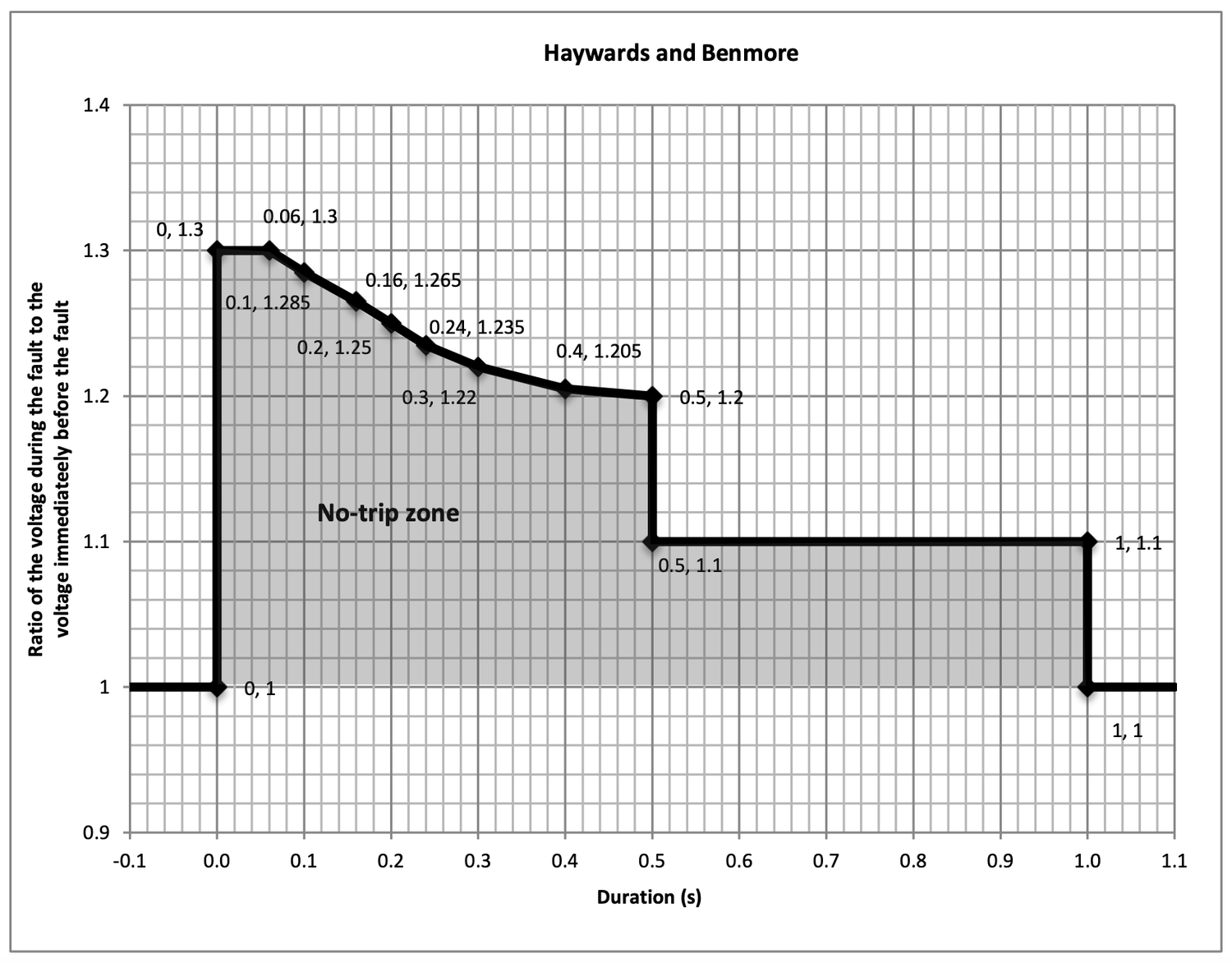
- (2) Each generator must ensure that each of its assets, when electrically connected to a network, is capable of remaining stable and electrically connected when the highest line-to-line voltage at Haywards 220 kV bus (for an asset in the North Island) or Benmore 220 kV bus (for an asset in the South Island) is within the no-trip zone shaded and marked "No-trip zone" in Figure 8.3 for the period of 1 second immediately following the commencement of a trip of the HVDC link.
- (3) Whether a generator is complying with subclause (2) must be determined using power system analysis that uses—
- (a) study cases provided by the relevant grid owner; and
- (b) relevant system assumptions provided by the system operator.
- (4) A generator is not required to comply with subclause (1) in respect of an asset in the event of a fault of a type described in subclause (1) if the asset becomes isolated from the grid as a result of the fault.
- (5) A generating unit need not comply with subclause (1) to the extent that it is complying with a special protection scheme approved by the system operator.
- (6) The absolute grid voltage (per unit) shown on the Y axis of Figure 8.1 and Figure 8.2 is the ratio of grid lowest line-to-line voltage on a line to the nominal operating voltage of the line (that is, 110 kV or 220 kV).
Figure 8.1: North Island no-trip zone during 110 kV or 220 kV faults
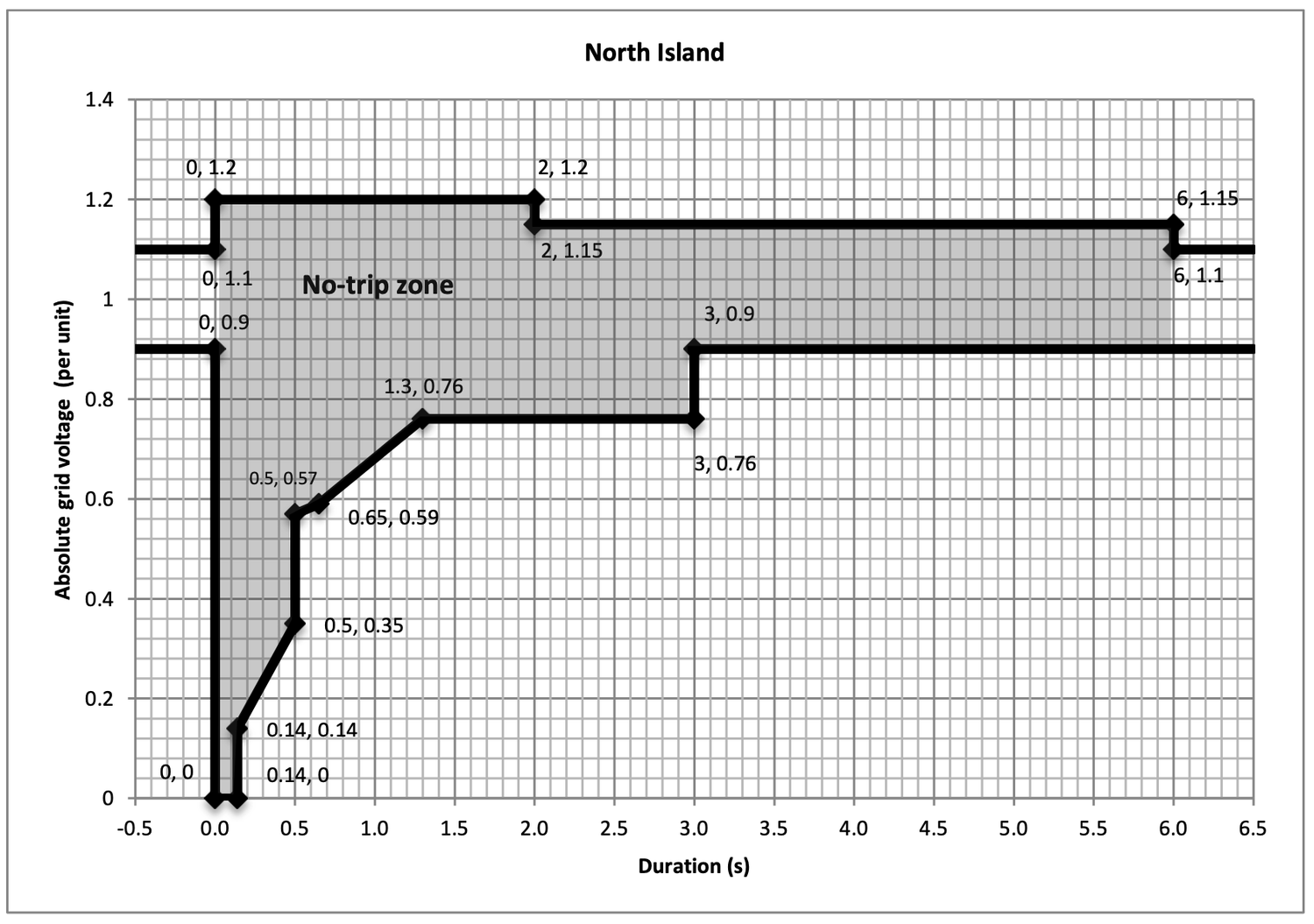
Figure 8.2: South Island no-trip zone during 110 kV or 220 kV faults
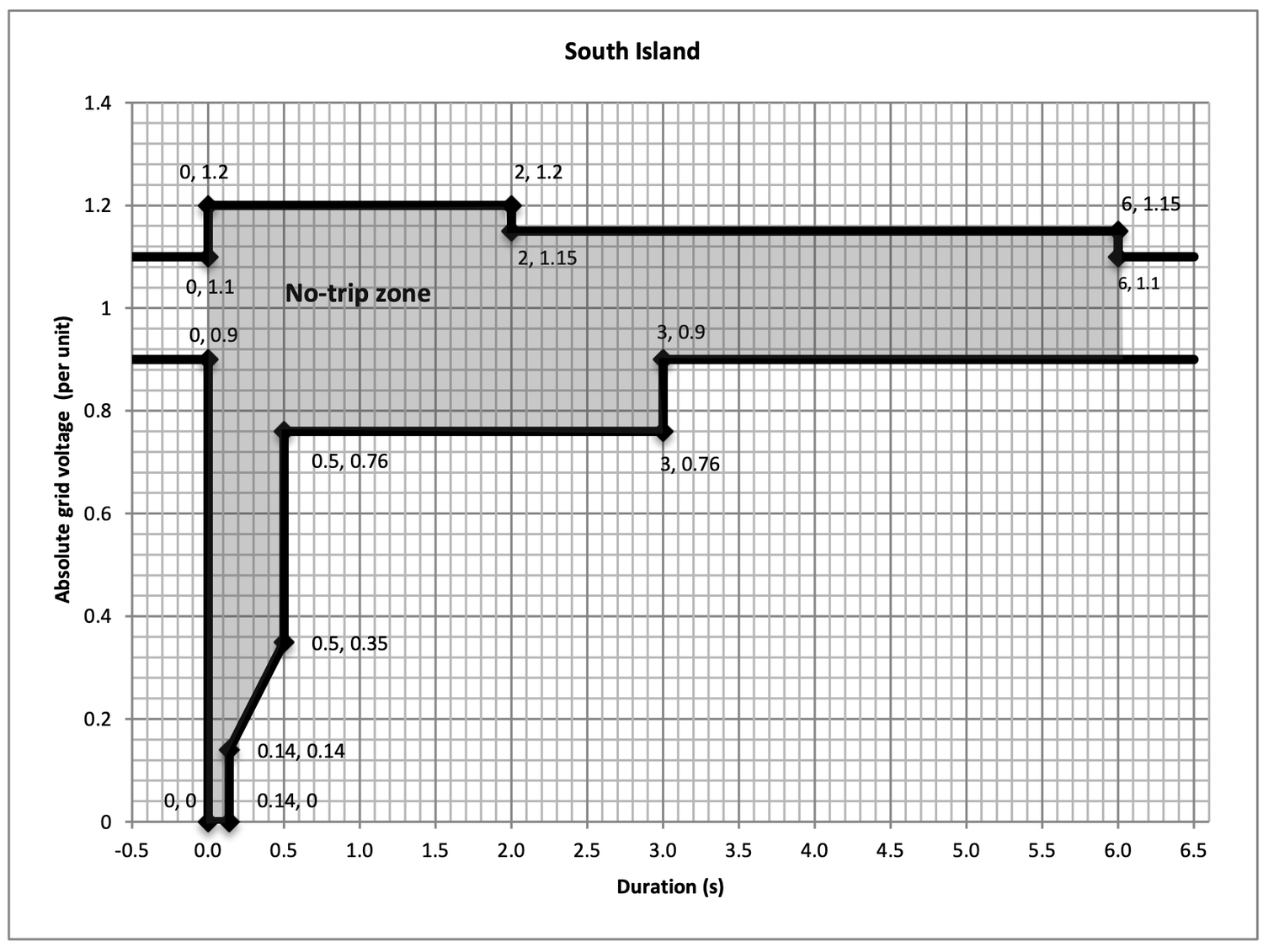
Figure 8.3: Haywards and Benmore no-trip zone during permanent loss of the HVDC link
Clause 8.25A Figure 8.1, Figure 8.2 and Figure 8.3: inserted, on 24 November 2016, by clause 6 of the Electricity Industry Participation Code Amendment (Generation Fault Ride Through) 2016.
Clause 8.25A(1): amended, on 5 October 2017, by clause 93(1) of the Electricity Industry Participation Code Amendment (Code Review Programme) 2017.
Clause 8.25A(2): amended, on 5 October 2017, by clause 93(2) of the Electricity Industry Participation Code Amendment (Code Review Programme) 2017.
8.25B
Reactive current and active power output
- (1) Each generator must ensure that each of its generating units generates reactive current to oppose the change in its terminal voltage without exceeding the maximum transient reactive current specified in the generator's asset capability statement for the period of 6 seconds immediately following the commencement of a fault on the grid of a type described in clause 8.25A(1).
- (2) Each generator must ensure that each of its generating units provides active power output relative to pre-fault active power output at least in proportion to the grid voltage at the grid injection point for the period of 6 seconds immediately following the clearance of a fault on the grid of a type described in clause 8.25A(1).
- (3) Subclause (2) does not apply to a wind generating station if there has been a reduction in the intermittent wind power source during the 6 seconds following the commencement of the fault.
Clause 8.25B: inserted, on 24 November 2016, by clause 6 of the Electricity Industry Participation Code Amendment (Generation Fault Ride Through) 2016.
8.25C
Use of additional equipment
- A generator may comply with clause 8.25A in relation to a generating station by—
- (a) ensuring that the performance of generating units that comprise the generating station comply; or
- (b) installing additional equipment within the generating station; or
- (c) a combination of the methods described in paragraphs (a) and (b).
Clause 8.25C: inserted, on 24 November 2016, by clause 6 of the Electricity Industry Participation Code Amendment (Generation Fault Ride Through) 2016.
8.25D
Application
- Clauses 8.25A and 8.25B do not apply—
- (a) to a wind generating station when it operates at less than 5% of rated MW; or
- (b) to any asset at an excluded generating station.
Clause 8.25D: inserted, on 24 November 2016, by clause 6 of the Electricity Industry Participation Code Amendment (Generation Fault Ride Through) 2016.
8.26
Asset owners must co-operate
- Each asset owner and each purchaser must co-operate with the system operator as may reasonably be required by the system operator in carrying out its functions.
Compare: Electricity Governance Rules 2003 rule 4.7 section III part C
Compliance
8.27
System operator to monitor compliance
- (1) To the extent possible, given the information made available by asset owners, the system operator must monitor, in the manner set out in the policy statement, which for the avoidance of doubt, sets out the system operator’s only monitoring obligations under this subpart, the ongoing compliance of asset owners with the asset owner performance obligations, the technical codes, and the connected asset commissioning, testing and information standard.
- (2) The system operator has a discretion to not dispatch an asset or configuration of assets, if it is not satisfied that the assets or configuration of assets comply with the relevant asset owner performance obligations or provisions of the technical codes or provisions of the connected asset commissioning, testing and information standard or that the asset owner has and is complying with a valid equivalence arrangement or dispensation from the relevant asset owner performance obligations or provisions of the technical codes or provisions of the connected asset commissioning, testing and information standard.
- (3) The system operator must immediately advise an asset owner if the system operator has reasonable grounds to believe that the asset owner is not complying with an asset owner performance obligation, equivalence arrangement or dispensation, and that the asset owner—
- (a) does not have a valid equivalence arrangement or dispensation from the relevant asset owner performance obligations or provisions of the technical codes or provisions of the connected asset commissioning, testing and information standard: or
- (b) is not complying with a valid equivalence arrangement or dispensation from the relevant asset owner performance obligations or provisions of the technical codes or provisions of the connected asset commissioning, testing and information standard.
Compare: Electricity Governance Rules 2003 rule 5 section III part C
Clause 8.27(1): replaced, on 1 July 2026, by clause 10(1) of the Electricity Industry Participation Code (Connected Asset Commissioning, Testing and Information Standard) Amendment 2026.
Clause 8.27(2): amended, on 19 May 2016, by clause 23 of the Electricity Industry Participation Code Amendment (System Operator and Alignment with Statutory Objective) 2016.
Clause 8.27(2): amended, on 1 July 2026, by clause 10(2) of the Electricity Industry Participation Code (Connected Asset Commissioning, Testing and Information Standard) Amendment 2026.
Clause 8.27(3): amended, on 1 July 2026, by clause 10(3) of the Electricity Industry Participation Code (Connected Asset Commissioning, Testing and Information Standard) Amendment 2026.
8.28
Responsibility for compliance
- (1) Each asset owner must comply with the asset owner performance obligations, technical codes, and the connected asset commissioning, testing and information standard at all times and must satisfy the system operator, whenever requested by the system operator acting reasonably, that each of its assets or configuration of assets complies with the asset owner performance obligations, technical codes, and provisions of the connected asset commissioning, testing and information standard that apply to that asset or configuration of assets.
- (2) If the system operator advises an asset owner under clause 8.27(3), the asset owner must co-operate with the system operator and use reasonable endeavours to restore compliance as soon as practicable.
- (3) During a period of commissioning or testing of assets, the asset owner performance obligations, technical codes, and the connected asset commissioning, testing and information standard do not apply to the asset owner in respect of the assets, if―
- (a) the obligations that do not apply to the asset owner are specified in the agreed commissioning plan or testing plan; and
- (b) during the period of non-compliance the asset owner complies with a commissioning plan or testing plan (as appropriate) agreed with the system operator; and
- (c) the period of non-compliance is no longer than the agreed commissioning plan or testing plan; and
- (d) subject to subclause (4), if an asset owner during a period of non-compliance meets the requirements of paragraphs (a) to (c), neither the asset owner nor the system operator is liable under this Code in relation to the non-compliance, except that the asset owner is not relieved of liability in the case of a negligent act or omission by the asset owner.
- (4) During any period of non-compliance, the non-compliant asset owner must pay the readily identifiable and quantifiable costs associated with its non-compliance, including the costs of the system operator purchasing additional ancillary services required as a consequence of its non-compliance.
Compare: Electricity Governance Rules 2003 rule 6 section III part C
Clause 8.28(1): replaced, on 1 July 2026, by clause 11(1) of the Electricity Industry Participation Code (Connected Asset Commissioning, Testing and Information Standard) Amendment 2026.
Clause 8.28(2): amended, on 1 November 2018, by clause 12 of the Electricity Industry Participation Code Amendment (Code Review Programme) 2018.
Clause 8.28(3): amended, on 5 October 2017, by clause 94 of the Electricity Industry Participation Code Amendment (Code Review Programme) 2017.
Clause 8.28(3): amended, on 1 July 2026, by clause 11(2) of the Electricity Industry Participation Code (Connected Asset Commissioning, Testing and Information Standard) Amendment 2026.
Equivalence arrangements and dispensations
8.29
Right to apply for approval of equivalence arrangement or grant of dispensation
- (1) Subject to subclause (2), if an asset owner cannot comply with an AOPO, a technical code obligation, or a connected asset commissioning, testing and information standard obligation in respect of a particular asset or configuration of assets, being an existing, new or proposed asset, the asset owner may apply for an equivalence arrangement to be approved or dispensation to be granted in accordance with Schedule 8.1.
- (2) The system operator may not grant a dispensation in relation to an obligation to provide automatic under-frequency load shedding under clause 8.19(5) or Schedule 8.3, Technical Code B, clause 7.
Compare: Electricity Governance Rules 2003 rule 7.1 section III part C
Clause 8.29(1): amended, on 7 August 2014, by clause 8(1) of the Electricity Industry Participation Code Amendment (Extended Reserve) 2014.
Clause 8.29(1): amended, on 1 July 2026, by clause 12 of the Electricity Industry Participation Code (Connected Asset Commissioning, Testing and Information Standard) Amendment 2026.
Clause 8.29(2): inserted, on 7 August 2014, by clause 8(2) of the Electricity Industry Participation Code Amendment (Extended Reserve) 2014.
Clause 8.29(2): amended, on 21 December 2021, by clause 11 of the Electricity Industry Participation Code Amendment (Automatic Under-Frequency Load Shedding Systems) 2021.
8.30
Approval of equivalence arrangements
- The system operator must approve an equivalence arrangement if it has received satisfactory evidence that the asset owner will put in place on the agreed date technical or commercial arrangements that will, in the reasonable opinion of the system operator, achieve compliance with the AOPO, a technical code obligation, or connected asset commissioning, testing and information standard obligation for which the equivalence arrangement is sought, even if the assets or configuration of assets do not strictly comply.
Compare: Electricity Governance Rules 2003 rule 7.2 section III part C
Clause 8.30: amended, on 1 July 2026, by clause 13 of the Electricity Industry Participation Code (Connected Asset Commissioning, Testing and Information Standard) Amendment 2026.
8.31
Grant of dispensations
- (1) Subject to subclause (1A), the system operator must grant a dispensation to an asset owner who has or will have assets or a configuration of assets that do not comply with either an AOPO, a technical code obligation, or connected asset commissioning, testing and information standard obligation if the system operator has a reasonable expectation that it can continue to operate the existing system and meet its principal performance obligations and if the system operator can readily quantify the costs on other persons of that dispensation, despite the non-compliance of the assets, but―
- (a) if the approval of a dispensation could impose readily identifiable and quantifiable costs on other persons, a condition of the dispensation must be that the asset owner is liable to pay the system operator for those costs, including the costs of the system operator purchasing any other ancillary services required as a consequence of its dispensation; and
- (b) the asset owner must acknowledge that the granting of a dispensation does not guarantee that the system operator will dispatch that asset for which the dispensation was granted, as dispatch will only occur in accordance with the dispatch objective; and
- (c) if the dispensation is a generating unit dispensation from clause 8.19(1) or (3), the generator must be allocated the following costs in a relevant trading period with respect to paragraph (a) for each of fast instantaneous reserves or sustained instantaneous reserves:
DispCostGENxt = 0.5 × QGENxt × PIRt
where
|
DispCostGENxt |
is the cost payable by a generator for generating unit x in any trading period t in which a class of instantaneous reserves is procured as a direct result of that generating unit’s dispensation to ensure that the frequency does not fall below 47 Hertz or, in the South Island, below the minimum South Island frequency |
|
QGENxt |
is the MW amount by which generating unit x is unable to sustain pre-event output in trading period t with reference to clause 8.19(1) or (3) (as the case may be) as determined from the capabilities specified in that generating unit’s dispensation (different amounts may be specified with respect to each class of instantaneous reserves) |
|
PIRt |
is the final reserve price for fast instantaneous reserves or sustained instantaneous reserves (as the case may be) in trading period t in the relevant island. |
- (1A) If the system operator grants a dispensation from clause 8.25A or clause 8.25B to an asset owner under subclause (1), and the granting of the dispensation could impose readily identifiable and quantifiable costs on any other person, the system operator must not impose a condition on the asset owner in accordance with subclause (1)(a) that has effect earlier than 24 November 2018.
- (2) The system operator may impose other reasonable conditions on the grant of a dispensation under subclause (1), including conditions as to duration of the dispensation.
Compare: Electricity Governance Rules 2003 rules 7.3 and 7.4 section III part C
Clause 8.31(1): amended, on 15 May 2014, by clause 7 of the Electricity Industry Participation (Minor Code Amendments) Code Amendment 2014.
Clause 8.31(1): amended, on 24 November 2016, by clause 7(1) of the Electricity Industry Participation Code Amendment (Generation Fault Ride Through) 2016.
Clause 8.31(1): amended, on 1 July 2026, by clause 14 of the Electricity Industry Participation Code (Connected Asset Commissioning, Testing and Information Standard) Amendment 2026.
Clause 8.31(1)(c): amended, on 19 May 2016, by clause 24 of the Electricity Industry Participation Code Amendment (System Operator and Alignment with Statutory Objective) 2016.
Clause 8.31(1)(c): replaced, on 1 August 2026, by clause 17 of the Electricity Industry Participation Code (Minor Amendments) Amendment 2026.
Clause 8.31(1A): inserted, on 24 November 2016, by clause 7(2) of the Electricity Industry Participation Code Amendment (Generation Fault Ride Through) 2016.
8.32
Liability of asset owner pending decision
- Pending determination of an asset owner’s application for a dispensation or an equivalence arrangement, if the asset does not comply with the AOPOs, the technical codes, or the connected asset commissioning, testing and information standard the asset owner is liable for the non-compliance and is responsible for additional costs incurred by the system operator or asset owners as a result of the non-compliance, including the costs of the system operator purchasing other ancillary services as a consequence of the non-compliance.
Compare: Electricity Governance Rules 2003 rule 8 section III part C
Clause 8.32: amended, on 15 May 2014, by clause 8 of the Electricity Industry Participation (Minor Code Amendments) Code Amendment 2014.
Clause 8.32: amended, on 1 July 2026, by clause 15 of the Electricity Industry Participation Code (Connected Asset Commissioning, Testing and Information Standard) Amendment 2026.
8.33
Modification of equivalence arrangement or dispensation
- An asset owner may apply to the system operator for a modification to an equivalence arrangement or dispensation, in which case clauses 8.34 to 8.36 and Schedule 8.1 apply.
Compare: Electricity Governance Rules 2003 rule 8.1 section III part C
8.34
Cancellation of equivalence arrangement or dispensation
- (1) An asset owner may at any time give written notice to the system operator for an equivalence arrangement or a dispensation to be cancelled on the grounds that the asset or configuration of assets subject to the equivalence arrangement or dispensation complies with AOPOs, technical codes, or the connected asset commissioning, testing and information standard.
- (2) A cancellation takes effect on the date specified in the notice as being the date the system operator accepted the cancellation.
- (3) The system operator must record the cancellation in the system operator register no later than 5 days after receiving the notice.
Compare: Electricity Governance Rules 2003 rule 8.2 section III part C
Clause 8.34(1): amended, on 1 July 2026, by clause 16 of the Electricity Industry Participation Code (Connected Asset Commissioning, Testing and Information Standard) Amendment 2026.
8.35
Revocation of equivalence arrangement and revocation or variation of dispensation
- (1) The system operator may revoke approval of an equivalence arrangement or revoke or vary the grant of a dispensation as the system operator reasonably considers appropriate if, at any time after the system operator has approved an equivalence arrangement or granted a dispensation, the system operator is satisfied that 1 or more of the following apply:
- (a) the dispensation or equivalence arrangement was approved on information that was false or materially misleading:
- (b) a prerequisite of the dispensation or equivalence arrangement has changed:
- (c) a condition on which the dispensation or equivalence arrangement was approved has not been complied with:
- (d) withdrawal is provided for under the terms of the dispensation granted:
- (e) a change to this Code has occurred that affects the dispensation or equivalence arrangement:
- (f) a decision has been reconsidered at the direction of the Rulings Panel under clause 8.36(4).
- (2) The system operator must not revoke or amend a dispensation or grant a further dispensation or revoke its approval of an equivalence arrangement under subclause (1), unless―
- (a) the asset owner to whom the dispensation was granted, or for whom an equivalence arrangement was approved, and any other person who in the opinion of the system operator is likely to have an interest in the matter, is given reasonable notice of the system operator’s intentions and a reasonable opportunity to make submissions to the system operator on the issue; and
- (b) the system operator has had regard to the submissions.
Compare: Electricity Governance Rules 2003 rule 8.3 section III part C
Clause 8.35(1)(d): amended, on 1 August 2026, by clause 18 of the Electricity Industry Participation Code (Minor Amendments) Amendment 2026.
8.36
Appeal against decisions
- (1) A participant may appeal a decision of the system operator in relation to an application for dispensation or equivalence arrangements on the grounds set out in subclause (3).
- (2) An appeal must be made to the Rulings Panel by giving written notice to the Authority specifying the grounds of appeal. A notice must be given no later than 10 business days after publication of the relevant decision in the system operator register under clause 8 of Schedule 8.1.
- (3) For the purposes of subclause (2), an appeal may be made on the grounds that―
- (a) the system operator made an error of fact or failed to take into account all relevant information or took into account irrelevant information and such error, failure or irrelevancy was material to the decision; or
- (b) the conditions imposed on the dispensation or equivalence arrangement are unjustifiably onerous, unnecessary or impose extra costs if appropriate alternatives exist.
- (4) The Rulings Panel, in determining an appeal, must approve the decision of the system operator or direct the system operator to reconsider the decision in full or by reference to specified matters.
- (5) Pending the outcome of an appeal, the decision of the system operator in relation to the grant of a dispensation or approval of an equivalence arrangement remains valid and may be relied upon by the relevant asset owner.
Compare: Electricity Governance Rules 2003 rule 8.4 section III part C
Clause 8.36(1): amended, on 1 November 2018, by clause 13 of the Electricity Industry Participation Code Amendment (Code Review Programme) 2018.
8.37
Other provisions relating to equivalence arrangements and dispensations
- (1) An asset owner who obtains approval for an equivalence arrangement must comply with its obligations under that arrangement.
- (1A) An asset owner who is granted a dispensation must comply with its obligations under that dispensation.
- (2) An equivalence arrangement and a dispensation are specific to an asset owner, and no approval of an equivalence arrangement or granting of a dispensation creates a precedent for the approval of other equivalence arrangements or dispensations.
- (3) The owner or operator of an asset or configuration of assets must advise the system operator if the owner or operator believes that it is in breach of a condition of its dispensation or equivalence arrangement or that the asset or configuration of assets, including any equivalence arrangement, does not, or is likely not to, comply with the asset owner performance obligations, technical codes, or the connected asset commissioning, testing and information standard.
- (4) If an asset owner fails to put in place, maintain and meet all requirements of an approved equivalence arrangement or dispensation, the asset owner is in breach of this Code.
Compare: Electricity Governance Rules 2003 rule 9 section III part C
Clause 8.37(1A): inserted, on 15 May 2014, by clause 9 of the Electricity Industry Participation (Minor Code Amendments) Code Amendment 2014.
Clause 8.37(3): amended, on 1 July 2026, by clause 17 of the Electricity Industry Participation Code (Connected Asset Commissioning, Testing and Information Standard) Amendment 2026.
8.38
Authority may require excluded generating stations to comply with certain clauses
- (1) Despite clauses 8.17, 8.19, and 8.25D, the system operator may, at any time, apply to the Authority for the Authority to issue a directive that an excluded generating station asset must comply with clauses 8.17, 8.19, 8.25A, and 8.25B, the provisions of the technical codes (or parts thereof), and the connected asset commissioning, testing and information standard (or parts thereof).
- (2) The Authority must issue the directive referred to in subclause (1) if the Authority is satisfied that there is a benefit to the public in obtaining compliance.
- (3) If a directive is issued under subclause (2), the owner of the excluded generating station asset must comply with the directive with effect from the date specified in the directive.
Compare: Electricity Governance Rules 2003 rule 10 section III part C
Clause 8.38(1): amended, on 24 November 2016, by clause 8(1) and (2) of the Electricity Industry Participation Code Amendment (Generation Fault Ride Through) 2016.
Clause 8.38(1): amended, on 1 July 2026, by clause 18 of the Electricity Industry Participation Code (Connected Asset Commissioning, Testing and Information Standard) Amendment 2026.
Subpart 3—Arrangements concerning ancillary services
8.39
Contents of this subpart
- This subpart provides for―
- (a) a procurement plan that the system operator must use reasonable endeavours to implement and comply with; and
- (b) the review of the procurement plan; and
- (c) alternative ancillary service arrangements; and
- (d) how ancillary services are to be priced and measured; and
- (e) identifying the allocable costs for ancillary services and the regime by which those costs are allocated to affected parties.
Compare: Electricity Governance Rules 2003 rule 1 section IV part C
Procurement plan
8.40
System operator to use reasonable endeavours to implement and comply with procurement plan
- The system operator must use reasonable endeavours to both implement and comply with the procurement plan.
Compare: Electricity Governance Rules 2003 rule 2 section IV part C
8.41
[Revoked]
Clause 8.41: revoked, on 10 January 2013, by clause 15 of the Electricity Industry Participation (Policy Statement and Procurement Plan Review Process) Code Amendment 2012.
8.42
Incorporation of procurement plan by reference
- (1) The procurement plan is incorporated by reference in this Code.
- (2) Clauses 7.13 to 7.22 apply to any amendment or replacement of the procurement plan.
Compare: Electricity Governance Rules 2003 rule 3 section IV part C
Clause 8.42(1): amended, on 10 January 2013, by clause 16 of the Electricity Industry Participation (Policy Statement and Procurement Plan Review Process) Code Amendment 2012.
Clause 8.42(1): amended, on 1 August 2023, by clause 19(1) of the Electricity Industry Participation Code Amendment (System Operation Documents) 2023.
Clause 8.42(2): amended, on 1 August 2023, by clause 19(2) of the Electricity Industry Participation Code Amendment (System Operation Documents) 2023.
Clause 8.42(2): amended, on 1 March 2024, by clause 28 of the Electricity Industry Participation Code Amendment (Code Review Programme) 2024.
8.42A
[Revoked]
Clause 8.42A: inserted, on 10 January 2013, by clause 17 of the Electricity Industry Participation (Policy Statement and Procurement Plan Review Process) Code Amendment 2012.
Clause 8.42A(1): amended, on 5 October 2017, by clause 95 of the Electricity Industry Participation Code Amendment (Code Review Programme) 2017.
Clause 8.42A: revoked, on 1 August 2023, by clause 20 of the Electricity Industry Participation Code Amendment (System Operation Documents) 2023.
8.42B
[Revoked]
Clause 8.42B: inserted, on 10 January 2013, by clause 17 of the Electricity Industry Participation (Policy Statement and Procurement Plan Review Process) Code Amendment 2012.
Clause 8.42B: revoked, on 1 August 2023, by clause 21 of the Electricity Industry Participation Code Amendment (System Operation Documents) 2023.
8.42C
[Revoked]
Clause 8.42C: inserted, on 10 January 2013, by clause 17 of the Electricity Industry Participation (Policy Statement and Procurement Plan Review Process) Code Amendment 2012.
Clause 8.42C(3): amended, on 5 October 2017, by clause 96 of the Electricity Industry Participation Code Amendment (Code Review Programme) 2017.
Clause 8.42C: revoked, on 1 August 2023, by clause 22 of the Electricity Industry Participation Code Amendment (System Operation Documents) 2023.
8.43
Content of procurement plan
- A procurement plan must, for each ancillary service―
- (a) specify the principles that the system operator must apply in making a net purchase quantity assessment, which must include―
- (i) determining the requirements for complying with the principal performance obligations; and
- (ii) determining the requirements for achieving the dispatch objective; and
- (iii) assessing the contribution that compliance by asset owners with the asset owner performance obligations will make towards the system operator’s compliance with the principal performance obligations; and
- (iv) assessing the impact that dispensations and alternative ancillary service arrangements held by asset owners will have on the quantity of ancillary services required to enable the system operator to comply with the principal performance obligations; and
- (b) contain a methodology for conducting a net purchase quantity assessment for each relevant ancillary service; and
- (c) outline the process that the system operator must use to procure that ancillary service, taking into account that the system operator must use―
- (i) market mechanisms to procure ancillary services wherever technology and transaction costs make this practicable and efficient; and
- (ii) transparent processes that encourage all potential providers to compete to supply ancillary services required to meet common quality standards at the best economic cost; and
- (d) specify the administrative costs for that ancillary service as proposed in the procurement plan; and
- (e) outline the system operator’s technical requirements and key contract terms to support the procurement plan; and
- (f) outline the rights and obligations of the system operator in relation to procurement of that ancillary service in circumstances not anticipated by the procurement plan, and if the assumptions made by the system operator in the procurement plan cannot be met; and
- (g) outline how the system operator will report on progress in implementing the procurement plan.
- (a) specify the principles that the system operator must apply in making a net purchase quantity assessment, which must include―
Compare: Electricity Governance Rules 2003 rule 4 section IV part C
Clause 8.43 Heading: amended, on 1 August 2023, by clause 23(1) of the Electricity Industry Participation Code Amendment (System Operation Documents) 2023.
Clause 8.43: substituted, on 10 January 2013, by clause 18 of the Electricity Industry Participation (Policy Statement and Procurement Plan Review Process) Code Amendment 2012.
Clause 8.43: amended, on 19 December 2014, by clause 9 of the Electricity Industry Participation Code Amendment (Minor Code Amendments) (No 3) 2014.
Clause 8.43: amended, on 1 August 2023, by clause 23(2) of the Electricity Industry Participation Code Amendment (System Operation Documents) 2023.
Clause 8.43(a)(iv): amended, on 1 August 2026, by clause 19 of the Electricity Industry Participation Code (Minor Amendments) Amendment 2026.
Clause 8.43(d): amended, on 1 August 2023, by clause 23(3) of the Electricity Industry Participation Code Amendment (System Operation Documents) 2023.
Clause 8.43(f): amended, on 1 August 2023, by clause 23(4) of the Electricity Industry Participation Code Amendment (System Operation Documents) 2023.
8.43A
[Revoked]
Clause 8.43A: inserted, on 10 January 2013, by clause 19 of the Electricity Industry Participation (Policy Statement and Procurement Plan Review Process) Code Amendment 2012.
Clause 8.43A(3)(b): amended, on 5 October 2017, by clause 97 of the Electricity Industry Participation Code Amendment (Code Review Programme) 2017.
Clause 8.43A: revoked, on 1 August 2023, by clause 24 of the Electricity Industry Participation Code Amendment (System Operation Documents) 2023.
8.44
[Revoked]
Compare: Electricity Governance Rules 2003 rule 5 section IV part C
Clause 8.44: substituted, on 10 January 2013, by clause 20 of the Electricity Industry Participation (Policy Statement and Procurement Plan Review Process) Code Amendment 2012.
Clause 8.44(1), (4) and (6): amended, on 5 October 2017, by clause 98(1) of the Electricity Industry Participation Code Amendment (Code Review Programme) 2017.
Clause 8.44(2): amended, on 5 October 2017, by clause 98(2) of the Electricity Industry Participation Code Amendment (Code Review Programme) 2017.
Clause 8.44: revoked, on 1 August 2023, by clause 25 of the Electricity Industry Participation Code Amendment (System Operation Documents) 2023.
8.44A
[Revoked]
Clause 8.44A: inserted, on 10 January 2013, by clause 21 of the Electricity Industry Participation (Policy Statement and Procurement Plan Review Process) Code Amendment 2012.
Clause 8.44A(4)(a) and (6): amended, on 5 October 2017, by clause 99 of the Electricity Industry Participation Code Amendment (Code Review Programme) 2017.
Clause 8.44A: revoked, on 1 August 2023, by clause 26 of the Electricity Industry Participation Code Amendment (System Operation Documents) 2023.
8.44B
[Revoked]
Clause 8.44B: inserted, on 10 January 2013, by clause 21 of the Electricity Industry Participation (Policy Statement and Procurement Plan Review Process) Code Amendment 2012.
Clause 8.44B(b): amended, on 5 October 2017, by clause 100 of the Electricity Industry Participation Code Amendment (Code Review Programme) 2017.
Clause 8.44B: revoked, on 1 August 2023, by clause 27 of the Electricity Industry Participation Code Amendment (System Operation Documents) 2023.
8.45
Contracts with ancillary service agents
- (1) The system operator must use reasonable endeavours to implement the procurement plan for each ancillary service by entering into contracts with the ancillary service agents in the manner specified in the procurement plan.
- (2) The system operator is the principal in any contract it enters into with an ancillary service agent.
- (3) If the system operator has entered into a contract, the system operator must use reasonable endeavours to ensure that the ancillary service agent complies with its contractual obligations, but the system operator is not otherwise liable in respect of any failure by an ancillary service agent to comply with such obligations.
Compare: Electricity Governance Rules 2003 rule 6 section IV part C
8.45A
Methodology to assess net purchase quantity
- The system operator must make the net purchase quantity assessment for each relevant ancillary service using the methodology in the procurement plan and publish the results of the assessment as soon as practicable.
Clause 8.45A: inserted, on 10 January 2013, by clause 22 of the Electricity Industry Participation (Policy Statement and Procurement Plan Review Process) Code Amendment 2012.
Clause 8.45A: amended, on 5 October 2017, by clause 101 of the Electricity Industry Participation Code Amendment (Code Review Programme) 2017.
8.46
[Revoked]
Compare: Electricity Governance Rules 2003 rule 7 section IV part C
Clause 8.46: revoked, on 10 January 2013, by clause 23 of the Electricity Industry Participation (Policy Statement and Procurement Plan Review Process) Code Amendment 2012.
8.47
Departure from procurement plan
- (1) The system operator may depart from the processes and arrangements set out in the procurement plan if the system operator reasonably considers it necessary to do so to comply with the principal performance obligations.
- (2) When the system operator makes a departure under subclause (1), the system operator must provide a report to the Authority setting out the circumstances of the departure and the actions taken to deal with it.
- (3) The Authority must publish the report within a reasonable time after receiving it.
Compare: Electricity Governance Rules 2003 rule 8 section IV part C
Clause 8.47(2): amended, on 10 January 2013, by clause 24(a) of the Electricity Industry Participation (Policy Statement and Procurement Plan Review Process) Code Amendment 2012.
Clause 8.47(3): inserted, on 10 January 2013, by clause 24(b) of the Electricity Industry Participation (Policy Statement and Procurement Plan Review Process) Code Amendment 2012.
Clause 8.47(3): amended, on 5 October 2017, by clause 102 of the Electricity Industry Participation Code Amendment (Code Review Programme) 2017.
Alternative ancillary service arrangements
8.48
Alternative ancillary service arrangements
- (1) If an asset owner wishes to have an alternative ancillary service arrangement authorised by the system operator, that asset owner (or, if more than 1 asset owner wishes to have an authorisation, those asset owners jointly) may apply to the system operator to have that arrangement authorised as an alternative ancillary service arrangement using the process set out in Schedule 8.2.
- (2) The system operator must authorise the arrangement as an alternative ancillary service arrangement if―
- (a) the proposed arrangement complies with the technical requirements for that ancillary service as set out in the current procurement plan; and
- (b) the implementation of the proposed arrangement will make the ancillary service available for dispatch by the system operator in substantially the same manner as if the ancillary service had been procured in accordance with the procurement plan.
- (3) As a condition of authorising an alternative ancillary service arrangement under subclause (2), the system operator may do 1 or more of the following:
- (a) require the asset owner to enter into arrangements with the system operator to ensure that the system operator can continue to meet the principal performance obligations:
- (b) specify the date on which the alternative ancillary service arrangement commences:
- (c) impose any other condition it reasonably believes is necessary, including conditions necessary for the system operator to meet its principal performance obligations and conditions necessary for the orderly reconciliation and settlement of ancillary services.
Compare: Electricity Governance Rules 2003 rules 9.1 to 9.3 section IV part C
8.49
Suspension of alternative ancillary service arrangement
- (1) An asset owner may at any time give written reasonable notice to the system operator of suspension of the alternative ancillary service arrangement for a period specified in the notice.
- (2) The system operator may suspend an alternative ancillary service arrangement in a system security situation.
Compare: Electricity Governance Rules 2003 rule 9.4 section IV part C
8.50
Modification of alternative ancillary service arrangement
- An asset owner may apply to the system operator for a modification to an alternative ancillary service arrangement in which case clauses 8.51 to 8.53 and Schedule 8.2 apply.
Compare: Electricity Governance Rules 2003 rule 9.5 section IV part C
8.51
Cancellation of alternative ancillary service arrangement
- An asset owner may at any time give reasonable notice in writing to the system operator of cancellation of the alternative ancillary service arrangement, which comes into effect on the date specified in the notice.
Compare: Electricity Governance Rules 2003 rule 9.6 section IV part C
8.52
Revocation of alternative ancillary service arrangements
- (1) The system operator may revoke authorisation of the alternative ancillary service arrangement as the system operator reasonably considers appropriate, if at any time after the system operator has authorised an alternative ancillary service arrangement, the system operator is satisfied that 1 or more of the following factors apply:
- (a) the alternative ancillary service arrangement was authorised on information that was false or materially misleading:
- (b) a prerequisite of the alternative ancillary service arrangement has changed:
- (c) a condition upon which the authorisation was granted has not been complied with:
- (d) such revocation is provided for under the terms of the authorisation.
- (2) Subject to clause 8.49(2), the system operator must not revoke or amend an alternative ancillary service arrangement unless—
- (a) the person to whom the authorisation was granted and any other person who, in the opinion of the system operator, is likely to have an interest in the matter, is given reasonable notice of the system operator’s intentions and a reasonable opportunity to make submissions to the system operator; and
- (b) the system operator has had regard to those submissions.
Compare: Electricity Governance Rules 2003 rule 9.7 section IV part C
8.53
Appeal of system operator decisions
- (1) An applicant may appeal any decision of the system operator in relation to any alternative ancillary service arrangement.
- (2) A participant may appeal any decision of the system operator in relation to an alternative ancillary service arrangement on the grounds set out in subclause (4).
- (3) An appeal must be commenced with the Rulings Panel by giving written notice to the Authority, specifying the grounds of appeal. A notice must be given within 10 business days of publication of the decision in the system operator register under clause 4 of Schedule 8.2.
- (4) For the purpose of subclause (2), an appeal may be made on the grounds that―
- (a) the system operator made an error of fact, or failed to take properly into account all relevant information or took into account irrelevant information, and such error, failure or irrelevancy was material to the decision; or
- (b) the conditions imposed on the alternative ancillary service arrangement are onerous, unnecessary or impose extra costs if appropriate alternatives exist.
- (5) The Rulings Panel, in determining an appeal, must either approve the decision of the system operator or direct the system operator to reconsider the decision in full or by reference to specified matters.
- (6) Pending the outcome of an appeal, the decision of the system operator in relation to the authorisation of an alternative ancillary service arrangement remains valid and can be acted upon by the relevant asset owner.
Compare: Electricity Governance Rules 2003 rule 9.8 section IV part C
8.54
Other provisions relating to alternative ancillary service arrangements
- (1) The system operator must monitor the performance of alternative ancillary service arrangements in accordance with the procurement plan and the monitoring regimes specified in the respective alternative ancillary service arrangements. If the system operator considers, on reasonable grounds, that an alternative ancillary service arrangement is not being, or likely not to be, complied with, the system operator must immediately advise the asset owner.
- (2) An asset owner who obtains an authorisation of an alternative ancillary service arrangement must comply with its obligations under the arrangement. If the system operator advises an asset owner under subclause (1), the asset owner must co-operate with the system operator and must immediately use reasonable endeavours to restore compliance as soon as possible.
- (3) An asset owner who holds an alternative ancillary service arrangement is relieved of an obligation to pay costs for ancillary service in the manner provided for in clauses 8.55 to 8.59 and 8.64 to 8.70 to the extent provided for in the alternative ancillary service arrangement.
- (4) The holder of an alternative ancillary service arrangement breaches this Code if ancillary services are not made available to the system operator in accordance with the alternative ancillary service arrangement, or if an alternative ancillary service arrangement fails. From the date a breach of an alternative ancillary service arrangement becomes known, the holder of the alternative ancillary service arrangement must meet its share of the ancillary costs as if the alternative ancillary service arrangement had not been authorised.
Compare: Electricity Governance Rules 2003 rule 10 section IV part C
Clause 8.54(2): amended, on 1 November 2018, by clause 14 of the Electricity Industry Participation Code Amendment (Code Review Programme) 2018.
Subpart 4—Interruptible load and emergency reserve
Heading: inserted, on 7 August 2014, by clause 9 of the Electricity Industry Participation Code Amendment (Extended Reserve) 2014.
Heading: amended, on 1 March 2026, by clause 5 of the Electricity Industry Participation Code (Emergency Reserve) Amendment 2026.
8.54A
Contents of this subpart
- This subpart provides for the provision of information relating to interruptible load and emergency reserve.
Clause 8.54A: inserted, on 7 August 2014, by clause 9 of the Electricity Industry Participation Code Amendment (Extended Reserve) 2014.
Clause 8.54A: amended, on 1 March 2026, by clause 6 of the Electricity Industry Participation Code (Emergency Reserve) Amendment 2026.
8.54AA
System operator to maintain and publish register
- (1) The system operator must maintain and publish an up to date copy of the system operator register.
- (2) The up to date copy of the system operator register published under subclause (1) must be available to the public at all times up until a new up to date copy is published.
Clause 8.54AA: inserted, on 20 December 2021, by clause 11 of the Electricity Industry Participation Code Amendment (Code Review Programme) 2019.
8.54B
Ancillary service agents to provide information about interruptible load and emergency reserve
- (1) Each ancillary service agent that contracts for interruptible load or emergency reserve in a network must, within 10 business days of entering into the contract, give the following participants the information in subclause (2):
- (a) if the interruptible load or emergency reserve is contracted on a local network, the connected asset owner that operates the local network:
- (b) if the interruptible load or emergency reserve is contracted on an embedded network, the connected asset owner that operates the local network to which the embedded network is connected:
- (c) if the interruptible load or emergency reserve is contracted on the grid, the grid owner that owns or operates the part of the grid on which the interruptible load or emergency reserve is contracted.
- (2) The information required is—
- (a) a list of the ICPs to which the contract relates; and
- (b) the maximum MW that can be activated or interrupted under the contract; and
- (c) the commencement and expiry dates of the contract.
- (3) If an ancillary service agent has given a connected asset owner or grid owner information under subclause (1), the connected asset owner or grid owner may require the ancillary service agent to provide further information about the interruptible load or emergency reserve to which the contract relates.
- (4) An ancillary service agent must comply with a requirement under subclause (3).
Clause 8.54B Heading: amended, on 1 March 2026, by clause 7(1) of the Electricity Industry Participation Code (Emergency Reserve) Amendment 2026.
Clause 8.54B: inserted, on 7 August 2014, by clause 9 of the Electricity Industry Participation Code Amendment (Extended Reserve) 2014.
Clause 8.54B: amended, on 1 March 2026, by clause 7(2) of the Electricity Industry Participation Code (Emergency Reserve) Amendment 2026.
Clause 8.54B(1)(b): amended, on 23 February 2015, by clause 75 of the Electricity Industry Participation Code Amendment (Distributed Generation) 2014.
Clause 8.54B(2)(b): amended, on 1 March 2026, by clause 7(3) of the Electricity Industry Participation Code (Emergency Reserve) Amendment 2026.
Clause 8.54B(1) and (3): amended, on 1 February 2016, by clause 11 of the Electricity Industry Participation Code Amendment (Code Review Programme) 2015.
8.54BA
Provision of information about the use of emergency reserve
- The system operator must, within 20 business days of the conclusion of a grid emergency for which the system operator has procured or activated emergency reserve, publish a report containing:
- (a) the total amount of emergency reserve procured in anticipation of the grid emergency;
- (b) the total amounts of emergency reserve pre-activated or activated during the grid emergency;
- (c) the estimated emergency reserve pre-event cost related to the grid emergency and the corresponding emergency reserve pre-event trading periods;
- (d) the estimated emergency reserve event cost related to the grid emergency and the corresponding emergency reserve event trading periods;
- (e) the estimated expected unserved energy that was avoided by the activation of emergency reserve; and
- (f) the estimated value of expected unserved energy that was avoided by the activation of emergency reserve.
Clause 8.54BA: inserted, on 1 March 2026, by clause 8 of the Electricity Industry Participation Code (Emergency Reserve) Amendment 2026.
Subpart 5—[Revoked]
Heading: inserted, on 7 August 2014, by clause 9 of the Electricity Industry Participation Code Amendment (Extended Reserve) 2014.
Heading: revoked, on 21 December 2021, by clause 12 of the Electricity Industry Participation Code Amendment (Automatic Under-Frequency Load Shedding Systems) 2021.
8.54C
[Revoked]
Clause 8.54C: inserted, on 7 August 2014, by clause 9 of the Electricity Industry Participation Code Amendment (Extended Reserve) 2014.
Clause 8.54C: revoked, on 21 December 2021, by clause 12 of the Electricity Industry Participation Code Amendment (Automatic Under-Frequency Load Shedding Systems) 2021.
8.54D
[Revoked]
Clause 8.54D: inserted, on 7 August 2014, by clause 9 of the Electricity Industry Participation Code Amendment (Extended Reserve) 2014.
Clause 8.54D: revoked, on 21 December 2021, by clause 12 of the Electricity Industry Participation Code Amendment (Automatic Under-Frequency Load Shedding Systems) 2021.
8.54E
[Revoked]
Clause 8.54E: inserted, on 7 August 2014, by clause 9 of the Electricity Industry Participation Code Amendment (Extended Reserve) 2014.
Clause 8.54E(2): amended, on 19 December 2014, by clause 10 of the Electricity Industry Participation Code Amendment (Minor Code Amendments) (No 3) 2014.
Clause 8.54E: revoked, on 21 December 2021, by clause 12 of the Electricity Industry Participation Code Amendment (Automatic Under-Frequency Load Shedding Systems) 2021.
8.54F
[Revoked]
Clause 8.54F: inserted, on 7 August 2014, by clause 9 of the Electricity Industry Participation Code Amendment (Extended Reserve) 2014.
Clause 8.54F(3): amended, on 5 October 2017, by clause 103 of the Electricity Industry Participation Code Amendment (Code Review Programme) 2017.
Clause 8.54F: revoked, on 21 December 2021, by clause 12 of the Electricity Industry Participation Code Amendment (Automatic Under-Frequency Load Shedding Systems) 2021.
8.54G
[Revoked]
Clause 8.54G: inserted, on 7 August 2014, by clause 9 of the Electricity Industry Participation Code Amendment (Extended Reserve) 2014.
Clause 8.54G(3)(g): amended, on 5 October 2017, by clause 104(1) of the Electricity Industry Participation Code Amendment (Code Review Programme) 2017.
Clause 8.54G(3)(h): revoked, on 5 October 2017, by clause 104(2) of the Electricity Industry Participation Code Amendment (Code Review Programme) 2017.
Clause 8.54G(3A): inserted, on 5 October 2017, by clause 104(3) of the Electricity Industry Participation Code Amendment (Code Review Programme) 2017.
Clause 8.54G: revoked, on 21 December 2021, by clause 12 of the Electricity Industry Participation Code Amendment (Automatic Under-Frequency Load Shedding Systems) 2021.
8.54H
[Revoked]
Clause 8.54H: inserted, on 7 August 2014, by clause 9 of the Electricity Industry Participation Code Amendment (Extended Reserve) 2014.
Clause 8.54H: revoked, on 21 December 2021, by clause 12 of the Electricity Industry Participation Code Amendment (Automatic Under-Frequency Load Shedding Systems) 2021.
8.54I
[Revoked]
Clause 8.54I: inserted, on 7 August 2014, by clause 9 of the Electricity Industry Participation Code Amendment (Extended Reserve) 2014.
Clause 8.54I: revoked, on 21 December 2021, by clause 12 of the Electricity Industry Participation Code Amendment (Automatic Under-Frequency Load Shedding Systems) 2021.
8.54J
[Revoked]
Clause 8.54J: inserted, on 7 August 2014, by clause 9 of the Electricity Industry Participation Code Amendment (Extended Reserve) 2014.
Clause 8.54J(2): amended, on 19 December 2014, by clause 11 of the Electricity Industry Participation Code Amendment (Minor Code Amendments) (No 3) 2014.
Clause 8.54J(12): inserted, on 19 January 2017, by clause 6 of the Electricity Industry Participation Code Amendment (Extended Reserve) 2016.
Clause 8.54J: revoked, on 21 December 2021, by clause 12 of the Electricity Industry Participation Code Amendment (Automatic Under-Frequency Load Shedding Systems) 2021.
8.54K
[Revoked]
Clause 8.54K: inserted, on 7 August 2014, by clause 9 of the Electricity Industry Participation Code Amendment (Extended Reserve) 2014.
Clause 8.54K(1): amended, on 19 January 2017, by clause 7(1) of the Electricity Industry Participation Code Amendment (Extended Reserve) 2016.
Clause 8.54K(2): replaced, on 19 January 2017, by clause 7(2) of the Electricity Industry Participation Code Amendment (Extended Reserve) 2016.
Clause 8.54K: revoked, on 21 December 2021, by clause 12 of the Electricity Industry Participation Code Amendment (Automatic Under-Frequency Load Shedding Systems) 2021.
8.54L
[Revoked]
Clause 8.54L: inserted, on 7 August 2014, by clause 9 of the Electricity Industry Participation Code Amendment (Extended Reserve) 2014.
Clause 8.54L: revoked, on 21 December 2021, by clause 12 of the Electricity Industry Participation Code Amendment (Automatic Under-Frequency Load Shedding Systems) 2021.
8.54M
[Revoked]
Clause 8.54M: inserted, on 7 August 2014, by clause 9 of the Electricity Industry Participation Code Amendment (Extended Reserve) 2014.
Clause 8.54M: revoked, on 21 December 2021, by clause 12 of the Electricity Industry Participation Code Amendment (Automatic Under-Frequency Load Shedding Systems) 2021.
8.54N
[Revoked]
Clause 8.54N: inserted, on 7 August 2014, by clause 9 of the Electricity Industry Participation Code Amendment (Extended Reserve) 2014.
Clause 8.54N: amended, on 19 January 2017, by clause 8 of the Electricity Industry Participation Code Amendment (Extended Reserve) 2016.
Clause 8.54N: revoked, on 21 December 2021, by clause 12 of the Electricity Industry Participation Code Amendment (Automatic Under-Frequency Load Shedding Systems) 2021.
8.54O
[Revoked]
Clause 8.54O: inserted, on 7 August 2014, by clause 9 of the Electricity Industry Participation Code Amendment (Extended Reserve) 2014.
Clause 8.54O(3)(c): amended, on 19 January 2017, by clause 9(1) of the Electricity Industry Participation Code Amendment (Extended Reserve) 2016.
Clause 8.54O(5): inserted, on 19 January 2017, by clause 9(2) of the Electricity Industry Participation Code Amendment (Extended Reserve) 2016.
Clause 8.54O: revoked, on 21 December 2021, by clause 12 of the Electricity Industry Participation Code Amendment (Automatic Under-Frequency Load Shedding Systems) 2021.
8.54P
[Revoked]
Clause 8.54P: inserted, on 7 August 2014, by clause 9 of the Electricity Industry Participation Code Amendment (Extended Reserve) 2014.
Clause 8.54P: revoked, on 21 December 2021, by clause 12 of the Electricity Industry Participation Code Amendment (Automatic Under-Frequency Load Shedding Systems) 2021.
8.54Q
[Revoked]
Clause 8.54Q: inserted, on 7 August 2014, by clause 9 of the Electricity Industry Participation Code Amendment (Extended Reserve) 2014.
Clause 8.54Q heading: amended, on 19 December 2014, by clause 12(1) of the Electricity Industry Participation Code Amendment (Minor Code Amendments) (No 3) 2014.
Clause 8.54Q heading: amended, on 19 January 2017, by clause 10(1) of the Electricity Industry Participation Code Amendment (Extended Reserve) 2016.
Clause 8.54Q heading: amended, on 5 October 2017, by clause 105(1) of the Electricity Industry Participation Code Amendment (Code Review Programme) 2017.
Clause 8.54Q(1) and (2)(b): amended, on 19 December 2014, by clause 12(2) of the Electricity Industry Participation Code Amendment (Minor Code Amendments) (No 3) 2014.
Clause 8.54Q(1) and (2)(b): amended, on 19 January 2017, by clause 10(2) of the Electricity Industry Participation Code Amendment (Extended Reserve) 2016.
Clause 8.54Q(1) and (2)(b): amended, on 5 October 2017, by clause 105(2) of the Electricity Industry Participation Code Amendment (Code Review Programme) 2017.
Clause 8.54Q: revoked, on 21 December 2021, by clause 12 of the Electricity Industry Participation Code Amendment (Automatic Under-Frequency Load Shedding Systems) 2021.
8.54R
[Revoked]
Clause 8.54R: inserted, on 7 August 2014, by clause 9 of the Electricity Industry Participation Code Amendment (Extended Reserve) 2014.
Clause 8.54R heading: amended, on 19 December 2014, by clause 13 of the Electricity Industry Participation Code Amendment (Minor Code Amendments) (No 3) 2014.
Clause 8.54R: revoked, on 21 December 2021, by clause 12 of the Electricity Industry Participation Code Amendment (Automatic Under-Frequency Load Shedding Systems) 2021.
8.54S
[Revoked]
Clause 8.54S: inserted, on 7 August 2014, by clause 9 of the Electricity Industry Participation Code Amendment (Extended Reserve) 2014.
Clause 8.54S Heading: amended, on 1 February 2016, by clause 12(1) of the Electricity Industry Participation Code Amendment (Code Review Programme) 2015.
Clause 8.54S(1) & (2): amended, on 1 February 2016, by clause 12(2) of the Electricity Industry Participation Code Amendment (Code Review Programme) 2015.
Clause 8.54S: revoked, on 21 December 2021, by clause 12 of the Electricity Industry Participation Code Amendment (Automatic Under-Frequency Load Shedding Systems) 2021.
8.54T
[Revoked]
Clause 8.54T: inserted, on 7 August 2014, by clause 9 of the Electricity Industry Participation Code Amendment (Extended Reserve) 2014.
Clause 8.54T(4): amended, on 19 December 2014, by clause 14 of the Electricity Industry Participation Code Amendment (Minor Code Amendments) (No 3) 2014.
Clause 8.54T(4): amended, on 5 October 2017, by clause 106 of the Electricity Industry Participation Code Amendment (Code Review Programme) 2017.
Clause 8.54T: revoked, on 21 December 2021, by clause 12 of the Electricity Industry Participation Code Amendment (Automatic Under-Frequency Load Shedding Systems) 2021.
8.54TA
[Revoked]
Clause 8.54TA: inserted, on 19 January 2017, by clause 11 of the Electricity Industry Participation Code Amendment (Extended Reserve) 2016.
Clause 8.54TA: revoked, on 21 December 2021, by clause 12 of the Electricity Industry Participation Code Amendment (Automatic Under-Frequency Load Shedding Systems) 2021.
8.54TB
[Revoked]
Clause 8.54TB: inserted, on 19 January 2017, by clause 11 of the Electricity Industry Participation Code Amendment (Extended Reserve) 2016.
Clause 8.54TB: revoked, on 21 December 2021, by clause 12 of the Electricity Industry Participation Code Amendment (Automatic Under-Frequency Load Shedding Systems) 2021.
8.54TC
[Revoked]
Clause 8.54TC: inserted, on 19 January 2017, by clause 11 of the Electricity Industry Participation Code Amendment (Extended Reserve) 2016.
Clause 8.54TC: revoked, on 21 December 2021, by clause 12 of the Electricity Industry Participation Code Amendment (Automatic Under-Frequency Load Shedding Systems) 2021.
8.54TD
[Revoked]
Clause 8.54TD: inserted, on 19 January 2017, by clause 11 of the Electricity Industry Participation Code Amendment (Extended Reserve) 2016.
Clause 8.54TD: revoked, on 21 December 2021, by clause 12 of the Electricity Industry Participation Code Amendment (Automatic Under-Frequency Load Shedding Systems) 2021.
8.54TE
[Revoked]
Clause 8.54TE: inserted, on 5 October 2017, by clause 107 of the Electricity Industry Participation Code Amendment (Code Review Programme) 2017.
Clause 8.54TE: revoked, on 21 December 2021, by clause 12 of the Electricity Industry Participation Code Amendment (Automatic Under-Frequency Load Shedding Systems) 2021.
8.54TF
[Revoked]
Clause 8.54TF: inserted, on 5 October 2017, by clause 107 of the Electricity Industry Participation Code Amendment (Code Review Programme) 2017.
Clause 8.54TF: revoked, on 21 December 2021, by clause 12 of the Electricity Industry Participation Code Amendment (Automatic Under-Frequency Load Shedding Systems) 2021.
Subpart 6—Allocating costs
Heading: inserted, on 24 March 2015, by clause 10 of the Electricity Industry Participation Code Amendment (Extended Reserve) 2014.
8.54U
Contents of this subpart
- This subpart provides for the allocation of costs relating to ancillary services.
Clause 8.54U: inserted, on 24 March 2015, by clause 10 of the Electricity Industry Participation Code Amendment (Extended Reserve) 2014.
Clause 8.54U: amended, on 21 December 2021, by clause 13 of the Electricity Industry Participation Code Amendment (Automatic Under-Frequency Load Shedding Systems) 2021.
Allocating costs for ancillary services
Cross heading: amended, on 24 March 2015, by clause 11 of the Electricity Industry Participation Code Amendment (Extended Reserve) 2014.
Cross heading: amended, on 21 December 2021, by clause 14 of the Electricity Industry Participation Code Amendment (Automatic Under-Frequency Load Shedding Systems) 2021.
8.55
Identifying costs associated with ancillary services
- (1) The allocable costs for each ancillary service are―
- (a) the actual amounts that the ancillary service agents are entitled to receive for that ancillary service under contracts entered into by the system operator in implementing the procurement plan; plus
- (b) the actual administrative costs of the system operator (as approved by the Authority) incurred in administering the procurement plan in respect of that ancillary service; less
- (c) any readily identifiable and quantifiable costs to be paid by asset owners in respect of that ancillary service as a condition of any dispensations stipulated in accordance with clause 8.31(1)(a); less
- (d) any identifiable costs to be paid by any person in respect of that ancillary service, as a condition of any agreement reached by the system operator, in accordance with clause 8.6.
- (2) [Revoked]
Compare: Electricity Governance Rules 2003 rule 11.1 section IV part C
Clause 8.55 heading: amended, on 24 March 2015, by clause 12(1) of the Electricity Industry Participation Code Amendment (Extended Reserve) 2014.
Clause 8.55 heading: amended, on 21 December 2021, by clause 15(1) of the Electricity Industry Participation Code Amendment (Automatic Under-Frequency Load Shedding Systems) 2021.
Clause 8.55(2): inserted, on 24 March 2015, by clause 12(2) of the Electricity Industry Participation Code Amendment (Extended Reserve) 2014.
Clause 8.55(2): revoked, on 21 December 2021, by clause 15(2) of the Electricity Industry Participation Code Amendment (Automatic Under-Frequency Load Shedding Systems) 2021.
8.56
Black start costs allocated to grid owner
- The allocable cost of black start must be paid by the registered participants who are grid owners to the system operator in accordance with the process described in clause 8.68. If there are multiple grid owners, those costs must be allocated between them in proportion to their respective ODV valuations.
Compare: Electricity Governance Rules 2003 rule 11.2 section IV part C
8.57
Over frequency reserve costs allocated to HVDC owner
- The allocable cost of over frequency reserve must be paid by the HVDC owner to the system operator in accordance with the process described in clause 8.68.
Compare: Electricity Governance Rules 2003 rule 11.3 section IV part C
8.58
Frequency keeping costs are allocated to purchasers
- The allocable cost of frequency keeping must be paid by purchasers to the system operator in accordance with the process in clause 8.68. Those costs must be calculated in accordance with the following formula:
where
|
SharePURx |
is purchaser x’s share of allocable cost in relation to frequency keeping |
|
Fc |
is the allocable cost of frequency keeping services in the billing period |
|
OfftakePURxt |
is the total reconciled quantity in kWh for purchaser x across all grid exit points in trading period t in the billing period |
|
EFKPURxt |
is the quantity of any frequency keeping provided under any alternative ancillary service arrangement for frequency keeping authorised by the system operator for purchaser x in trading period t. |
Compare: Electricity Governance Rules 2003 rule 11.4 section IV part C
Clause 8.58: replaced, on 1 August 2026, by clause 20 of the Electricity Industry Participation Code (Minor Amendments) Amendment 2026.
8.58A
Emergency reserve costs are allocated to purchasers
- The allocable cost of emergency reserve must be paid by purchasers to the system operator in accordance with the process in clause 8.68. Those costs must be calculated in accordance with the following formula:
where
|
SharePURx |
is purchaser x’s share of emergency reserve allocable costs. |
|
ERPct |
is the emergency reserve pre-event cost in the billing period. |
|
ERPOfftakePURxt |
is the total reconciled quantity in kWh for purchaser x across all grid exit points in emergency reserve pre-event trading periods in the billing period. |
|
EREct |
is the emergency reserve event cost in the billing period. |
|
EREOfftakePURxt |
is the total reconciled quantity in kWh for purchaser x across all grid exit points in emergency reserve event trading periods in the billing period. |
Clause 8.58A: inserted, on 1 March 2026, by clause 9 of the Electricity Industry Participation Code (Emergency Reserve) Amendment 2026.
8.59
Availability costs allocated to generators and HVDC owner
- The availability costs in a billing period must be allocated separately to persons in the North Island and South Island in accordance with the following formula:
where
|
Sharet |
is the availability cost allocated to a generator who owns generating unit x or to the HVDC link for trading period t for the North Island or South Island as appropriate |
|
Act |
is the availability cost for the North Island or South Island as appropriate incurred in respect of trading period t |
|
mt |
is max(0,INJGENxt-(h * INJD)-EIRGENxt) = mxt for any generating unit is max(0,HVDCRiskt-(h * INJD)-EIRHVDCt) = mht for the HVDC link |
|
Mt |
is ∑x mxt + mht |
|
h |
is 0.5 MWh/MW |
|
INJGENxt |
is the electricity injected (expressed in MWh) by generating unit x in trading period t into the North Island or South Island as appropriate |
|
EIRGENxt |
is the quantity of any instantaneous reserve provided under any alternative ancillary service arrangements for instantaneous reserve authorised by the system operator for generating unit x in trading period t |
|
HVDCRiskt |
is the at risk HVDC transfer (expressed in MWh) in trading period t into the North Island or South Island as appropriate |
|
EIRHVDCt |
is the quantity of any instantaneous reserve provided under any alternative ancillary service arrangement for instantaneous reserve authorised by the system operator for at risk HVDC transfer in trading period t |
|
INJD |
is 60 MW. |
Compare: Electricity Governance Rules 2003 rule 11.5.1 section IV part C
Clause 8.59: amended, on 1 August 2026, by clause 21 of the Electricity Industry Participation Code (Minor Amendments) Amendment 2026.
8.60
System operator must investigate causer of under-frequency event
- (1) The system operator must promptly advise the Authority and every participant substantially affected by an under-frequency event, that an under-frequency event has occurred.
- (2) The system operator may, by notice in writing to a participant, require a participant to provide information required by the system operator for the purposes of this clause.
- (3) A notice given under subclause (2) must specify the information required by the system operator and the date by which the information must be provided (which must not be earlier than 20 business days after the notice is given).
- (4) A participant who has received a notice under subclause (2) must provide the information required by the system operator by the date specified by the system operator in the notice.
- (5) Within 40 business days of receiving the information, or such longer period as may be agreed by the Authority, the system operator must provide a report to the Authority that includes the following:
- (a) whether, in the system operator's view, the under-frequency event was caused by a participant and if so, the identity of the causer:
- (b) the reasons for the system operator's view:
- (c) all of the information the system operator considered in reaching its view.
Compare: Electricity Governance Rules 2003 rule 11.5.1A section IV part C
Clause 8.60 Heading: amended, on 19 May 2016, by clause 25(1) of the Electricity Industry Participation Code Amendment (System Operator and Alignment with Statutory Objective) 2016.
Clause 8.60(1): amended, on 19 May 2016, by clause 25(2) of the Electricity Industry Participation Code Amendment (System Operator and Alignment with Statutory Objective) 2016.
Clause 8.60(1): amended, on 1 November 2018, by clause 15 of the Electricity Industry Participation Code Amendment (Code Review Programme) 2018.
Clause 8.60(1): amended, on 1 May 2025, by clause 9(1) of the Electricity Industry Participation Code Amendment (Common Quality Related Amendments) 2025.
Clause 8.60(2): amended, on 19 May 2016, by clause 25(3)(a), (b) and (c) of the Electricity Industry Participation Code Amendment (System Operator and Alignment with Statutory Objective) 2016.
Clause 8.60(3): amended, on 19 May 2016, by clause 25(4)(a) and (b) of the Electricity Industry Participation Code Amendment (System Operator and Alignment with Statutory Objective) 2016.
Clause 8.60(5): inserted, on 19 May 2016, by clause 25(5) of the Electricity Industry Participation Code Amendment (System Operator and Alignment with Statutory Objective) 2016.
Clause 8.60(5)(a): amended, on 1 May 2025, by clause 9(2) of the Electricity Industry Participation Code Amendment (Common Quality Related Amendments) 2025.
8.61
Authority to determine causer of under-frequency event
- (1) The Authority must determine whether an under-frequency event has been caused by a participant and, if so, the identity of the causer.
- (2) In circumstances where the causer of an under-frequency event is not identified in the system operator’s report, or the alleged causer as identified in the system operator’s report denies it is the causer, the Authority must publish a draft determination that states whether the under-frequency event was caused by a participant and, if so, the identity of the causer.
- (2A) In circumstances where the causer of an under-frequency event is identified in the system operator’s report and the alleged causer accepts it is the causer, the Authority must provide a draft determination, for comment, to the causer that states the identity of the causer, but is not required to publish the draft determination or otherwise consult on the draft determination under subclause (4).
- (3) The Authority must give reasons for its findings in the draft determination.
- (4) The Authority must consult every participant substantially affected by an under-frequency event in relation to the draft determination.
- (5) When the Authority publishes the draft determination under subclause (2), the Authority must give notice to participants substantially affected by the under-frequency event of the closing date for submissions on the draft determination.
- (6) The date referred to in subclause (5) must be no earlier than 10 business days after the date of publication of the draft determination.
- (7) The Authority must publish submissions received under subclause (4) unless there is good reason for withholding information in a submission.
- (8) For the purposes of subclause (7), good reason for withholding information exists if there is good reason for withholding the information under the Official Information Act 1982.
- (9) Following the opportunity for comment under subclause (2A) or consultation under subclause (4), the Authority must publish a final determination.
Compare: Electricity Governance Rules 2003 rule 11.5.1B section IV part C
Clause 8.61 Heading: amended, on 19 May 2016, by clause 26(1) of the Electricity Industry Participation Code Amendment (System Operator and Alignment with Statutory Objective) 2016.
Clause 8.61: amended, on 19 May 2016, by clause 26(2) of the Electricity Industry Participation Code Amendment (System Operator and Alignment with Statutory Objective) 2016.
Clause 8.61: amended, on 1 May 2025, by clause 10(1) of the Electricity Industry Participation Code Amendment (Common Quality Related Amendments) 2025.
Clause 8.61(1): amended, on 19 May 2016, by clause 26(3) of the Electricity Industry Participation Code Amendment (System Operator and Alignment with Statutory Objective) 2016.
Clause 8.61(2): amended, on 1 June 2025, by clause 4(1) of the Electricity Industry Participation Code Amendment (Under-frequency event - removing the obligation for the Authority to consult on non-contentious draft determinations) 2025.
Clause 8.61(2A): inserted, on 1 June 2025, by clause 4(2) of the Electricity Industry Participation Code Amendment (Under-frequency event - removing the obligation for the Authority to consult on non-contentious draft determinations) 2025.
Clause 8.61(4): amended, on 1 May 2025, by clause 10(2) of the Electricity Industry Participation Code Amendment (Common Quality Related Amendments) 2025.
Clause 8.61(5): amended, on 19 May 2016, by clause 26(4)(a) and (b) of the Electricity Industry Participation Code Amendment (System Operator and Alignment with Statutory Objective) 2016
Clause 8.61(5): amended, on 1 May 2025, by clause 10(3) of the Electricity Industry Participation Code Amendment (Common Quality Related Amendments) 2025.
Clause 8.61(9): amended, on 1 June 2025, by clause 4(3) of the Electricity Industry Participation Code Amendment (Under-frequency event - removing the obligation for the Authority to consult on non-contentious draft determinations) 2025.
8.62
Disputes regarding Authority determinations
- (1) A participant who is substantially affected by a determination may dispute the determination by referring the matter to the Rulings Panel.
- (2) A dispute is commenced by giving written notice to the Rulings Panel specifying the grounds of the dispute.
- (3) A notice under subclause (2) must be given within 10 business days after the determination is published.
- (4) The Authority’s determination is suspended if a dispute is referred to the Rulings Panel within that time.
- (5) If a dispute is not referred to the Rulings Panel within that time, the determination is final.
- (6) If a dispute is referred to the Rulings Panel, the Authority must provide the Rulings Panel with all information considered by the Authority in making the determination.
Compare: Electricity Governance Rules 2003 rule 11.5.1C section IV part C
Clause 8.62 Heading: amended, on 19 May 2016, by clause 27(1) of the Electricity Industry Participation Code Amendment (System Operator and Alignment with Statutory Objective) 2016.
Clause 8.62(1): amended, on 19 May 2016, by clause 27(2) of the Electricity Industry Participation Code Amendment (System Operator and Alignment with Statutory Objective) 2016.
Clause 8.62(3): amended, on 5 October 2017, by clause 108 of the Electricity Industry Participation Code Amendment (Code Review Programme) 2017.
Clause 8.62 (4): amended, on 19 May 2016, by clause 27(3) of the Electricity Industry Participation Code Amendment (System Operator and Alignment with Statutory Objective) 2016.
Clause 8.62(6): amended, on 19 May 2016, by clause 27(4) of the Electricity Industry Participation Code Amendment (System Operator and Alignment with Statutory Objective) 2016.
8.63
Decision of the Rulings Panel
- (1) The Rulings Panel may—
- (a) confirm the determination; or
- (b) amend the determination; or
- (c) substitute its own determination; or
- (d) refer the determination back to the Authority with directions as to the particular matters that require reconsideration or amendment.
- (2) The Authority’s determination has effect as confirmed, amended, or substituted by the Rulings Panel from the date of the Rulings Panel’s decision.
- (3) The Rulings Panel must give a copy of its decision to the Authority as soon as reasonably practicable.
- (4) The Authority must publish the Rulings Panel’s decision as soon as reasonably practicable.
- (5) If the Rulings Panel refers the matter back to the Authority, the Authority must have regard to the Rulings Panel’s directions under subclause (1)(d).
Compare: Electricity Governance Rules 2003 rule 11.5.1D section IV part C
Clause 8.63: amended, on 19 May 2016, by clause 28(1) of the Electricity Industry Participation Code Amendment (System Operator and Alignment with Statutory Objective) 2016.
Clause 8.63(3): amended, on 19 May 2016, by clause 28(2) of the Electricity Industry Participation Code Amendment (System Operator and Alignment with Statutory Objective) 2016.
8.64
Allocating event costs to event causers where electricity supply interrupted or reduced
- The event charge payable by the causer of an under-frequency event where the cause of the under-frequency event is an interruption to or reduction of electricity (referred to as “Event e” below) must be calculated in accordance with the following formula:
EC = ECR * (∑y (INTye for all y) - INJD)
where
|
EC |
is the event charge payable by the causer |
|
ECR |
is $1,250 per MW |
|
INJD |
is 60 MW |
|
INTye |
is the loss of electric power (expressed in MW) at point y by reason of Event e (being the net reduction in the injection of electricity (expressed in MW) experienced at point y by reason of Event e) excluding any loss of electric power (expressed in MW) at point y by reason of secondary Event e |
|
y |
is a point of connection or the HVDC injection point at which the injection of electricity was interrupted or reduced by reason of Event e. |
Compare: Electricity Governance Rules 2003 rule 11.5.2 section IV part C
Clause 8.64: amended, on 21 September 2012, by clause 10 of the Electricity Industry Participation (Minor Amendments) Code Amendment 2012.
Clause 8.64 Heading: replaced, on 1 May 2025, by clause 11(1) of the Electricity Industry Participation Code Amendment (Common Quality Related Amendments) 2025.
Clause 8.64: amended, on 1 May 2025, by clause 11(2) of the Electricity Industry Participation Code Amendment (Common Quality Related Amendments) 2025.
8.64A
Allocating event costs to event causers where electricity demand increase
- The event charge payable by the causer of an under-frequency event where the cause of the under-frequency event is an increase in electricity demand (referred to as “Event e” below) must be calculated in accordance with the following formula:
EC = ECR * (Σy (INCye for all y) - COND)
where
|
EC |
is the event charge payable by the causer |
|
ECR |
is $1,250 per MW |
|
COND |
is 60 MW |
|
INCye |
is the increase in electricity demand (expressed in MW) at point y by reason of Event e (being the net increase in the demand for electricity (expressed in MW) experienced at point y by reason of Event e) excluding any increase in electricity demand (expressed in MW) at point y by reason of secondary Event e |
|
y |
is a point of connection or the point at which electricity is supplied to the HVDC link at which an increase in electricity demand occurs by reason of Event e. |
Clause 8.64A: inserted, on 1 May 2025, by clause 12 of the Electricity Industry Participation Code Amendment (Common Quality Related Amendments) 2025.
8.65
Rebates paid for under-frequency events
- An event charge that has been paid for an under-frequency event (referred to as “Event e”) under clause 8.64 or under clause 8.64A must be rebated in accordance with the following formula to persons who are allocated availability costs in accordance with clause 8.59:
Rebatexe = ECe * Zxe/Ztote
where
|
Rebatexe |
is the rebate of the event charge paid for Event e to person “x”, who has been allocated availability costs in accordance with clause 8.59 |
|
ECe |
is the event charge paid for Event e |
|
Zxe |
is the sum of all availability costs paid by x during the billing period in which Event e occurred and the 2 preceding billing periods |
|
Ztote |
is the sum of all availability costs paid for all trading periods during the billing period in which Event e occurred and the two preceding billing periods. |
Compare: Electricity Governance Rules 2003 rule 11.5.3 section IV part C
Clause 8.65: amended, on 1 May 2025, by clause 13 of the Electricity Industry Participation Code Amendment (Common Quality Related Amendments) 2025.
Clause 8.65: amended, on 1 August 2026, by clause 22 of the Electricity Industry Participation Code (Minor Amendments) Amendment 2026.
8.66
Payments and rebates
- All costs calculated in accordance with clauses 8.59, 8.64 and 8.64A are payable by the relevant participants to the system operator, and all event charge rebates calculated in accordance with clause 8.65 are payable by the system operator to the relevant participants, in accordance with clause 8.69.
Compare: Electricity Governance Rules 2003 rule 11.5.4 section IV part C
Clause 8.66: amended, on 1 May 2025, by clause 14 of the Electricity Industry Participation Code Amendment (Common Quality Related Amendments) 2025.
8.67
Voltage support costs allocated in 3 parts – nominated peak, monthly peak and residual charges
- (1) Each connected asset owner must pay the allocable cost of voltage support in each zone to the system operator in accordance with clause 8.68. The costs must be calculated in accordance with this clause.
- (2) Each connected asset owner must pay a nominated peak kvar charge calculated in accordance with the following formula:
NomChargexz = PeakRatez * ∑j Qxjz
where
|
NomChargexz |
is the total nominated peak charges for connected asset owner x in zone z |
|
PeakRatez |
is the fixed $/kvar set annually in advance by system operator for zone z |
|
Qxjz |
is Nom PeakLINESxjz, which is the peak demand in kvar (in zone z) nominated to the system operator in advance of, and having effect from, 1 March each year by connected asset owner x at its connected asset owner kvar reference node j |
|
∑j |
is the sum across all connected asset owner kvar reference nodes j of connected asset owner x in zone z |
- (3) Each connected asset owner must pay a monthly peak penalty charge calculated in accordance with the following formula:
PeakPenaltyChargeLINExz = PenaltyRatez * ∑j PenaltyQuantityLINExjz
where
|
PeakPenaltyChargeLINExz |
is the total peak penalty charges for connected asset owner x across all connected asset owner kvar reference nodes j for connected asset owner x in zone z |
|
PenaltyRatez |
is the fixed $/kvar penalty charge for “kvar above nominated kvar” set annually in advance by the system operator in zone z |
|
∑j |
is the sum across all connected asset owner kvar reference nodes j of connected asset owner x in zone z |
|
PenaltyQuantityLINExjz |
is the “kvar above nominated kvar” quantity for connected asset owner x at its connected asset owner kvar reference node j in zone z |
- (4) For the purpose of calculating the “kvar above nominated kvar” quantity, the kvar taken by the connected asset owner—
- (a) includes only kvar demands on weekdays (Monday to Friday but excluding national holidays) between the hours of 0700 to 2100 inclusive; and
- (b) includes no more than 2 kvar peaks in any 1 day; and
- (c) is the average of the 6 largest kvar peaks for the connected asset owner in each month measured at the connected asset owner kvar reference node j within the zone z,—
- and “kvar above nominated kvar” is the difference between the kvar taken by the connected asset owners as determined in accordance with paragraphs (a) to (c) and the nominated kvar specified by the connected asset owner.
- (5) Each connected asset owner must pay a residual charge or receive a residual payment calculated in accordance with the following formulae:
ResidualALLZ = Vcostz – Nom ChargeALLz – PeakPenaltyChargeALLz
ResidualLINEallz = ResidualALLz * (∑xj NomPeakLINExjz / ∑xj Qxjz)
ResidualLINExz = ResidualLINEallz * (BillingPeriodOfftakeLINExz / BillingPeriodOfftakeALLz)
where
|
Vcostz |
is the total allocable costs for voltage support in zone z in the billing period |
|
Nom ChargeALLz |
is the sum of all Nom Chargexz for zone z |
|
PeakPenaltyChargeALLz |
is the sum of all connected asset owners’ PeakPenaltyChargeLINExz for zone z |
|
ResidualALLz |
is the total residual to be recovered from or paid to connected asset owners in zone z |
|
ResidualLINEallz |
is the portion of ResidualALLz to be recovered from or paid to connected asset owners in zone z |
|
ResidualLINExz |
is the portion of ResidualLINEallz to be recovered from or paid to connected asset owner x in zone z |
|
BillingPeriodOfftakeLINExz |
is the sum of metering information for connected asset owner x across all connected asset owner kvar reference nodes in zone z for the billing period for all trading periods |
|
BillingPeriodOfftakeALLz |
is the sum of metering information for all connected asset owners across all connected asset owner kvar reference nodes in zone z for the billing period for all trading periods |
|
∑xj |
is the sum across all connected asset owner kvar reference nodes j for all connected asset owners x in zone z |
|
∑j |
is the sum across all connected asset owner kvar reference nodes j of connected asset owner x in zone z |
|
Qxjz |
is Nom PeakLINESxjz, which is the peak demand in kvar (in zone z) nominated to the system operator in advance of, and having effect from, 1 March each year by connected asset owner x at its connected asset owner kvar reference node j |
- (6) For the purposes of this clause, a connected asset owner does not include a generator who is supplied electricity for consumption at a point of connection with the grid.
Compare: Electricity Governance Rules 2003 rule 11.6 section IV part C
Clause 8.67: amended, on 1 February 2016, by clause 13 of the Electricity Industry Participation Code Amendment (Code Review Programme) 2015.
Clause 8.67(2): amended, on 1 August 2026, by clause 23(1) of the Electricity Industry Participation Code (Minor Amendments) Amendment 2026.
Clause 8.67(3): amended, on 1 August 2026, by clause 23(2) of the Electricity Industry Participation Code (Minor Amendments) Amendment 2026.
Clause 8.67(5): amended, on 15 May 2014, by clause 10 of the Electricity Industry Participation (Minor Code Amendments) Code Amendment 2014.
Clause 8.67(5): amended, on 1 August 2026, by clause 23(3) of the Electricity Industry Participation Code (Minor Amendments) Amendment 2026.
8.67A
[Revoked]
Clause 8.67A: inserted, on 24 March 2015, by clause 13 of the Electricity Industry Participation Code Amendment (Extended Reserve) 2014.
Clause 8.67A Heading: amended, on 1 February 2016, by clause 14(1) of the Electricity Industry Participation Code Amendment (Code Review Programme) 2015.
Clause 8.67A: amended, on 1 February 2016, by clause 14(2) of the Electricity Industry Participation Code Amendment (Code Review Programme) 2015.
Clause 8.67A: amended, on 19 January 2017, by clause 12 of the Electricity Industry Participation Code Amendment (Extended Reserve) 2016.
Clause 8.67A: revoked, on 21 December 2021, by clause 16 of the Electricity Industry Participation Code Amendment (Automatic Under-Frequency Load Shedding Systems) 2021.
8.68
Clearing manager to determine amounts owing
- (1) The clearing manager must determine the amount owing to the system operator by each grid owner, purchaser, generator and connected asset owner for ancillary services under clauses 8.55 to 8.67. On behalf of the system operator, the clearing manager must collect those amounts, and any amounts advised by the system operator as owing to it under clauses 8.6 and 8.31(1)(a), by including the relevant amounts in the amounts advised by the clearing manager as owing under Part 14.
- (2) To enable the clearing manager to determine those amounts, the system operator must provide to the clearing manager the total allocable cost for each ancillary service and any additional information required to carry out the calculations under clauses 8.55 to 8.67 that is not otherwise provided by the reconciliation manager under Part 13.
- (3) [Revoked]
- (4) [Revoked]
- (5) [Revoked]
- (6) All amounts owing under this clause are subject to the priority order of payments set out in clause 14.56.
Compare: Electricity Governance Rules 2003 rule 11.7 section IV part C
Clause 8.68 heading: amended, on 24 March 2015, by clause 7(1) of the Electricity Industry Participation (Settlement and Prudential Security) Code Amendment 2013.
Clause 8.68(1): amended, on 24 March 2015, by clause 7(2) of the Electricity Industry Participation (Settlement and Prudential Security) Code Amendment 2013.
Clause 8.68(1): amended, on 24 March 2015, by clause 14(1) of the Electricity Industry Participation Code Amendment (Extended Reserve) 2014.
Clause 8.68(1): amended, on 1 February 2016, by clause 15 of the Electricity Industry Participation Code Amendment (Code Review Programme) 2015.
Clause 8.68(3), (4), (5) and (6): inserted, on 24 March 2015, by clause 14(2) of the Electricity Industry Participation Code Amendment (Extended Reserve) 2014.
Clause 8.68(3): amended, on 1 February 2016, by clause 15 of the Electricity Industry Participation Code Amendment (Code Review Programme) 2015.
Clause 8.68(3): amended, on 19 January 2017, by clause 13 of the Electricity Industry Participation Code Amendment (Extended Reserve) 2016.
Clause 8.68(3), (4) and (5): revoked, on 21 December 2021, by clause 17 of the Electricity Industry Participation Code Amendment (Automatic Under-Frequency Load Shedding Systems) 2021.
Clause 8.68(2): amended, on 1 November 2022, by clause 6 of the Electricity Industry Participation Code Amendment (Real Time Pricing) 2022.
8.69
Clearing manager to determine wash up amounts payable and receivable
- (1) The clearing manager must determine the following amounts owing as a result of washups under subpart 6 of Part 14:
- (a) the amount owing to the system operator by each grid owner, purchaser, generator and connected asset owner for ancillary services under clauses 8.55 to 8.67:
- (b) the amount owing to each grid owner, purchaser, generator and connected asset owner by the system operator for ancillary services under clauses 8.55 to 8.67:
- (c) [Revoked]:
- (d) [Revoked].
- (2) On behalf of the system operator the clearing manager must collect or pay the amounts owing for ancillary services, and any amounts advised by the system operator as payable to it under clauses 8.6 and 8.31(1)(a) by including the relevant amounts advised by the clearing manager as owing under Part 14.
- (3) To enable the clearing manager to determine the amounts payable for ancillary services, the system operator must provide to the clearing manager the allocable cost for each ancillary service and any additional information required to carry out the recalculations under clauses 8.55 to 8.67 that is not otherwise provided by the reconciliation manager under Part 13.
- (4) All amounts owing under this clause are subject to the priority order of payments set out in clause 14.56.
Compare: Electricity Governance Rules 2003 rule 11.8 section IV part C
Clause 8.69 heading: amended, on 24 March 2015, by clause 8(1) of the Electricity Industry Participation (Settlement and Prudential Security) Code Amendment 2013.
Clause 8.69: substituted, on 24 March 2015, by clause 15 of the Electricity Industry Participation Code Amendment (Extended Reserve) 2014.
Clause 8.69(1): amended, on 24 March 2015, by clause 8(2) of the Electricity Industry Participation (Settlement and Prudential Security) Code Amendment 2013.
Clause 8.69(1)(a) & (b): amended, on 1 February 2016, by clause 16(1) of the Electricity Industry Participation Code Amendment (Code Review Programme) 2015.
Clause 8.69(1)(c) and (d): revoked, on 21 December 2021, by clause 18 of the Electricity Industry Participation Code Amendment (Automatic Under-Frequency Load Shedding Systems) 2021.
Clause 8.69(4): amended, on 1 February 2016, by clause 16(2) of the Electricity Industry Participation Code Amendment (Code Review Programme) 2015.
Clause 8.69(3): amended, on 1 November 2022, by clause 7 of the Electricity Industry Participation Code Amendment (Real Time Pricing) 2022.
8.70
System operator pays ancillary service agents
- (1) The system operator must pay each ancillary service agent the amounts that each ancillary service agent is entitled to receive for ancillary services under contracts entered into by the system operator in implementing the procurement plan.
- (2) The system operator must use the clearing manager as its agent to pay participants.
Compare: Electricity Governance Rules 2003 rule 11.9 section IV part C
Subpart 7—Connected asset commissioning, testing and information standard
Subpart 7: inserted, on 1 July 2026, by clause 19 of the Electricity Industry Participation Code (Connected Asset Commissioning, Testing and Information Standard) Amendment 2026.
8.71
Contents of this subpart
- This subpart contains provisions relating to the connected asset commissioning, testing and information standard.
Clause 8.71: inserted, on 1 July 2026, by clause 19 of the Electricity Industry Participation Code (Connected Asset Commissioning, Testing and Information Standard) Amendment 2026.
Connected asset commissioning, testing and information standard
8.72
System operator to comply with connected asset commissioning, testing and information standard
- The system operator must comply with the connected asset commissioning, testing and information standard.
Clause 8.72: inserted, on 1 July 2026, by clause 19 of the Electricity Industry Participation Code (Connected Asset Commissioning, Testing and Information Standard) Amendment 2026.
8.73
Incorporation of connected asset commissioning, testing and information standard by reference
- (1) The connected asset commissioning, testing and information standard is incorporated by reference in this Code.
- (2) Clauses 7.13 to 7.22 apply to any amendment or replacement of the connected asset commissioning, testing and information standard.
Clause 8.73: inserted, on 1 July 2026, by clause 19 of the Electricity Industry Participation Code (Connected Asset Commissioning, Testing and Information Standard) Amendment 2026.
8.74
Content of connected asset commissioning, testing and information standard
- A connected asset commissioning, testing and information standard must set out the following requirements on asset owners which are to assist the system operator in planning to comply, and complying, with the principal performance obligations and achieving the dispatch objective:
- (a) the information that an asset owner must provide to the system operator relating to commissioning a new or existing asset or configuration of assets or decommissioning assets; and
- (b) the information, including any modelling information, that an asset owner must provide to the system operator in an asset capability statement; and
- (c) requirements for carrying out connection studies for an asset or configuration of assets; and
- (d) requirements for periodically testing an asset or configuration of assets; and
- (e) minimum requirements for operational communications between asset owners and the system operator; and
- (f) requirements for high-speed monitors; and
- (g) requirements for asset owners to provide information to the system operator to enable the system operator to assess the grid interface;
- (h) requirements for an asset owner to provide information to the system operator if an asset owner reasonably believes that an asset may not comply with an asset owner performance obligation or with Technical Code A of Schedule 8.3;
- (i) requirements on an asset owner to undertake remedial action or testing of its assets if the situation described in paragraph (h) arises;
- (j) time frames that an asset owner must meet in relation to any of the matters in paragraphs (a) to (i) or within which information must be provided under this Code; and
- (k) the manner and form in which information must be provided to the system operator or requirements that information is provided in a manner and form that is compatible with the system operator’s systems, as advised by the system operator.
Clause 8.74: inserted, on 1 July 2026, by clause 19 of the Electricity Industry Participation Code (Connected Asset Commissioning, Testing and Information Standard) Amendment 2026.
8.75
Transitional provisions for the connected asset commissioning, testing and information standard
- (1) Subject to subclause (4) and clause 8.76, an asset that is first electrically connected to the grid or to a local network before 1 July 2026 meets the requirements of the connected asset commissioning, testing and information standard if―
- (a) except as specified in any exemption, dispensation, equivalence arrangement, or in any agreement between the asset owner and the system operator made before 1 July 2026, the asset complied, and continues to comply, with the requirements in Part 8 of this Code as they applied immediately before this clause came into effect; and
- (b) the asset is not able to comply, without modification, with one or more of the requirements in the connected asset commissioning, testing and information standard; and
- (c) the asset owner updates the asset capability statement for the asset to record that this subclause applies to the asset.
- (2) Subject to subclauses (3) and (4), and clause 8.76, an asset that is first electrically connected to the grid or to a local network on or after 1 July 2026 and before 1 July 2027 meets the requirements of the connected asset commissioning, testing and information standard if―
- (a) except as specified in any exemption, dispensation, equivalence arrangement, or in any agreement between the asset owner and system operator made before 1 July 2026, the asset complies, and continues to comply, with the requirements in Part 8 of this Code as they applied immediately before this clause came into effect; and
- (b) the asset is not able to comply, without modification, with one or more of the requirements in the connected asset commissioning, testing and information standard; and
- (c) the asset owner updates the asset capability statement for the asset to record that this subclause applies to the asset.
- (3) In order for subclause (2) to apply to an asset, the asset owner must confirm in writing to the system operator before 1 August 2026 that the following has occurred in respect of the asset―
- (a) the asset owner has secured financing that enables the asset owner to develop and commission the asset; and
- (b) the asset owner has obtained all consents necessary to enable the asset owner to develop and commission the asset; and
- (c) the asset owner has obtained rights to use the land on which the asset is to be located.
- (4) Subclauses (1) and (2) do not apply in respect of the following:
- (a) the time frame requirements in Chapter 1 of the connected asset commissioning, testing and information standard:
- (b) the requirement in the connected asset commissioning, testing and information standard for connected asset owners to provide the system operator with indications and measurements in Chapter 8 of the connected asset commissioning, testing and information standard:
- (c) subject to subclause (5), an asset from the date a modification is made to the asset that results in a 5% or greater change to the asset’s―
- (i) MW rating; or
- (ii) frequency response curve for 100 milliseconds or longer; or
- (iii) voltage response curve for 100 milliseconds or longer.
- (5) Subclause (4)(c) does not apply if―
- (a) the asset owner and the system operator, acting reasonably, agree that subclause (1) or (2) should continue to apply to an asset notwithstanding the modification; or
- (b) the modification is made so that one or more generating units comply with the maximum dead band requirement in clause 5(1)(c) of Technical Code A.
- (6) An asset owner must, as soon as practicable, update the asset capability statement for an asset to record when subclause (1) or (2) ceases to apply to the asset.
- (7) Each connected asset owner must comply with any obligation to provide the system operator with indications and measurements in accordance with Chapter 8 of the connected asset commissioning, testing and information standard by 1 July 2027.
Clause 8.75: inserted, on 1 July 2026, by clause 19 of the Electricity Industry Participation Code (Connected Asset Commissioning, Testing and Information Standard) Amendment 2026.
8.76
Determination that there is a public benefit in the connected asset commissioning, testing and information standard applying to an asset
- (1) If there is a benefit to the public in the connected asset commissioning, testing and information standard (or any part thereof) applying to an asset that would otherwise not have to comply with the connected asset commissioning, testing and information standard due to clause 8.75, the system operator may apply to the Authority for a determination under this clause.
- (2) The Authority must issue a determination under this clause if satisfied that there is a benefit to the public in the connected asset commissioning, testing and information standard (or any part thereof) applying to the asset that is subject to the application.
- (3) If a determination is issued under this clause, the owner of the asset must comply with the connected asset commissioning, testing and information standard (or any part thereof) to the extent provided for, and with effect from the date specified, in the determination.
Clause 8.76: inserted, on 1 July 2026, by clause 19 of the Electricity Industry Participation Code (Connected Asset Commissioning, Testing and Information Standard) Amendment 2026.
Schedule 8.1
cls 8.29 and 8.33Approval of equivalence arrangement or grant of dispensation
1
Contents of this Schedule
- This Schedule sets out the process for an asset owner who wishes to apply for—
- (a) approval of an equivalence arrangement; or
- (b) the grant of a dispensation.
Compare: Electricity Governance Rules 2003 clause 1 schedule C1 part C
2
Application and supporting information
- Each application for an equivalence arrangement or a dispensation must―
- (a) be in writing; and
- (b) specify the AOPO or technical code obligation or connected asset commissioning, testing and information standard obligation from which approval for an equivalence arrangement or the grant of dispensation is sought; and
- (c) provide supporting information for the application, including sufficient information about the actual capability of the asset or configuration of assets; and
- (d) describe any remedial action planned to return the asset or configuration of assets to a compliant state; and
- (e) specify the required term of the equivalence arrangement or dispensation; and
- (f) indicate any information for which confidentiality is sought on the grounds that it would, if disclosed, unreasonably prejudice the commercial position of the person who supplied the information (or of the person who is the subject of that information), or would disclose a trade secret, or on the ground that it is necessary to protect information which is itself subject to an obligation of confidence, and the duration of the requirement for confidentiality.
Compare: Electricity Governance Rules 2003 clause 2 schedule C1 part C
Clause 2(b): amended, on 1 July 2026, by clause 20 of the Electricity Industry Participation Code (Connected Asset Commissioning, Testing and Information Standard) Amendment 2026.
3
System operator obligations on receipt of application
- No later than 5 business days after receiving the application made under clause 2, the system operator must―
- (a) record the name of the asset owner making the application, the date and the subject matter of the application in the system operator register; and
- (b) give written notice to the Authority of the application; and
- (c) provide the asset owner with an estimate of the likely time that it will take to consider the application and the likely costs associated with processing the application.
Compare: Electricity Governance Rules 2003 clause 3 schedule C1 part C
Clause 3: amended, on 20 December 2021, by clause 12 of the Electricity Industry Participation Code Amendment (Code Review Programme) 2019.
Clause 3(b): amended, on 5 October 2017, by clause 109 of the Electricity Industry Participation Code Amendment (Code Review Programme) 2017.
4
Rights and obligations while processing applications
- (1) The system operator must use reasonable endeavours to process an application for approval of an equivalence arrangement or grant of a dispensation within the timeframe and costs estimated in accordance with clause 3(c).
- (2) If the system operator cannot process the application within the timeframe or costs originally estimated, it must give notice of this fact and its amended estimates of timeframe or costs to the asset owner, and clause 5 applies in respect of those costs.
- (3) The system operator may require the provision of additional information at any stage during the application process and, provided the system operator’s requirements are reasonable, that information must be provided by the asset owner if the application is to be processed.
- (4) The asset owner may withdraw an application at any time, provided that it meets all costs incurred by the system operator as at the date of the withdrawal of the application. If any costs have been paid in advance, those monies outstanding to the credit of the asset owner must immediately be returned to the asset owner.
- (5) An applicant may amend an application being considered by the system operator at any time. All amendments must be in writing and submitted to the system operator and take effect from the date of receipt.
Compare: Electricity Governance Rules 2003 clause 4 schedule C1 part C
5
Obligation of asset owner to pay costs
- (1) The system operator and the asset owner must agree on the costs involved in processing an application for approval of an equivalence arrangement or grant of a dispensation and the method for payment to the system operator by the asset owner of those costs―
- (a) before the system operator proceeds with the application; and
- (b) at any time during the processing of the application when either―
- (i) the system operator gives written notice to the asset owner that it considers the estimate of the likely timeframe involved in processing the application will exceed the estimate given under clause 3(c) or any revised estimate given under clause 4; or
- (ii) an asset owner varies its application and the system operator, acting reasonably, considers this variation will change the cost of processing the application.
- (2) The system operator is entitled not to proceed until agreement on costs is reached at any of these stages.
Compare: Electricity Governance Rules 2003 clause 5 schedule C1 part C
Clause 5(1)(b)(i): amended, on 5 October 2017, by clause 110 of the Electricity Industry Participation Code Amendment (Code Review Programme) 2017.
6
Special provisions relating to the grant of dispensations
- (1) Before granting a dispensation, the system operator must issue a draft decision on the application. The draft decision must be published on the system operator register and must include―
- (a) an assessment by the system operator of the technical issues; and
- (b) advice from the system operator about any changes required to ancillary services procurement as a result of the proposed dispensation.
- (2) If changes are required to the procurement plan, the draft decision must be conditional on the procurement plan being amended appropriately in accordance with clauses 7.13 to 7.22.
- (3) A participant may make a submission to the system operator on the application that resulted in the publication of the draft decision no later than 10 business days after the draft decision is recorded on the system operator register.
- (4) The system operator must—
- (a) consider all submissions; and
- (b) give written notice of its decision on an application to the participant who made the application.
Compare: Electricity Governance Rules 2003 clause 6 schedule C1 part C
Clause 6(2): amended, on 1 August 2023, by clause 28 of the Electricity Industry Participation Code Amendment (System Operation Documents) 2023.
Clause 6(4): replaced, on 5 October 2017, by clause 111 of the Electricity Industry Participation Code Amendment (Code Review Programme) 2017.
Clause 6(2): amended, on 1 March 2024, by clause 29 of the Electricity Industry Participation Code Amendment (Code Review Programme) 2024.
7
Decision of the system operator
- The system operator must advise all applicants for approval of an equivalence arrangement or grant of a dispensation of—
- (a) its decision as soon as it is made in writing; and
- (b) the reason for its decision.
Compare: Electricity Governance Rules 2003 clause 7 schedule C1 part C
8
Decisions must be recorded
- (1) An approval of an equivalence arrangement or grant of a dispensation by the system operator must be recorded in the system operator register.
- (2) The approval must state the name of the asset owner, the date, duration and nature of the equivalence arrangement or dispensation, including any conditions.
- (3) On request, and at the cost of the person making the request, the system operator must supply all background information in relation to its decision to that person, other than information designated as commercially sensitive by the relevant asset owner.
Compare: Electricity Governance Rules 2003 clause 8 schedule C1 part C
Schedule 8.2
cls 8.48 and 8.50Approval of alternative ancillary service arrangement
1
Process for approval of alternative ancillary service arrangement
- (1) An application for an alternative ancillary service arrangement must―
- (a) be in writing; and
- (b) specify the ancillary service for which approval for an alternative ancillary service arrangement is sought; and
- (c) provide supporting information for the application, including sufficient information about the actual capability of the asset or configuration of assets; and
- (d) describe any remedial action planned to return the asset or configuration of assets to a compliant state; and
- (e) specify the required term of the alternative ancillary service arrangement; and
- (f) indicate any information for which confidentiality is sought on the grounds that it would, if disclosed, unreasonably prejudice the commercial position of the person who supplied the information (or the person who is the subject of that information), or would disclose a trade secret, or on the ground that it is necessary to protect information which is itself subject to an obligation of confidence.
- (2) No later than 5 business days after receiving the application under subclause (1), the system operator must―
- (a) record the name of the asset owner making the application, the date and the subject matter of the application in the system operator register; and
- (b) give written notice to the Authority of the application; and
- (c) provide the asset owner with an estimate of the likely time it will take to consider the application and the likely costs associated with processing the application.
- (3) The system operator and the asset owner must agree on the costs involved in processing an application for authorisation of an alternative ancillary service arrangement and the method for payment to the system operator by the asset owner of those costs―
- (a) before the system operator proceeds with the application; and
- (b) at any time during the processing of the application, the system operator is entitled not to proceed until agreement is reached if either―
- (i) the system operator gives written notice to the asset owner that it considers the estimate of the likely timeframe and costs involved in processing the application will exceed the estimate given under subclause (2)(c); or
- (ii) an asset owner varies its application and the system operator, acting reasonably, considers this variation will change the costs in processing the application.
Compare: Electricity Governance Rules 2003 clauses 1.1 to 1.3 schedule C2 part C
Clause 1(2): amended, on 20 December 2021, by clause 13 of the Electricity Industry Participation Code Amendment (Code Review Programme) 2019.
Clause 1(2)(b) and (3)(b)(i): amended, on 5 October 2017, by clause 112(1) and (2) of the Electricity Industry Participation Code Amendment (Code Review Programme) 2017.
2
Obligations in processing applications
- (1) The system operator must use reasonable endeavours to process an application for authorisation of an alternative ancillary service arrangement within the timeframe and costs estimated in accordance with clause 1(2)(c).
- (2) If the system operator cannot process an application within the timeframe and costs originally estimated, it must give notice of this fact and its amended estimates of timeframe and costs to the asset owner and the provisions of clause 1(3) must apply in respect of those costs.
- (3) The system operator may require the provision of additional information at any stage during the application process and, provided the system operator’s requirements are reasonable, that information must be provided by the asset owner if the application is to be processed.
- (4) The asset owner may withdraw an application at any time provided that it meets all costs incurred by the system operator as at the date of withdrawal of the application. If those costs have been paid in advance, those monies outstanding to the credit of the asset owner must immediately be returned to the asset owner.
- (5) An applicant may amend an application being considered by the system operator at any time. All amendments must be in writing and submitted to the system operator and must take effect from the date of receipt.
Compare: Electricity Governance Rules 2003 clause 1.4 schedule C2 part C
3
Decision of the system operator
- The system operator must advise all applicants for authorisation of an alternative ancillary service arrangement of its decision as soon as it is made in writing, and advise such applicants of the reason for that decision.
Compare: Electricity Governance Rules 2003 clause 1.5 schedule C2 part C
4
Decisions must be recorded
- An authorisation of an alternative ancillary service arrangement by the system operator must be recorded in the system operator register. Except for information that the system operator agreed was commercially sensitive, the authorisation must state the name of the asset owner, the date, duration and nature of the alternative ancillary service arrangement, including any conditions. On request, and at the cost of the person making the request, the system operator must supply all background information in relation to its decision to that person, other than information designated as commercially sensitive by the relevant asset owner.
Compare: Electricity Governance Rules 2003 clause 1.6 schedule C2 part C
Schedule 8.3
cls 8.25 and 8.28Technical codes
Schedule heading: amended, on 1 August 2026, by clause 25 of the Electricity Industry Participation Code (Minor Amendments) Amendment 2026.
Technical Code A – Assets
1
Purpose
- The purpose of this technical code is to define obligations for asset owners and technical standards for assets that are supportive of, or more detailed than, those set out in subpart 2 of Part 8, in order to enable the system operator to plan to comply, and to comply, with the principal performance obligations.
Compare: Electricity Governance Rules 2003 clause 1 technical code A schedule C3 part C
2
General requirements
- (1) Each asset owner must ensure that―
- (a) its assets at grid exit points and at grid injection points, and, in the case of connected asset owners, the assets of any embedded generator connected to it, are identified and referred to by a system number; and
- (b) its assets, both in the manner in which they are designed and operated, are capable of being operated, and operate, within the limits stated in the asset capability statement provided by the asset owner for that asset; and
- (c) it meets any requirements of the system operator identified in the connected asset commissioning, testing and information standard.
- (2) [Revoked]
- (2A) [Revoked]
- (3) On, or before, completion of commissioning of an asset or configuration of assets, the asset owner must obtain a final assessment of the asset or configuration of assets in writing from the system operator in accordance with the requirements set out in the connected asset commissioning, testing and information standard.
- (4) Any permission granted by the system operator to an asset owner to conduct commissioning of any asset or configuration of assets must permit connection of the asset (or configuration of assets) solely for the purposes of commissioning.
- (5) Each asset owner must provide the system operator with an asset capability statement in accordance with the connected asset commissioning, testing and information standard―
- (a) for each asset that is―
- (i) proposed to be connected, or is connected to, or forms part of the grid; or
- (ii) proposed to be connected, or is connected directly or indirectly to a local network; and
- (b) for each asset, where the asset owner is a generator, that―
- (i) forms part or all of a generating station with a capacity equal to or greater than the threshold specified in clause 8.21(1) at the point of connection to the network; or
- (ii) forms part or all of a generating unit with a capacity equal to or greater than the threshold specified in clause 8.21(2) at the point of connection to the network.
- (a) for each asset that is―
- (5A) [Revoked]
- (6) Each asset owner must provide a commissioning plan or test plan to the system operator in compliance with the connected asset commissioning, testing and information standard.
- (7) [Revoked]
- (8) [Revoked]
- (9) Once assessed by the system operator, acting reasonably, the asset owner must follow the commissioning plan or test plan at all times, unless otherwise agreed with the system operator (such agreement must not be unreasonably withheld if compliance with the commissioning plan or testing plan is not practicable and non-compliance does not impact on the system operator's ability to comply with its principal performance obligations or on other asset owners).
- (10) Each asset owner must—
- (a) carry out connection studies for each asset in accordance with the connected asset commissioning, testing and information standard; and
- (b) provide connection study reports to the system operator in compliance with the connected asset commissioning, testing and information standard; and
- (c) ensure that modelling information is provided to the system operator in compliance with the connected asset commissioning, testing and information standard; and
- (d) provide a model to the system operator in compliance with the connected asset commissioning, testing and information standard that can be used for the network models in clause 8.25A(3)(a).
- (11) The obligation in subclause (10)(c) to ensure that modelling information is provided to the system operator and any related obligation on an asset owner to provide modelling information to the system operator in the connected asset commissioning, testing and information standard may be met by the asset owner arranging for an original equipment manufacturer to provide the information to the system operator directly.
Compare: Electricity Governance Rules 2003 clause 2 technical code A schedule C3 part C
Clause 2(1)(a): amended, on 1 February 2016, by clause 17 of the Electricity Industry Participation Code Amendment (Code Review Programme) 2015.
Clause 2(1)(a): amended, on 20 December 2021, by clause 14 of the Electricity Industry Participation Code Amendment (Code Review Programme) 2019.
Clause 2(1)(c): replaced, on 1 July 2026, by clause 21(1) of the Electricity Industry Participation Code (Connected Asset Commissioning, Testing and Information Standard) Amendment 2026.
Clause 2(1) and (4) – (7): amended, on 23 February 2015, by clause 75 of the Electricity Industry Participation Code Amendment (Distributed Generation) 2014.
Clause 2(1) - (7) and (9): amended, on 5 October 2017, by clause 113 of the Electricity Industry Participation Code Amendment (Code Review Programme) 2017.
Clause 2(2): revoked, on 1 July 2026, by clause 21(2) of the Electricity Industry Participation Code (Connected Asset Commissioning, Testing and Information Standard) Amendment 2026.
Clause 2(2A): inserted, on 1 May 2025, by clause 15(1) of the Electricity Industry Participation Code Amendment (Common Quality Related Amendments) 2025.
Clause 2(2A): revoked, on 1 July 2026, by clause 21(3) of the Electricity Industry Participation Code (Connected Asset Commissioning, Testing and Information Standard) Amendment 2026.
Clause 2(3): replaced, on 1 July 2026, by clause 21(4) of the Electricity Industry Participation Code (Connected Asset Commissioning, Testing and Information Standard) Amendment 2026.
Clause 2(4): amended, on 1 July 2026, by clause 21(5) of the Electricity Industry Participation Code (Connected Asset Commissioning, Testing and Information Standard) Amendment 2026.
Clause 2(5): replaced, on 1 May 2025, by clause 15(2) of the Electricity Industry Participation Code Amendment (Common Quality Related Amendments) 2025.
Clause 2(5): replaced, on 1 July 2026, by clause 21(6) of the Electricity Industry Participation Code (Connected Asset Commissioning, Testing and Information Standard) Amendment 2026.
Clause 2(5A): inserted, on 1 May 2025, by clause 15(3) of the Electricity Industry Participation Code Amendment (Common Quality Related Amendments) 2025.
Clause 2(5A): revoked, on 1 July 2026, by clause 21(7) of the Electricity Industry Participation Code (Connected Asset Commissioning, Testing and Information Standard) Amendment 2026.
Clause 2(6): replaced, on 1 July 2026, by clause 21(8) of the Electricity Industry Participation Code (Connected Asset Commissioning, Testing and Information Standard) Amendment 2026.
Clauses 2(7) and (8): revoked, on 1 July 2026, by clauses 21(9) and (10) of the Electricity Industry Participation Code (Connected Asset Commissioning, Testing and Information Standard) Amendment 2026.
Clause 2(9): amended, on 1 July 2026, by clause 21(11) of the Electricity Industry Participation Code (Connected Asset Commissioning, Testing and Information Standard) Amendment 2026.
Clauses 2(10) and 2(11): inserted, on 1 July 2026, by clause 21(12) of the Electricity Industry Participation Code (Connected Asset Commissioning, Testing and Information Standard) Amendment 2026.
3
Requirements for asset information
- (1) [Revoked]
- (2) Information about an asset, supply or demand of other asset owners must only be disclosed by the system operator―
- (a) as expressly provided for in this Code; or
- (b) as reasonably required in a grid emergency or to ensure the security of the grid; or
- (c) as required by law; or
- (d) otherwise as may be agreed with the relevant asset owners.
- (2A) The system operator must―
- (a) store the information provided under clause 2(10)(c) in a secure server that is accessible only to system operator employees, contractors or advisers that require access to the information to perform their roles; and
- (b) treat the information provided under clause 2(10)(c) as confidential to the party that provided the information except as required by law; and
- (c) ensure that it has systems, policies, procedures and confidentially obligations in place for the purpose of ensuring, as far as reasonably possible, that any person given or who has access to information in accordance with paragraph (a) does not disclose the information to any other person, except persons given access to that information in accordance with paragraph (a) or as required by law.
- (3) [Revoked]
- (4) Each asset owner must ensure that all supporting information for the operational control of assets is kept up to date.
Compare: Electricity Governance Rules 2003 clause 3 technical code A schedule C3 part C
Clause 3(1)(a): amended, on 23 February 2015, by clause 75 of the Electricity Industry Participation Code Amendment (Distributed Generation) 2014.
Clause 3(1)(a): amended, on 5 October 2017, by clause 114 of the Electricity Industry Participation Code Amendment (Code Review Programme) 2017.
Clause 3(1): revoked, on 1 July 2026, by clause 22(1) of the Electricity Industry Participation Code (Connected Asset Commissioning, Testing and Information Standard) Amendment 2026.
Clause 3(2): amended, on 20 December 2021, by clause 15(a) of the Electricity Industry Participation Code Amendment (Code Review Programme) 2019.
Clause 3(2)(cc): amended, on 20 December 2021, by clause 15(b) of the Electricity Industry Participation Code Amendment (Code Review Programme) 2019.
Clause 3(2A): inserted, on 1 July 2026, by clause 22(2) of the Electricity Industry Participation Code (Connected Asset Commissioning, Testing and Information Standard) Amendment 2026.
Clause 3(3): revoked, on 1 July 2026, by clause 22(3) of the Electricity Industry Participation Code (Connected Asset Commissioning, Testing and Information Standard) Amendment 2026.
4
Requirements for grid and grid interface
- (1) Each asset owner and grid owner must co-operate with the system operator to ensure that protection systems on both sides of a grid interface, which include main protection systems and back up protection systems, are co-ordinated so that a faulted asset is electrically disconnected by the main protection system first and the other assets are not prematurely electrically disconnected.
- (2) A proposed grid interface, including the settings of any associated protection system, must be agreed between the relevant asset owner and the system operator before being implemented.
- (3) Each asset owner must ensure that sufficient circuit breakers are provided for its assets so that each of its assets is able to be electrically disconnected from the grid whenever a fault occurs within the asset.
- (4) Each asset owner must ensure that it provides protection systems for its assets that are connected to, or form part of, the grid. Each asset owner must also ensure that as a minimum requirement―
- (a) such protection systems support the system operator in planning to comply, and complying, with the principal performance obligations and are designed, commissioned and maintained, and settings are applied, to achieve the following performance in a reliable manner:
- (i) electrically disconnect any faulted asset in minimum practical time (taking into account selectivity margins and industry best design practice) and minimum disruption to the operation of the grid or other assets:
- (ii) be selective when operating, so that the minimum amount of assets are electrically disconnected:
- (iii) as far as reasonably practicable, preserve power system stability; and
- (b) it provides duplicated main protection systems for each of its assets at voltages of 220 kV a.c. or above, other than busbars; and
- (c) it provides, for each of its 220 kV a.c. busbars―
- (i) a single main protection system and a back up protection system; or
- (ii) if the performance of its back up protection system does not meet the requirements of paragraph (a), a duplicated main protection system; and
- (d) it provides duplicated main protection systems for each of its busbars at voltages above 220 kV a.c; and
- (e) it designs, tests and maintains its main protection systems at voltages of 220 kV a.c. or above in accordance with the requirements set out in Appendix A; and
- (f) it provides a circuit breaker failure protection system, that need not be duplicated, for each circuit breaker at voltages of 220 kV a.c. or above. Circuit breaker duplication is not required; and
- (g) protection system design for a connection of assets to the grid at lower voltages must be similar to existing design practice in adjacent connections of assets to ensure coordination of protection systems.
- (a) such protection systems support the system operator in planning to comply, and complying, with the principal performance obligations and are designed, commissioned and maintained, and settings are applied, to achieve the following performance in a reliable manner:
- (5) At a point of connection on the grid―
- (a) an asset owner, other than a grid owner, must provide a means of checking synchronisation before the switching of assets if it is possible that such switching may result in electrical connection of parts of the New Zealand electric power system that are not synchronised; and
- (b) a grid owner must provide a means of checking synchronisation before the switching of assets in locations agreed with the system operator so that it is not possible for such switching to result in electrical connection of parts of the New Zealand electric power system that are not synchronised.
- (6) An auto-reclose facility at the grid interface, at which power flows into the grid can occur, must include an appropriate synchronising check facility.
Compare: Electricity Governance Rules 2003 clause 4 technical code A schedule C3 part C
Clause 4 Heading: amended, on 15 May 2014, by clause 11 of the Electricity Industry Participation (Minor Code Amendments) Code Amendment 2014.
Clause 4(1), (3), (4) and (5): amended, on 5 October 2017, by clause 115 of the Electricity Industry Participation Code Amendment (Code Review Programme) 2017.
Clause 4(4) and (5): amended, on 23 February 2015, by clause 75 of the Electricity Industry Participation Code Amendment (Distributed Generation) 2014.
Clause 4(5): chapeau amended, on 1 July 2026, by clause 8 of the Electricity Industry Participation Code (Frequency and Voltage Related Amendments) Amendment 2026.
5
Specific requirements for generators
- (1) Each generator must ensure that―
- (a) each of its generating units, and its associated control systems,―
- (i) supports the system operator to plan to comply, and to comply, with the principal performance obligations; and
- (ii) is able to synchronise at a stable frequency within the frequency range stated in the asset capability statement for that asset; and
- (b) the rate of change in the output of any of its generating units does not adversely affect the system operator's ability to plan to comply, and to comply, with the principal performance obligations. The rate of change must be adjustable to allow for changes in grid conditions; and
- (c) each of its generating units has a speed governor and/or frequency control system that―
- (i) provides stable performance with adequate damping; and
- (ii) has an adjustable droop over the range of 1% to 7%; and
- (iii) does not adversely affect the operation of the grid because of any of its non-linear characteristics; and
- (iv) operates with a dead band not exceeding the greater of;
- (A) ±0.1 Hertz; or
- (B) the inherent dead band of the generating unit, as agreed with the system operator acting reasonably; and
- (d) appropriate speed governor and/or frequency control system settings to be applied before commencing system tests for a generating unit are agreed between the system operator and the generator. The performance of the generating unit is then assessed by measurements from system tests and final settings are then applied to the generating unit before making it ready for service after those final settings are agreed between the system operator and the generator. An asset owner must not change speed governor and/or frequency control system settings without system operator approval.
- (a) each of its generating units, and its associated control systems,―
- (1A) For a generator with a generating unit that has electrically connected to a network prior to the commencement of the Electricity Industry Participation Code (Frequency and voltage related amendments) Amendment 2026, the requirement in subclause (1)(c)(iv) only applies from the time of the next periodic test of the generating unit carried out in accordance with Appendix B of Technical Code A following the commencement of the Electricity Industry Participation Code (Frequency and voltage related amendments) Amendment 2026.
- (1AB) The requirement in subclause 1(c)(iv) does not apply to generating units for which geothermal heat is the primary power source.
- (2) Each generator must ensure that each of its generating units connected to the grid is equipped with―
- (a) a voltage control system with a voltage set point that is adjustable over the range of voltage set out in clause 8.23 and operates continuously in the voltage control mode when synchronised; and
- (b) in order to meet the asset owner performance obligations, either―
- (i) a connection transformer with an appropriate range of taps on each transformer together with an on-load tap-changer; or
- (ii) assets to give a dynamic performance equivalent to those required by subparagraph (i).
- (2A) Each embedded generator must at all times ensure that each of its embedded generating stations connected to a local network is equipped with, and operates when the conditions specified in subclause (2B) apply, a voltage control system that enables the embedded generating station to export or import reactive power through the embedded generating station’s point of connection to the local network so as to regulate voltage at the embedded generating station’s point of connection to the local network.
- (2B) The conditions that apply under subclause (2A) are that the embedded generating station—
- (a) electrically connects to the local network at the nominal voltage of the electrical busbar—
- (i) at which a grid owner has agreed to provide services to the local network owner; and
- (ii) that is electrically closest to the embedded generating station; and
- (b) has a maximum continuous MW output power of 10 MW or more.
- (a) electrically connects to the local network at the nominal voltage of the electrical busbar—
- (2C) Subclause (2A) only applies in respect of an embedded generating station—
- (a) if the distributor who operates the local network has not directed the embedded generator to operate the embedded generating station in an alternative voltage control mode (such as constant reactive power or constant power factor) for the purpose of enabling the distributor to operate the local network in accordance with good electricity industry practice; and
- (b) that, if first electrically connected to a local network before 1 July 2027, is able to comply, without modification, with all the requirements in subclause (2A) and in clause 8.23A.
- (2D) Subclause (2C)(b) ceases to apply in respect of an embedded generating station from the date―
- (a) a modification is made to the embedded generating station that means it is able to comply with all the requirements in subclause (2A) and clause 8.23A; or
- (b) the embedded generating station’s maximum continuous MW output power increases by 5 MW or more above its maximum continuous MW output power immediately before 1 July 2027.
- (2E) Each embedded generator must update the asset capability statement for an embedded generating station to―
- (a) explain the extent to which the embedded generating station complies with the requirements of subclause (2A), where that subclause applies; and
- (b) record any direction given in respect of the embedded generating station under subclause (2C)(a).
- (2F) When preparing the information required under subclause (2E), an embedded generator is not required to undertake and provide power system studies that are additional to the power system studies the embedded generator must undertake for, and provide to, the distributor who operates the local network to which the embedded generating station is connected.
- (3) If the output of more than 1 generating unit is controlled by a common control system, the generator must ensure that―
- (a) the common control system does not adversely affect the ability of the system operator to plan to comply, and to comply, with the principal performance obligations; and
- (b) the combined output from the generating units performs as though it were from 1 generating unit; and
- (c) the control system does not degrade the individual performance of any one generating unit.
- (4) Each generator and grid owner must ensure that each of its assets is capable of operating under the voltage imbalance conditions stated in clause 4.9 of the Connection Code and, when operated within the limits stated in its asset capability statement, does not―
- (a) contribute unbalanced phase currents into the grid; or
- (b) aggravate any current imbalance that may occur on the grid.
- (5) At some points of connection, a generator must ensure that its generating units have both main protection systems and back up protection systems for nearby faults on the grid, if the necessity for, and the method of providing, such protection systems is agreed between the system operator and the generator.
Compare: Electricity Governance Rules 2003 clause 5 technical code A schedule C3 part C
Clause 5(1)(c) and (d): amended, on 1 May 2025, by clause 16(1) of the Electricity Industry Participation Code Amendment (Common Quality Related Amendments) 2025.
Clause 5(1)(c)(ii): amended, on 1 March 2024, by clause 30 of the Electricity Industry Participation Code Amendment (Code Review Programme) 2024.
Clause 5(1)(c)(iv): inserted, on 1 July 2026, by clause 9(1) of the Electricity Industry Participation Code (Frequency and Voltage Related Amendments) Amendment 2026.
Clause 5(1A) and 5(1AB): inserted, on 1 July 2026, by clause 9(2) of the Electricity Industry Participation Code (Frequency and Voltage Related Amendments) Amendment 2026.
Clause 5(2): amended, on 23 February 2015, by clause 75 of the Electricity Industry Participation Code Amendment (Distributed Generation) 2014.
Clause 5(2): amended, on 5 October 2017, by clause 116 of the Electricity Industry Participation Code Amendment (Code Review Programme) 2017.
Clause 5(2): amended, on 20 December 2021, by clause 16 of the Electricity Industry Participation Code Amendment (Code Review Programme) 2019.
Clause 5(2)(a): amended, on 1 May 2025, by clause 16(2) of the Electricity Industry Participation Code Amendment (Common Quality Related Amendments) 2025.
Clauses 5(2A), (2B), (2C), (2D), (2E) and (2F): inserted, on 1 July 2026, by clause 9(3) of the Electricity Industry Participation Code (Frequency and Voltage Related Amendments) Amendment 2026.
Clause 5(4): amended, on 19 May 2016, by clause 29 of the Electricity Industry Participation Code Amendment (System Operator and Alignment with Statutory Objective) 2016.
6
Specific requirements for connected asset owners
- Each connected asset owner must agree with the system operator any temporary or permanent connection of the connected asset owner’s assets if those assets become simultaneously connected to the grid at more than 1 point of connection on the grid.
Compare: Electricity Governance Rules 2003 clause 6 technical code A schedule C3 part C
Clause 6 Heading: amended, on 1 February 2016, by clause 18(1) of the Electricity Industry Participation Code Amendment (Code Review Programme) 2015.
Clause 6: amended, on 23 February 2015, by clause 75 of the Electricity Industry Participation Code Amendment (Distributed Generation) 2014.
Clause 6: amended, on 1 February 2016, by clause 18(2) of the Electricity Industry Participation Code Amendment (Code Review Programme) 2015.
Clause 6: amended, on 5 October 2017, by clause 117 of the Electricity Industry Participation Code Amendment (Code Review Programme) 2017.
Clause 6: amended, on 1 July 2026, by clause 10 of the Electricity Industry Participation Code (Frequency and Voltage Related Amendments) Amendment 2026.
7
Modifications and changes to assets
- (1) Subject to subclause (1B), assets that are modified, or are proposed to be modified, are—
- (a) to be treated as new assets for the purposes of this Code and the connected asset commissioning, testing and information standard; and
- (b) are subject to the requirements for connection to the grid and the requirements for commissioning assets in this Code and the connected asset commissioning, testing and information standard.
- (1A) For the purposes of this Schedule, the following are considered to be modifications to assets, if the new connection or alteration may affect the capacity of the assets or may affect asset owner performance obligations, technical code requirements or requirements in the connected asset commissioning, testing and information standard:
- (a) a new connection of assets to the grid or a local network:
- (b) a new connection of assets to form part of the grid:
- (c) a new connection of an embedded generator to a local network other than an excluded generating station as defined in clause 8.21(1):
- (d) an alteration to assets already connected to the grid or, in the case of an embedded generator, already connected to a local network.
- (1B) Subclause (1) does not apply in respect of the requirements in Chapter 4 of the connected asset commissioning, testing and information standard.
- (1C) If an asset owner reasonably considers that a modification to an asset materially affects the asset’s capability, the asset owner must advise the system operator as soon as reasonably practicable.
- (1D) If, in respect of an asset notified under subclause (1C), the system operator reasonably considers it necessary, the system operator―
- (a) may require that an asset owner provide updated modelling information for that asset in accordance with the connected asset commissioning, testing and information standard; and
- (b) must advise the asset owner in writing of this requirement as soon as it is made.
- (2) If an asset owner proposes or intends to decommission an asset, the asset owner must provide the system operator with a decommissioning plan for that asset and give written notice to the system operator in accordance with the connected asset commissioning, testing and information standard.
Compare: Electricity Governance Rules 2003 clause 7 technical code A schedule C3 part C
Clause 7(1): amended, on 23 February 2015, by clause 75 of the Electricity Industry Participation Code Amendment (Distributed Generation) 2014.
Clause 7(1) and (2): amended, on 5 October 2017, by clause 118 of the Electricity Industry Participation Code Amendment (Code Review Programme) 2017.
Clause 7(1): replaced, on 1 July 2026, by clause 23(1) of the Electricity Industry Participation Code (Connected Asset Commissioning, Testing and Information Standard) Amendment 2026.
Clause 7(1A) to 7(1D): inserted, on 1 July 2026, by clause 23(1) & (2) of the Electricity Industry Participation Code (Connected Asset Commissioning, Testing and Information Standard) Amendment 2026.
Clause 7(1A): amended, on 1 August 2026, by clause 26 of the Electricity Industry Participation Code (Minor Amendments) Amendment 2026.
Clause 7(2): replaced, on 1 July 2026, by clause 23(3) of the Electricity Industry Participation Code (Connected Asset Commissioning, Testing and Information Standard) Amendment 2026.
8
Records, tests and inspections
- (1) Each asset owner must arrange for, and retain, records for each of its assets to demonstrate that the assets comply with the asset owner performance obligations, this technical code, and the connected asset commissioning, testing and information standard.
- (2) In addition to the requirements for commissioning or testing in clause 2(6), 2(8) and 2(10) each asset owner must—
- (a) carry out periodic testing of its assets, including automatic under-frequency load shedding systems, in accordance with the connected asset commissioning, testing and information standard; and
- (b) [Revoked]
- (c) provide high-speed monitors that comply with the requirements specified in the connected asset commissioning, testing and information standard.
- (2A) Each asset owner with one or more generating units commissioned before 1 January 2016 for which wind is the primary power source must complete the first of each test required under subclause (2)(a) for those generating units no later than 31 December 2028.
- (3) If the system operator advises an asset owner that it reasonably believes that an asset may not comply with an asset owner performance obligation or this technical code, the asset owner must advise the system operator and undertake remedial action or testing of its assets in accordance with the connected asset commissioning, testing and information standard.
- (4) Each asset owner must, at the request of the system operator, provide access to records of the performance or testing of an asset and access to inspect an asset.
Compare: Electricity Governance Rules 2003 clause 8 technical code A schedule C3 part C
Clause 8(1): amended, on 1 July 2026, by clause 24(1) of the Electricity Industry Participation Code (Connected Asset Commissioning, Testing and Information Standard) Amendment 2026.
Clause 8(2): substituted, on 7 August 2014, by clause 16 of the Electricity Industry Participation Code Amendment (Extended Reserve) 2014.
Clause 8(2): amended, on 5 October 2017, by clause 119 of the Electricity Industry Participation Code Amendment (Code Review Programme) 2017.
Clause 8(2) chapeau: amended, on 1 July 2026, by clause 24(2) of the Electricity Industry Participation Code (Connected Asset Commissioning, Testing and Information Standard) Amendment 2026.
Clause 8.2(a): amended, on 21 December 2021, by clause 19(1) of the Electricity Industry Participation Code Amendment (Automatic Under-Frequency Load Shedding Systems) 2021.
Clause 8(2)(a): amended, on 1 July 2026, by clause 24(3) of the Electricity Industry Participation Code (Connected Asset Commissioning, Testing and Information Standard) Amendment 2026.
Clause 8.2(b): revoked, on 21 December 2021, by clause 19(2) of the Electricity Industry Participation Code Amendment (Automatic Under-Frequency Load Shedding Systems) 2021.
Clause 8(2)(c): inserted, on 1 July 2026, by clause 24(4) of the Electricity Industry Participation Code (Connected Asset Commissioning, Testing and Information Standard) Amendment 2026.
Clause 8(2A): inserted, on 1 July 2026, by clause 24(4) of the Electricity Industry Participation Code (Connected Asset Commissioning, Testing and Information Standard) Amendment 2026.
Clause 8(3): replaced, on 1 July 2026, by clause 24(5) of the Electricity Industry Participation Code (Connected Asset Commissioning, Testing and Information Standard) Amendment 2026.
9
Status of system operator approval
- A review and approval by the system operator under this Code must not be construed as confirming or endorsing the design or warranting the safety, durability or reliability of an asset. Such review or approval does not relieve the asset owner from its obligations to continue to meet the requirements of this Code. The system operator is not, by reason of any such review or lack of review, responsible for strength, adequacy of design or capacity of an asset. In undertaking a review, the system operator is not responsible for any consequence of a failure of an asset due to inadequate design.
Compare: Electricity Governance Rules 2003 clause 9 technical code A schedule C3 part C
Appendix A: Main protection system requirements
1
General requirements
- An asset owner must design, test and maintain all main protection systems at voltages of 220 kV a.c. or above to conform to electricity industry standards and practices as they are reasonably and ordinarily applied by a skilled and experienced asset owner to current installations at voltages of 220 kV a.c. or above in the New Zealand context.
Compare: Electricity Governance Rules 2003 clause 1 appendix A technical code A schedule C3 part C
2
Specific requirements for main protection systems
- Main protection systems at voltages of 220 kV a.c. or above must meet the requirements set out below:
- (a) either test blocks or both test switches and test terminals must be provided:
- (b) the electrical continuity of fused protection circuits, including d.c. and voltage transformer circuits must be supervised:
- (c) the electrical continuity of circuit breaker trip circuits must be supervised.
Compare: Electricity Governance Rules 2003 clause 2 appendix A technical code A schedule C3 part C
3
Specific requirements for duplicated main protection systems
- Duplicated main protection systems (the 2 components of which are referred to in this appendix as main 1 protection and main 2 protection) at voltages of 220 kV a.c. or above must meet the requirements set out below:
- (a) duplicated main protection systems must be designed with sufficient coverage and probability of detection that if any or all parts of 1 main protection system fail, the other main protection system electrically disconnects a faulted asset before a back up protection system initiates the electrical disconnection of other non-faulted assets:
- (b) the d.c. supply to duplicated main protection systems must consist of 2 independent station batteries, each with its own charger, supervision, and with a capacity and carry over duty to cover charger failure until repair and restoration. Station batteries may only feed a common primary d.c. busbar provided that the busbar is insulated and isolated from earth:
- (c) the d.c. supply to each duplicated main protection system must be independently fused at the primary d.c. busbar:
- (d) the manufacturer of main 1 protection must not be the same as the manufacturer of main 2 protection, unless one protection uses different measurement principles from the other:
- (e) the current transformer core (or an equivalent instrument) and the cabling associated with that current transformer core or equivalent instrument (as the case may be) used for main 1 protection must be independent from that used for main 2 protection:
- (f) if a voltage transformer supply is required for main 1 or main 2 protection―
- (i) the supply must be fused at the voltage transformer; and
- (ii) the supply for main 1 protection must use an independent fuse and cable from those used for main 2 protection:
- (g) main 1 protection must use, in each of the circuit breakers tripped by that main 1 protection, an independent trip coil from that used for main 2 protection:
- (h) if protection signalling is used, main 1 protection must use a signal channel over an independent bearer on a different route from that used for main 2 protection:
- (i) main 1 protection cabling must be segregated from main 2 protection cabling in a manner that minimises the risk of common mode failure of main 1 and 2 protection and minimises the number of connections in any protection circuit.
Compare: Electricity Governance Rules 2003 clause 3 appendix A technical code A schedule C3 part C
Clause 3(a) and (i): amended, on 5 October 2017, by clause 120 of the Electricity Industry Participation Code Amendment (Code Review Programme) 2017.
Clause 3(i): amended, on 23 February 2015, by clause 75 of the Electricity Industry Participation Code Amendment (Distributed Generation) 2014.
4
Existing equipment
- Despite clauses 1 and 3―
- (a) a current transformer commissioned before 31 May 2007 is not required to comply with clause 3(e) until the current transformer is replaced; and
- (b) a circuit breaker commissioned before 31 May 2007, if not designed to incorporate a second trip coil, is not required to comply with clause 3(g) until the circuit breaker is replaced; and
- (c) cabling commissioned before 31 May 2007, if not designed to be segregated, is not required to comply with the segregation requirements of clause 3(i) until the cabling is replaced.
Compare: Electricity Governance Rules 2003 clause 4 appendix A technical code A schedule C3 part C
Clause 4: amended, on 5 October 2017, by clause 121 of the Electricity Industry Participation Code Amendment (Code Review Programme) 2017.
Appendix B: Routine testing of assets and automatic under-frequency load shedding systems [Revoked]
Cross heading: amended, on 7 August 2014, by clause 17 of the Electricity Industry Participation Code Amendment (Extended Reserve) 2014.
Cross heading: amended, on 21 December 2021, by clause 20 of the Electricity Industry Participation Code Amendment (Automatic Under-Frequency Load Shedding Systems) 2021.
Appendix B: revoked, on 1 July 2026, by clause 25 of the Electricity Industry Participation Code (Connected Asset Commissioning, Testing and Information Standard) Amendment 2026.
1
[Revoked]
Compare: Electricity Governance Rules 2003 clause 1 appendix B technical code A schedule C3 part C
Clause 1: substituted, on 7 August 2014, by clause 18 of the Electricity Industry Participation Code Amendment (Extended Reserve) 2014.
Clause 1(2): amended, on 21 December 2021, by clause 21 of the Electricity Industry Participation Code Amendment (Automatic Under-Frequency Load Shedding Systems) 2021.
Clause 1(3): revoked, on 1 May 2025, by clause 17(1) of the Electricity Industry Participation Code Amendment (Common Quality Related Amendments) 2025.
Clause 1(4): inserted, on 1 May 2025, by clause 17(2) of the Electricity Industry Participation Code Amendment (Common Quality Related Amendments) 2025.
Clause 1: revoked, on 1 July 2026, by clause 25 of the Electricity Industry Participation Code (Connected Asset Commissioning, Testing and Information Standard) Amendment 2026.
2
[Revoked]
Compare: Electricity Governance Rules 2003 clause 2 appendix B technical code A schedule C3 part C
Clause 2(a), (b) and (c): amended, on 1 May 2025, by clause 18(1) of the Electricity Industry Participation Code Amendment (Common Quality Related Amendments) 2025.
Clause 2(ba): inserted, on 1 May 2025, by clause 18(2) of the Electricity Industry Participation Code Amendment (Common Quality Related Amendments) 2025.
Clause 2(ca): inserted, on 1 May 2025, by clause 18(3) of the Electricity Industry Participation Code Amendment (Common Quality Related Amendments) 2025.
Clause 2(d): amended, on 1 May 2025, by clause 18(4) of the Electricity Industry Participation Code Amendment (Common Quality Related Amendments) 2025.
Clause 2(e): amended, on 1 May 2025, by clause 18(5) of the Electricity Industry Participation Code Amendment (Common Quality Related Amendments) 2025.
Clause 2: revoked, on 1 July 2026, by clause 25 of the Electricity Industry Participation Code (Connected Asset Commissioning, Testing and Information Standard) Amendment 2026.
3
[Revoked]
Compare: Electricity Governance Rules 2003 clause 3 appendix B technical code A schedule C3 part C
Clause 3 Heading: replaced, on 1 May 2025, by clause 19(1) of the Electricity Industry Participation Code Amendment (Common Quality Related Amendments) 2025.
Clause 3(a): replaced, on 1 May 2025, by clause 19(2) of the Electricity Industry Participation Code Amendment (Common Quality Related Amendments) 2025.
Clause 3(b): replaced, on 1 May 2025, by clause 19(3) of the Electricity Industry Participation Code Amendment (Common Quality Related Amendments) 2025.
Clause 3(ba) and (bb): inserted, on 1 May 2025, by clause 19(4) of the Electricity Industry Participation Code Amendment (Common Quality Related Amendments) 2025.
Clause 3(c): amended, on 1 May 2025, by clause 19(5)(a) to (g) of the Electricity Industry Participation Code Amendment (Common Quality Related Amendments) 2025.
Clause 3: revoked, on 1 July 2026, by clause 25 of the Electricity Industry Participation Code (Connected Asset Commissioning, Testing and Information Standard) Amendment 2026.
4
[Revoked]
Compare: Electricity Governance Rules 2003 clause 4 appendix B technical code A schedule C3 part C
Clause 4: revoked, on 1 July 2026, by clause 25 of the Electricity Industry Participation Code (Connected Asset Commissioning, Testing and Information Standard) Amendment 2026.
5
[Revoked]
Compare: Electricity Governance Rules 2003 clause 5 appendix B technical code A schedule C3 part C
Clause 5(a): replaced, on 1 May 2025, by clause 20(1) of the Electricity Industry Participation Code Amendment (Common Quality Related Amendments) 2025.
Clause 5(b): replaced, on 1 May 2025, by clause 20(2) of the Electricity Industry Participation Code Amendment (Common Quality Related Amendments) 2025.
Clause 5(ba) and (bb): inserted, on 1 May 2025, by clause 20(3) of the Electricity Industry Participation Code Amendment (Common Quality Related Amendments) 2025.
Clause 5(c): amended, on 1 May 2025, by clause 20(4)(a) of the Electricity Industry Participation Code Amendment (Common Quality Related Amendments) 2025.
Clause 5(c)(i): amended, on 1 May 2025, by clause 20(4)(b) of the Electricity Industry Participation Code Amendment (Common Quality Related Amendments) 2025.
Clause 5(ii): revoked, on 1 May 2025, by clause 20(4)(c) of the Electricity Industry Participation Code Amendment (Common Quality Related Amendments) 2025.
Clause 5(iii): amended, on 1 May 2025, by clause 20(4)(d) of the Electricity Industry Participation Code Amendment (Common Quality Related Amendments) 2025.
Clause 5(c)(iv): inserted, on 1 May 2025, by clause 20(4)(e) of the Electricity Industry Participation Code Amendment (Common Quality Related Amendments) 2025.
Clause 5: revoked, on 1 July 2026, by clause 25 of the Electricity Industry Participation Code (Connected Asset Commissioning, Testing and Information Standard) Amendment 2026.
6
[Revoked]
Compare: Electricity Governance Rules 2003 clause 6 appendix B technical code A schedule C3 part C
Clause 6: revoked, on 7 August 2014, by clause 19 of the Electricity Industry Participation Code Amendment (Extended Reserve) 2014.
Clause 6: replaced, on 21 December 2021, by clause 22 of the Electricity Industry Participation Code Amendment (Automatic Under-Frequency Load Shedding Systems) 2021.
Clause 6: revoked, on 1 July 2026, by clause 25 of the Electricity Industry Participation Code (Connected Asset Commissioning, Testing and Information Standard) Amendment 2026.
7
[Revoked]
Compare: Electricity Governance Rules 2003 clause 7 appendix B technical code A schedule C3 part C
Clause 7: revoked, on 7 August 2014, by clause 19 of the Electricity Industry Participation Code Amendment (Extended Reserve) 2014.
Clause 7: replaced, on 21 December 2021, by clause 22 of the Electricity Industry Participation Code Amendment (Automatic Under-Frequency Load Shedding Systems) 2021.
Clause 7: revoked, on 1 July 2026, by clause 25 of the Electricity Industry Participation Code (Connected Asset Commissioning, Testing and Information Standard) Amendment 2026.
8
[Revoked]
Compare: Electricity Governance Rules 2003 clause 8 appendix B technical code A schedule C3 part C
Clause 8: revoked, on 1 July 2026, by clause 25 of the Electricity Industry Participation Code (Connected Asset Commissioning, Testing and Information Standard) Amendment 2026.
9
[Revoked]
Compare: Electricity Governance Rules 2003 clause 9 appendix B technical code A schedule C3 part C
Clause 9 Heading: replaced, on 1 May 2025, by clause 21(1) of the Electricity Industry Participation Code Amendment (Common Quality Related Amendments) 2025.
Clause 9: amended, on 1 May 2025, by clause 21(2) of the Electricity Industry Participation Code Amendment (Common Quality Related Amendments) 2025.
Clause 9(a): amended, on 1 May 2025, by clause 21(3) of the Electricity Industry Participation Code Amendment (Common Quality Related Amendments) 2025.
Clause 9(b): amended, on 1 May 2025, by clause 21(4) of the Electricity Industry Participation Code Amendment (Common Quality Related Amendments) 2025.
Clause 9(c): amended, on 1 May 2025, by clause 21(5) of the Electricity Industry Participation Code Amendment (Common Quality Related Amendments) 2025.
Clause 9(d): amended, on 1 May 2025, by clause 21(6) of the Electricity Industry Participation Code Amendment (Common Quality Related Amendments) 2025.
Clause 9: revoked, on 1 July 2026, by clause 25 of the Electricity Industry Participation Code (Connected Asset Commissioning, Testing and Information Standard) Amendment 2026.
10
[Revoked]
Compare: Electricity Governance Rules 2003 clause 10 appendix B technical code A schedule C3 part C
Clause 10: revoked, on 1 July 2026, by clause 25 of the Electricity Industry Participation Code (Connected Asset Commissioning, Testing and Information Standard) Amendment 2026.
11
[Revoked]
Compare: Electricity Governance Rules 2003 clause 11 appendix B technical code A schedule C3 part C
Clause 11(a): amended, on 1 May 2025, by clause 22(1) of the Electricity Industry Participation Code Amendment (Common Quality Related Amendments) 2025.
Clause 11(b): amended, on 1 May 2025, by clause 22(2) of the Electricity Industry Participation Code Amendment (Common Quality Related Amendments) 2025.
Clause 11(c)(i): amended, on 1 May 2025, by clause 22(3)(a) of the Electricity Industry Participation Code Amendment (Common Quality Related Amendments) 2025.
Clause 11(c)(ii): revoked, on 1 May 2025, by clause 22(3)(b) of the Electricity Industry Participation Code Amendment (Common Quality Related Amendments) 2025.
Clause 11(c)(iii): amended, on 1 May 2025, by clause 22(3)(c) of the Electricity Industry Participation Code Amendment (Common Quality Related Amendments) 2025.
Clause 11: revoked, on 1 July 2026, by clause 25 of the Electricity Industry Participation Code (Connected Asset Commissioning, Testing and Information Standard) Amendment 2026.
12
[Revoked]
Compare: Electricity Governance Rules 2003 clause 12 appendix B technical code A schedule C3 part C
Clause 12: revoked, on 1 July 2026, by clause 25 of the Electricity Industry Participation Code (Connected Asset Commissioning, Testing and Information Standard) Amendment 2026.
13
[Revoked]
Compare: Electricity Governance Rules 2003 clause 13 appendix B technical code A schedule C3 part C
Clause 13: revoked, on 1 July 2026, by clause 25 of the Electricity Industry Participation Code (Connected Asset Commissioning, Testing and Information Standard) Amendment 2026.
14
[Revoked]
Compare: Electricity Governance Rules 2003 clause 14 appendix B technical code A schedule C3 part C
Clause 14: revoked, on 1 July 2026, by clause 25 of the Electricity Industry Participation Code (Connected Asset Commissioning, Testing and Information Standard) Amendment 2026.
15
[Revoked]
Compare: Electricity Governance Rules 2003 clause 15 appendix B technical code A schedule C3 part C
Clause 15(1): amended, on 21 September 2012, by clause 11(1) of the Electricity Industry Participation (Minor Amendments) Code Amendment 2012.
Clause 15(2): amended, on 21 September 2012, by clause 11(2) of the Electricity Industry Participation (Minor Amendments) Code Amendment 2012.
Clause 15: revoked, on 1 July 2026, by clause 25 of the Electricity Industry Participation Code (Connected Asset Commissioning, Testing and Information Standard) Amendment 2026.
Technical Code B – Emergencies
1
Purpose and application
- The purpose of this technical code is to set out the basis on which the system operator and participants must plan for, anticipate and respond to emergency events on the grid that affect the system operator’s ability to plan to comply, and to comply with its principal performance obligations.
Compare: Electricity Governance Rules 2003 clause 1.1 technical code B schedule C3 part C
Clause 1: amended, on 21 December 2021, by clause 23 of the Electricity Industry Participation Code Amendment (Automatic Under-Frequency Load Shedding Systems) 2021.
2
Application
- This technical code applies to all asset owners except for excluded generating stations. If the system operator reasonably considers it necessary to assist the system operator in planning to comply and complying with the principal performance obligations, the system operator may require that an excluded generating station comply with some or all of the requirements of this technical code.
Compare: Electricity Governance Rules 2003 clause 1.2 technical code B schedule C3 part C
3
Obligations of all parties
- The system operator and all participants must plan individually and, if appropriate, collectively, for a grid emergency, and act quickly and safely during a grid emergency in accordance with this technical code, so that the actual and potential impacts of any grid emergency are minimised.
Compare: Electricity Governance Rules 2003 clause 2 technical code B schedule C3 part C
4
Obligations of the system operator
- The system operator must use reasonable endeavours to ensure that—
- (a) if necessary, each participant is advised of any independent action required of it if there is a grid emergency; and
- (b) grid owners or other asset owners specify to the system operator the facilities they have in place to manually electrically disconnect demand at each point of connection.
Compare: Electricity Governance Rules 2003 clause 3 technical code B schedule C3 part C
Clause 4: amended, on 15 May 2014, by clause 12 of the Electricity Industry Participation (Minor Code Amendments) Code Amendment 2014.
Clause 4(b): amended, on 5 October 2017, by clause 122 of the Electricity Industry Participation Code Amendment (Code Review Programme) 2017.
Clause 4(b): amended, on 1 March 2024, by clause 31 of the Electricity Industry Participation Code Amendment (Code Review Programme) 2024.
5
Formal notices and responses
- (1) The system operator must issue a notice either orally or in writing to relevant participants whenever, or as soon as practicable after, any of the following events has occurred:
- (a) the ability of the system operator to plan to comply, and to comply, with the principal performance obligations is at risk or is compromised (as set out in the policy statement):
- (b) public safety is at risk:
- (c) there is a risk of significant damage to assets:
- (d) independent action has been taken in accordance with this technical code to restore the system operator’s principal performance obligations:
- (e) an unsupplied demand situation.
- (1A) [Revoked]
- (1B) [Revoked]
- (1C) [Revoked]
- (2) The system operator must ensure that a formal notice issued in accordance with subclause (1) includes the following:
- (a) the electrical or geographical region affected by the notice:
- (b) the potential consequences of the situation:
- (c) the responses requested of participants:
- (d) the start time and end time of the situation to which the notice applies.
- (3) The system operator must record the issue of a formal notice, and each participant must record receipt of a formal notice.
- (4) If the system operator issues a request in accordance with this technical code to a participant, the participant must use reasonable endeavours to respond to the request.
Compare: Electricity Governance Rules 2003 clause 4 technical code B schedule C3 part C
Clause 5(1)(d): inserted, on 1 November 2022, by clause 8(1) of the Electricity Industry Participation Code Amendment (Real Time Pricing) 2022.
Clause 5(1A): inserted, on 1 June 2013, by clause 5(a) of the Electricity Industry Participation (Scarcity Pricing) Code Amendment 2011.
Clause 5(1A): amended, on 5 October 2017, by clause 123 of the Electricity Industry Participation Code Amendment (Code Review Programme) 2017.
Clause 5(1A): amended, on 20 December 2021, by clause 17 of the Electricity Industry Participation Code Amendment (Code Review Programme) 2019.
Clause 5(1B): inserted, on 1 June 2013, by clause 5(a) of the Electricity Industry Participation (Scarcity Pricing) Code Amendment 2011.
Clause 5(1C): inserted, on 1 June 2013, by clause 5(a) of the Electricity Industry Participation (Scarcity Pricing) Code Amendment 2011.
Clause 5(1A), (1B) and (1C): revoked, on 1 November 2022, by clause 8(2) of the Electricity Industry Participation Code Amendment (Real Time Pricing) 2022.
Clause 5(2): amended, on 1 June 2013, by clause 5(b) of the Electricity Industry Participation (Scarcity Pricing) Code Amendment 2011.
Clause 5(2): amended, on 1 November 2022, by clause 8(3) of the Electricity Industry Participation Code Amendment (Real Time Pricing) 2022.
Clause 5(2)(d): amended, on 19 January 2017, by clause 4 of the Electricity Industry Participation Code Amendment (Scarcity Pricing) 2016.
5A
Request to inform the system operator of available controllable load
- (1) A connected asset owner must, as soon as reasonably practicable following a request by the system operator, inform the system operator of its available controllable load using a method or form agreed with the system operator.
- (2) A connected asset owner must submit difference bids to provide the information required under subclause (1) to the system operator, unless the connected asset owner agrees an alternative form or method for providing this information with the system operator.
- (3) For the purposes of subclauses (4) and (5), a connected asset owner who submits difference bids to the system operator under subclause (1) is deemed to be a purchaser who purchases non-dispatch-capable load at a conforming GXP for the purposes of clauses 13.7AA, 13.7AC, 13.7AD, 13.13(2), 13.15, 13.16 and 13.19A.
- (4) If the system operator requests information regarding available controllable load under subclause (1), a connected asset owner who submits difference bids must, as soon as reasonably practicable following a request by the system operator—
- (a) submit to the system operator for each trading period notified by the system operator a difference bid that represents a reasonable estimate of the available controllable load which the connected asset owner can use to decrease its demand—
- (i) at each conforming GXP in the connected asset owner’s network or at a conforming GXP nominated by the system operator and agreed with the connected asset owner; and
- (ii) for the trading period; and
- (iii) at a single price band of $20,000 per MWh; and
- (b) following any difference bids submitted under paragraph (a), submit revised difference bids to reflect any changes in the connected asset owner’s estimate of available controllable load, as soon as reasonably practicable following such changes.
- (a) submit to the system operator for each trading period notified by the system operator a difference bid that represents a reasonable estimate of the available controllable load which the connected asset owner can use to decrease its demand—
- (5) No later than 5 business days following a request or requirement from the system operator under this technical code to reduce or disconnect controllable load, a connected asset owner who submits difference bids to the system operator must provide data as reasonably requested by the system operator to enable it to confirm the connected asset owner’s compliance with subclause (4).
- (6) For the purposes of this clause 5A and the definition of controllable load in Part 1, a connected asset owner means a distributor in its capacity as the owner or operator of a local network, but excludes—
- (a) an embedded generator; and
- (b) an owner or operator of an embedded network.
Clause 5A: inserted, on 3 May 2023, by clause 5 of the Electricity Industry Participation Code Amendment (Discretionary Demand Control) 2023 and expired 3 February 2024.
Clause 5A: inserted, on 1 May 2024, by clause 5 of the Electricity Industry Participation Code Amendment (Controllable Load) 2024.
Clause 5A(4)(a)(i): amended, on 1 August 2026, by clause 28 of the Electricity Industry Participation Code (Minor Amendments) Amendment 2026
Clause 5A(4)((a)(iii): amended, on 17 April 2025, by clause 4 of the Electricity Industry Participation Code Amendment (Scarcity Pricing) 2025.
5B
- An ancillary service agent must, as soon as reasonably practicable following a request by the system operator, inform the system operator of its available emergency reserve using a method or form agreed with the system operator.
Clause 5B: inserted, on 1 March 2026, by clause 10 of the Electricity Industry Participation Code (Emergency Reserve) Amendment 2026.
6
Actions to be taken by the system operator in a grid emergency
- (1) If an unsupplied demand situation, or insufficient generation and frequency keeping gives rise to a grid emergency, the system operator may, having regard to the priority below, if practicable, and regardless of whether a formal notice has been issued, do 1 or more of the following:
- (a) request that a generator varies its offer and dispatch the generator in accordance with that offer, to ensure there is sufficient generation and frequency keeping:
- (b) request that a purchaser or a connected asset owner reduce demand:
- (c) require a grid owner to reconfigure the grid:
- (ca) activate emergency reserve:
- (d) require the electrical disconnection of demand in accordance with clause 7(20):
- (e) take any other reasonable action to alleviate the grid emergency.
- (2) If insufficient transmission capacity gives rise to a grid emergency, the system operator may, having regard to the priority below, if practicable, and regardless of whether a formal notice has been issued, do 1 or more of the following:
- (a) request that a generator varies its offer and dispatch the generator in accordance with that offer, to ensure that the available transmission capacity within the grid is sufficient to transmit the remaining level of demand:
- (b) request that an asset owner restores its assets that are not in service:
- (c) request that a purchaser or connected asset owner reduces its demand:
- (ca) activate emergency reserve:
- (d) require the electrical disconnection of demand in accordance with clause 7(20):
- (e) take any other reasonable action to alleviate the grid emergency.
- (3) If frequency is outside the normal band and all available injection has been dispatched, the system operator may require the electrical disconnection of demand in accordance with clause 7(20) in appropriate block sizes until frequency is restored to the normal band.
- (4) If any grid voltage reaches the minimum voltage limit set out in the table contained in clause 8.22(1), and is sustained at or below that limit, the system operator may require the electrical disconnection of demand in accordance with clause 7(20) in appropriate block sizes until the voltage is restored to above the minimum voltage limit.
- (5) The system operator may, if an unexpected event occurs giving rise to a grid emergency, take any reasonable action to alleviate the grid emergency.
Compare: Electricity Governance Rules 2003 clause 5 technical code B schedule C3 part C
Clause 6: amended, on 5 October 2017, by clause 124 of the Electricity Industry Participation Code Amendment (Code Review Programme) 2017.
Clause 6(1)(b): amended, on 1 February 2016, by clause 19 of the Electricity Industry Participation Code Amendment (Code Review Programme) 2015.
Clause 6(1)(ca): inserted, on 1 March 2026, by clause 11(1) of the Electricity Industry Participation Code (Emergency Reserve) Amendment 2026.
Clause 6(1)(d), amended, on 7 August 2014, by clause 20(1) of the Electricity Industry Participation Code Amendment (Extended Reserve) 2014.
Clause 6(2)(c): amended, on 1 February 2016, by clause 19 of the Electricity Industry Participation Code Amendment (Code Review Programme) 2015.
Clause 6(2)(ca): inserted, on 1 March 2026, by clause 11(2) of the Electricity Industry Participation Code (Emergency Reserve) Amendment 2026.
Clause 6(2)(d): amended, on 7 August 2014, by clause 20(1) of the Electricity Industry Participation Code Amendment (Extended Reserve) 2014.
Clause 6(3): amended, on 7 August 2014, by clause 20(2) of the Electricity Industry Participation Code Amendment (Extended Reserve) 2014.
Clause 6(4): amended, on 7 August 2014, by clause 20(1) of the Electricity Industry Participation Code Amendment (Extended Reserve) 2014.
Clause 6(1)(d), (2)(d), 3 and 4: amended, on 21 December 2021, by clause 24 of the Electricity Industry Participation Code Amendment (Automatic Under-Frequency Load Shedding Systems) 2021
Clause 6(1): amended, on 1 November 2022, by clause 9 of the Electricity Industry Participation Code Amendment (Real Time Pricing) 2022.
7
Load shedding systems
- (1) Each North Island connected asset owner must ensure, at all times, that an automatic under-frequency load shedding system is installed in accordance with subclauses (6) and (6AA).
- (2) Every South Island grid owner must ensure, at all times, that an automatic under-frequency load shedding system is installed in accordance with subclause (6A) for each grid exit point in the South Island.
- (3) Subject to subclause (8), each connected asset owner and grid owner must use reasonable endeavours to ensure that at all times its automatic under-frequency load shedding systems are maintained in accordance with subclauses (6) and (6AA) or (6A) as applicable.
- (4) If, at any time, a North Island connected asset owner believes that an automatic under-frequency load shedding system may not be capable of meeting the requirements of subclauses (6) or (6AA) or a South Island grid owner believes that an automatic under-frequency load shedding system may not be capable of meeting the requirements of subclause (6A), the relevant connected asset owner or grid owner must notify the system operator as soon as practicable and provide any information that the system operator reasonably requests.
- (5) Each South Island connected asset owner must co-operate fully with any grid owner in relation to an automatic under-frequency load shedding system installed at any grid exit points at which the connected asset owner is connected to the grid. Each South Island connected asset owner must also provide the grid owner with any information relating to automatic under-frequency load shedding that the grid owner reasonably requests.
- (6) An automatic under-frequency load shedding system required to be provided in accordance with subclause (1) must enable, at all times, automatic electrical disconnection of demand either—
- (a) as 2 blocks of demand (each block being a minimum of 16% of the connected asset owner’s total pre-event demand excluding the pre-event demand of energy storage systems with a capacity equal to or greater than the threshold in clause 8.21(1)), with—
- (i) block 1 electrically disconnecting demand within 0.4 seconds after the frequency reduces to, and remains at or below, 47.8 Hertz; and
- (ii) block 2 electrically disconnecting demand—
- (A) 15 seconds after the frequency reduces to, and remains at or below, 47.8 Hertz; and
- (B) within 0.4 seconds after the frequency reduces to, and remains at or below, 47.5 Hertz; or
- (b) in accordance with the system operator’s AUFLS technical requirements report, as agreed with the system operator and subject to subclause (6AA).
- (a) as 2 blocks of demand (each block being a minimum of 16% of the connected asset owner’s total pre-event demand excluding the pre-event demand of energy storage systems with a capacity equal to or greater than the threshold in clause 8.21(1)), with—
- (6AA) Each North Island connected asset owner must transition as soon as reasonably practicable, and must be proactively engaging with the system operator to transition as soon as reasonably practicable, to an automatic under-frequency load shedding system that complies with the system operator’s AUFLS technical requirements report. The transition must be completed before 30 June 2025.
- (6AB) Despite subclause (6AA), each North Island connected asset owner must exclude the pre-event demand of energy storage systems with a capacity equal to or greater than the threshold in clause 8.21(1) in accordance with subclause (6)(a) until such time as the requirement to include this measure in its automatic under-frequency load shedding system is included in the system operator’s AUFLS technical requirements report.
- (6AC) For the avoidance of doubt, in relation to subclause (6AB), each North Island connected asset owner’s automatic under-frequency load shedding system must comply with the system operator’s AUFLS technical requirements report in all other respects from 30 June 2025.
- (6A) An automatic under-frequency load shedding system required to be provided in accordance with subclause (2) must enable, at all times, automatic electrical disconnection of 2 blocks of demand (each block being a minimum of 16% of the grid owner’s total pre-event demand excluding the pre-event demand of energy storage systems with a capacity equal to or greater than the threshold in clause 8.21(1) subject to subclause (8), with—
- (a) block 1 electrically disconnecting demand within 0.4 seconds after the frequency reduces to, and remains at or below, 47.5 Hertz; and
- (b) block 2 electrically disconnecting demand—
- (i) 15 seconds after the frequency reduces to, and remains at or below, 47.5 Hertz; and
- (ii) within 0.4 seconds after the frequency reduces to, and remains at or below, 46.5 Hertz.
- (7) To avoid doubt, the demand calculated to comprise automatic under-frequency load shedding blocks must be net of any interruptible load or emergency reserve procured by the system operator.
- (8) Subject to the system operator’s agreement, which must not be unreasonably withheld, a grid owner may redistribute automatic under-frequency load shedding quantities between grid exit points, if the overall automatic under-frequency load shedding quantity obligations in subclause (6A) are met.
- (9) In addition to their obligations to provide information under Chapter 7 of the connected asset commissioning, testing and information standard each North Island connected asset owner and each South Island grid owner must provide automatic under-frequency load shedding block demand profile information to the system operator if reasonably requested by the system operator. For each North Island connected asset owner that information must be in the form, and supplied by the date, specified by the system operator in the AUFLS technical requirements report. For each South Island grid owner that information must be in the form, and supplied by the date, specified by the system operator in the relevant asset capability statement.
- (9A) If requested by the Authority, the system operator must provide information it obtains under Chapter 7 of the connected asset commissioning, testing and information standard and subclause (9) of this clause to the Authority, supplemented by the system operator’s assessment, based on its analysis of that information, as to whether the automatic under-frequency load shedding scheme is secure.
- (10) Subclauses (12) to (16) apply if a direction under clause 9.15 is in force.
- (11) When subclauses (12) to (16) apply, the system operator may give notice to 1 or more of the participants specified in subclause (14), specifying modifications to the extent to which subclauses (1) to (4), (6), (6AA) and (6A) apply to the participant during any 1 or more periods, or in any 1 or more circumstances, specified in the notice.
- (12) The system operator must keep a record of each notice given under subclause (11).
- (13) When a notice under subclause (11) is in force in relation to a participant, the requirements of subclauses (1) to (4), (6), (6AA) and (6A) are modified for that participant to the extent, and during the periods, or in the circumstances (as the case may be), specified in the notice.
- (14) The participants to whom the system operator may issue a notice in accordance with subclause (11) are—
- (a) connected asset owners in the North Island:
- (b) grid owners in the South Island.
- (15) The system operator may amend or revoke a notice, or revoke and substitute a new notice.
- (16) A notice under subclause (11) expires on the earlier of—
- (a) the date (if any) specified in the notice for its expiry:
- (b) the revocation or expiry of the direction referred to in subclause (10).
- (17) The system operator, each connected asset owner, each grid owner and each relevant retailer must, to the extent reasonably practicable, co-operate to ensure that any interruptible load or emergency reserve contracted by the system operator that could affect the size of an automatic under-frequency load shedding block is identified to assist the connected asset owner or the grid owner to meet its obligations in subclauses (1) to (9).
- (18) On the operation of an automatic under-frequency load shedding system, the connected asset owner or grid owner—
- (a) must, as soon as practicable, advise the system operator of the operation of the automatic under-frequency load shedding system and, if reasonably required by the system operator to plan to comply, or to comply, with its principal performance obligations, a reasonable estimate of the amount of demand that has been electrically disconnected; and
- (b) may electrically connect the demand electrically disconnected through the automatic under-frequency load shedding system only when permitted to do so by the system operator; and
- (c) must ensure demand electrically connected in accordance with paragraph (b) complies with subclauses (6), (6AA) and (6A); and
- (d) must report to the system operator if demand is moved between points of connection; and
- (e) may request permission to electrically connect demand from the system operator if no instruction to electrically connect demand is received from the system operator within 15 minutes of the frequency returning to the normal band; and
- (f) may cautiously and gradually electrically connect the demand electrically disconnected through the automatic under-frequency load shedding system if there is a loss of communication, after 15 minutes of the loss of communication occurring. This restoration must be done only while the frequency is within the normal band and the voltage is within the required range. Each connected asset owner must immediately cease the restoration of demand and, to the extent necessary, electrically disconnect demand, if the frequency drops below the normal band or the voltage moves outside the required range. As soon as practicable after communications are restored, each connected asset owner or each grid owner must report to the system operator on the status of load restoration and the status of re-arming the automatic under-frequency load shedding system; and
- (g) must provide data detailing the automatic under-frequency load shedding system operation as detailed in the AUFLS technical requirements report or in a format agreed with the system operator.
- (19) Each connected asset owner must maintain an up-to-date process for the electrical disconnection of demand for points of connection, including the specification of the participant who will effect the electrical disconnection of demand. The connected asset owner must obtain agreement for the process from the system operator and each grid owner (such agreement not to be unreasonably withheld). Each connected asset owner must advise the system operator of the agreed process in addition to any changes to a process previously advised.
- (20) If the system operator requires the electrical disconnection of demand in accordance with this Technical Code, the system operator must instruct connected asset owners and grid owners (as the case may be) in accordance with the agreed process in subclause (19) to electrically disconnect demand for the relevant point of connection. If the system operator and a connected asset owner or grid owner (as the case may be) have not agreed on a process for electrical disconnection of demand for a point of connection, the system operator must instruct grid owners to electrically disconnect demand directly at the relevant point of connection. To the extent practicable, the system operator must use reasonable endeavours to ensure equity between connected asset owners when instructing the electrical disconnection of demand.
- (21) Each connected asset owner or grid owner must act as instructed by the system operator operating in accordance with clauses 6 and 7.
Compare: Electricity Governance Rules 2003 clause 6 technical code B schedule C3 part C
Clause 7: substituted, on 7 August 2014, by clause 21 of the Electricity Industry Participation Code Amendment (Extended Reserve) 2014.
Clause 7: replaced, on 21 December 2021, by clause 25 of the Electricity Industry Participation Code Amendment (Automatic Under-Frequency Load Shedding Systems) 2021.
Clause 7(2): amended, on 19 December 2014, by clause 15 of the Electricity Industry Participation Code Amendment (Minor Code Amendments) (No 3) 2014.
Clause 7(2): amended, on 5 October 2017, by clause 125 of the Electricity Industry Participation Code Amendment (Code Review Programme) 2017.
Clause 7(2): amended, on 1 May 2025, by clause 23(1) of the Electricity Industry Participation Code Amendment (Common Quality Related Amendments) 2025.
Clause 7(6): amended, on 1 May 2025, by clause 23(2) of the Electricity Industry Participation Code Amendment (Common Quality Related Amendments) 2025.
Clause 7(6AB) and 7(6AC): inserted, on 1 May 2025, by clause 23(3) of the Electricity Industry Participation Code Amendment (Common Quality Related Amendments) 2025.
Clause 7(6A): amended, on 1 May 2025, by clause 23(4) of the Electricity Industry Participation Code Amendment (Common Quality Related Amendments) 2025.
Clause 7(7): amended, on 1 March 2026, by clause 12 of the Electricity Industry Participation Code (Emergency Reserve) Amendment 2026.
Clause 7(9): amended, on 1 April 2025, by clause 7 of the Electricity Industry Participation Code Amendment (Code Review Programme) 2025.
Clause 7(9): amended, on 1 July 2026, by clause 26(1) of the Electricity Industry Participation Code (Connected Asset Commissioning, Testing and Information Standard) Amendment 2026.
Clause 7(9A) and (9B): inserted, from 3 January 2013 to 2 October 2013, by clause 4(a) of the Electricity Industry Participation (Automatic Under-Frequency Load Shedding Systems) Code Amendment 2012.
Clause 7(9A) and (9B): inserted, on 2 October 2013, by clause 4(a) of the Electricity Industry Participation (Automatic Under-Frequency Load Shedding Systems) Code Amendment 2013.
Clause 7(9A) and (9B): revoked, on 3 April 2014, by clause 5(a) of the Electricity Industry Participation (Automatic Under-Frequency Load Shedding Systems) Code Amendment 2013.
Clause 7(9A): amended, on 1 July 2026, by clause 26(2) of the Electricity Industry Participation Code (Connected Asset Commissioning, Testing and Information Standard) Amendment 2026.
Clause 7(10): revoked, from 3 January 2013 to 2 October 2013, by clause 4(b) of the Electricity Industry Participation (Automatic Under-Frequency Load Shedding Systems) Code Amendment 2012.
Clause 7(10): revoked, on 2 October 2013, by clause 4(b) of the Electricity Industry Participation (Automatic Under-Frequency Load Shedding Systems) Code Amendment 2013.
Clause 7(10): inserted, on 3 April 2014, by clause 5(b) of the Electricity Industry Participation (Automatic Under-Frequency Load Shedding Systems) Code Amendment 2013.
Clause 7(11): amended, from 3 January 2013 to 2 October 2013, by clause 4(c) of the Electricity Industry Participation (Automatic Under-Frequency Load Shedding Systems) Code Amendment 2012.
Clause 7(11): amended, on 2 October 2013, by clause 4(c) of the Electricity Industry Participation (Automatic Under-Frequency Load Shedding Systems) Code Amendment 2013.
Clause 7(11): amended, on 3 April 2014, by clause 5(c) of the Electricity Industry Participation (Automatic Under-Frequency Load Shedding Systems) Code Amendment 2013.
Clause 7(12A) and (12B): inserted, from 3 January 2013 to 2 October 2013, by clause 4(d) of the Electricity Industry Participation (Automatic Under-Frequency Load Shedding Systems) Code Amendment 2012.
Clause 7(12A) and (12B): inserted, on 2 October 2013, by clause 4(d) of the Electricity Industry Participation (Automatic Under-Frequency Load Shedding Systems) Code Amendment 2013.
Clause 7(12A) and (12B): revoked, on 3 April 2014, by clause 5(d) of the Electricity Industry Participation (Automatic Under-Frequency Load Shedding Systems) Code Amendment 2013.
Clause 7(13): amended, from 3 January 2013 to 2 October 2013, by clause 4(e) of the Electricity Industry Participation (Automatic Under-Frequency Load Shedding Systems) Code Amendment 2012.
Clause 7(13): amended, on 2 October 2013, by clause 4(e) of the Electricity Industry Participation (Automatic Under-Frequency Load Shedding Systems) Code Amendment 2013.
Clause 7(13): amended, on 3 April 2014, by clause 5(e) of the Electricity Industry Participation (Automatic Under-Frequency Load Shedding Systems) Code Amendment 2013.
Clause 7(15): amended, from 3 January 2013 to 2 October 2013, by clause 4(f) of the Electricity Industry Participation (Automatic Under-Frequency Load Shedding Systems) Code Amendment 2012.
Clause 7(15): amended, on 2 October 2013, by clause 4(f) of the Electricity Industry Participation (Automatic Under-Frequency Load Shedding Systems) Code Amendment 2013.
Clause 7(15): amended, on 3 April 2014, by clause 5(f) of the Electricity Industry Participation (Automatic Under-Frequency Load Shedding Systems) Code Amendment 2013.
Clause 7(16): substituted, from 3 January 2013 to 2 October 2013, by clause 4(g) of the Electricity Industry Participation (Automatic Under-Frequency Load Shedding Systems) Code Amendment 2012.
Clause 7(16): substituted, on 2 October 2013, by clause 4(g) of the Electricity Industry Participation (Automatic Under-Frequency Load Shedding Systems) Code Amendment 2013.
Clause 7(16): substituted, on 3 April 2014, by clause 5(g) of the Electricity Industry Participation (Automatic Under-Frequency Load Shedding Systems) Code Amendment 2013.
Clause 7(16A) and (16B): inserted, from 3 January 2013 to 2 October 2013, by clause 4(g) of the Electricity Industry Participation (Automatic Under-Frequency Load Shedding Systems) Code Amendment 2012.
Clause 7(16A) and (16B): inserted on 2 October 2013, by clause 4(g) of the Electricity Industry Participation (Automatic Under-Frequency Load Shedding Systems) Code Amendment 2013.
Clause 7(16A) and (16B): revoked on 3 April 2014, by clause 5(g) of the Electricity Industry Participation (Automatic Under-Frequency Load Shedding Systems) Code Amendment 2013.
Clause 7(17): amended, on 1 March 2026, by clause 12 of the Electricity Industry Participation Code (Emergency Reserve) Amendment 2026.
7A
[Revoked]
Clause 7A: inserted, on 7 August 2014, by clause 21 of the Electricity Industry Participation Code Amendment (Extended Reserve) 2014.
Clause 7A(1), (2), (5), (6) and (7): amended, on 5 October 2017, by clause 126 of the Electricity Industry Participation Code Amendment (Code Review Programme) 2017.
Clause 7A(1), (3), (4), (5), (6), (7) and (8): amended, on 1 February 2016, by clause 20 of the Electricity Industry Participation Code Amendment (Code Review Programme) 2015.
Clause 7A: revoked, on 21 December 2021, by clause 26 of the Electricity Industry Participation Code Amendment (Automatic Under-Frequency Load Shedding Systems) 2021.
7B
[Revoked]
Clause 7B: inserted, on 7 August 2014, by clause 21 of the Electricity Industry Participation Code Amendment (Extended Reserve) 2014.
Clause 7B: amended, on 5 October 2017, by clause 127 of the Electricity Industry Participation Code Amendment (Code Review Programme) 2017.
Clause 7B: revoked, on 21 December 2021, by clause 27 of the Electricity Industry Participation Code Amendment (Automatic Under-Frequency Load Shedding Systems) 2021.
7C
[Revoked]
Clause 7C: inserted, on 7 August 2014, by clause 21 of the Electricity Industry Participation Code Amendment (Extended Reserve) 2014.
Clause 7C(5)(a): amended, on 1 February 2016, by clause 21 of the Electricity Industry Participation Code Amendment (Code Review Programme) 2015.
Clause 7C: revoked, on 21 December 2021, by clause 28 of the Electricity Industry Participation Code Amendment (Automatic Under-Frequency Load Shedding Systems) 2021.
8
Obligations of grid owners
- (1) A grid owner must use reasonable endeavours to ensure that appropriate assets are installed for the manual electrical disconnection of demand at points of connection.
- (2) A grid owner must take independent action as may be required by the system operator in accordance with clause 6(4), to electrically disconnect demand at points of connection when any grid voltage reaches the minimum voltage limit set out in the table contained in clause 8.22(1) and is sustained at or below that level. A grid owner must continue to electrically disconnect demand at points of connection while the voltage remains below that minimum voltage limit, being guided by any arrangements with connected asset owners as advised by the system operator.
Compare: Electricity Governance Rules 2003 clause 7 technical code B schedule C3 part C
Clause 8(2): amended, on 1 February 2016, by clause 22 of the Electricity Industry Participation Code Amendment (Code Review Programme) 2015.
Clause 8(1) and (2): amended, on 5 October 2017, by clause 128(1) and (2) of the Electricity Industry Participation Code Amendment (Code Review Programme) 2017.
9
Obligations of generators and ancillary service agents to take independent action
- (1) The following independent action is required of generators and ancillary service agents during the occurrence of extreme variations of frequency or voltage at the points of connection to which their assets are connected (such extreme levels of frequency or voltage are deemed to constitute a grid emergency and require a fast and independent response from each generator and each ancillary service agent):
- (a) when the under-frequency limit is reached and the frequency continues to fall, each generator must use reasonable endeavours to take the following immediate independent action to assist in restoring frequency:
- (i) increase the energy injection from each generating unit that is physically capable of increasing such injection:
- (ii) attempt to restore grid frequency to the normal band by synchronising and loading each generating unit that is not electrically connected but is able to be electrically connected and operated in this manner:
- (iii) re-synchronise and load each generating unit that has tripped and is able to be electrically connected and operated in this manner:
- (iv) report to the system operator as soon as practicable after taking action in accordance with subparagraphs (i) to (iii):
- (b) when the over frequency limit is reached and the frequency continues to rise, each generator must use reasonable endeavours to take the following immediate independent action to assist in restoring frequency:
- (i) decrease the energy injection from electrically connected generating units if the generator is physically capable of decreasing such injection:
- (ii) report to the system operator as soon as practicable after taking action in accordance with subparagraph (i):
- (c) when either the minimum voltage limit or the maximum voltage limit set out in the table contained in clause 8.22(1) is exceeded at any point of connection;
- (i) generators and ancillary service agents must use reasonable endeavours to take immediate independent action to return the voltage to, as close as practicable, within such limits:
- (ii) each generator must use reasonable endeavours to synchronise and, as necessary, load and adjust all available generating units that can assist in restoring the voltage:
- (iii) ancillary service agents must use reasonable endeavours to electrically connect to the grid and, as necessary, load all available reactive capability resources, that can assist in restoring the voltage:
- (iv) as soon as practicable after taking the actions described in subparagraphs (i) to (iii), each generator and ancillary service agent must report to the system operator on the action taken to correct voltage:
- (d) for a loss of communication with the system operator, lasting at least 5 minutes, each generator must use reasonable endeavours to―
- (i) for synchronised generating units, take independent action to adjust supply to maintain frequency as close as possible to the normal band, and maintain voltage as close as possible either to that previously advised by the system operator, or as can be best established by the generator; and
- (ii) synchronise available generating units to the grid if the generating units currently electrically connected do not have the capacity to control the frequency and voltage as required by paragraph (e)(i); and
- (iii) continue to attempt to maintain the frequency and voltage to meet the requirements of paragraph (e)(i); and
- (iv) as soon as practicable after communications are restored, report to the system operator on the action taken:
- (e) for a loss of communication with the system operator lasting at least 5 minutes, ancillary service agents must use reasonable endeavours to―
- (i) if on load, take independent action to adjust any real or reactive power resources to maintain frequency and voltage as close as possible either to that previously advised by the system operator or as can be best established by the ancillary service agent; and
- (ii) electrically connect available reactive capability resources to the grid if the currently electrically connected reactive power resources do not have the capacity to control the voltage above the minimum limit set out in the table contained in clause 8.22(1); and
- (iii) continue to attempt to maintain the voltage above the minimum limit set out in the table contained in clause 8.22(1); and
- (iv) as soon as practicable after communications are restored, report to the system operator on the action taken:
- (f) in the event of a failure at the system operator’s operational centre that disables the main dispatch or communication systems, the system operator may temporarily transfer its operational activities to an alternative operational centre. If the system operator makes such a transfer, the system operator must:
- (i) arrange for communication facilities to transfer to the new location; and
- (ii) give written notice to participants of those arrangements.
- (a) when the under-frequency limit is reached and the frequency continues to fall, each generator must use reasonable endeavours to take the following immediate independent action to assist in restoring frequency:
- (2) For the purpose of subclause (1), ancillary service agent does not include a person in respect of that person’s provision of emergency reserve.
Compare: Electricity Governance Rules 2003 clause 8 technical code B schedule C3 part C
Clause 9(1): amended, on 23 February 2015, by clause 75 of the Electricity Industry Participation Code Amendment (Distributed Generation) 2014.
Clause 9(1): amended, on 5 October 2017, by clause 129 of the Electricity Industry Participation Code Amendment (Code Review Programme) 2017.
Clause 9(1)(c): replaced, on 20 December 2021, by clause 18(1) of the Electricity Industry Participation Code Amendment (Code Review Programme) 2019.
Clause 9(1)(f): replaced, on 20 December 2021, by clause 18(2) of the Electricity Industry Participation Code Amendment (Code Review Programme) 2019.
Clause 9(2): inserted, on 1 March 2026, by clause 13 of the Electricity Industry Participation Code (Emergency Reserve) Amendment 2026.
Technical Code C – Operational communications [Revoked]
Technical Code C: revoked, on 1 July 2026, by clause 27 of the Electricity Industry Participation Code (Connected Asset Commissioning, Testing and Information Standard) Amendment 2026.
1
[Revoked]
Compare: Electricity Governance Rules 2003 clause 1.1 technical code C schedule C3 part C
Clause 1: revoked, on 1 July 2026, by clause 27 of the Electricity Industry Participation Code (Connected Asset Commissioning, Testing and Information Standard) Amendment 2026.
2
[Revoked]
Compare: Electricity Governance Rules 2003 clause 1.2 technical code C schedule C3 part C
Clause 2: revoked, on 1 July 2026, by clause 27 of the Electricity Industry Participation Code (Connected Asset Commissioning, Testing and Information Standard) Amendment 2026.
3
[Revoked]
Compare: Electricity Governance Rules 2003 clause 2 technical code C schedule C3 part C
Clause 3: revoked, on 1 July 2026, by clause 27 of the Electricity Industry Participation Code (Connected Asset Commissioning, Testing and Information Standard) Amendment 2026.
4
[Revoked]
Compare: Electricity Governance Rules 2003 clause 3 technical code C schedule C3 part C
Clause 4: revoked, on 1 July 2026, by clause 27 of the Electricity Industry Participation Code (Connected Asset Commissioning, Testing and Information Standard) Amendment 2026.
5
[Revoked]
Compare: Electricity Governance Rules 2003 clause 4 technical code C schedule C3 part C
Heading: amended, on 5 October 2017, by clause 130(1) of the Electricity Industry Participation Code Amendment (Code Review Programme) 2017.
Clause 5(1): replaced, on 5 October 2017, by clause 130(2) of the Electricity Industry Participation Code Amendment (Code Review Programme) 2017.
Clause 5(2) and (3): amended, on 5 October 2017, by clause 130(3) and (4) of the Electricity Industry Participation Code Amendment (Code Review Programme) 2017.
Clause 5: revoked, on 1 July 2026, by clause 27 of the Electricity Industry Participation Code (Connected Asset Commissioning, Testing and Information Standard) Amendment 2026.
6
[Revoked]
Compare: Electricity Governance Rules 2003 clause 5 technical code C schedule C3 part C
Clause 6: revoked, on 1 July 2026, by clause 27 of the Electricity Industry Participation Code (Connected Asset Commissioning, Testing and Information Standard) Amendment 2026.
7
[Revoked]
Compare: Electricity Governance Rules 2003 clause 6 technical code C schedule C3 part C
Clause 7: revoked, on 1 July 2026, by clause 27 of the Electricity Industry Participation Code (Connected Asset Commissioning, Testing and Information Standard) Amendment 2026.
8
[Revoked]
Compare: Electricity Governance Rules 2003 clause 7 technical code C schedule C3 part C
Clause 8 heading: amended, on 1 November 2018, by clause 16 of the Electricity Industry Participation Code Amendment (Code Review Programme) 2018.
Clause 8: amended, on 5 October 2017, by clause 131 of the Electricity Industry Participation Code Amendment (Code Review Programme) 2017.
Clause 8: revoked, on 1 July 2026, by clause 27 of the Electricity Industry Participation Code (Connected Asset Commissioning, Testing and Information Standard) Amendment 2026.
9
[Revoked]
Compare: Electricity Governance Rules 2003 clause 8 technical code C schedule C3 part C
Clause 9: revoked, on 1 July 2026, by clause 27 of the Electricity Industry Participation Code (Connected Asset Commissioning, Testing and Information Standard) Amendment 2026.
Appendix A: Indications and Measurements (Clause 9(1)-(3) of Technical Code C) [Revoked]
Table A1
[Revoked]
Compare: Electricity Governance Rules 2003 table A1 appendix A technical code C schedule C3 part C
Table A1: amended, on 23 February 2015, by clause 75 of the Electricity Industry Participation Code Amendment (Distributed Generation) 2014.
Table A1: amended, on 5 October 2017, by clause 132 of the Electricity Industry Participation Code Amendment (Code Review Programme) 2017.
Table A1: revoked, on 1 July 2026, by clause 27 of the Electricity Industry Participation Code (Connected Asset Commissioning, Testing and Information Standard) Amendment 2026.
Table A2
[Revoked]
Compare: Electricity Governance Rules 2003 table A2 appendix A technical code C schedule C3 part C
Table A2: amended, on 23 February 2015, by clause 75 of the Electricity Industry Participation Code Amendment (Distributed Generation) 2014.
Table A2: amended, on 5 October 2017, by clause 133 of the Electricity Industry Participation Code Amendment (Code Review Programme) 2017.
Table A2: amended, on 20 December 2021, by clause 19 of the Electricity Industry Participation Code Amendment (Code Review Programme) 2019.
Table A2: revoked, on 1 July 2026, by clause 27 of the Electricity Industry Participation Code (Connected Asset Commissioning, Testing and Information Standard) Amendment 2026.
Table A3
[Revoked]
Compare: Electricity Governance Rules 2003 table A3 appendix A technical code C schedule C3 part C
Table A3 heading: amended, on 1 February 2016, by clause 23(1) of the Electricity Industry Participation Code Amendment (Code Review Programme) 2015.
Table A3: amended, on 23 February 2015, by clause 75 of the Electricity Industry Participation Code Amendment (Distributed Generation) 2014.
Table A3: amended, on 1 February 2016, by clause 23(2) of the Electricity Industry Participation Code Amendment (Code Review Programme) 2015.
Table A3: amended, on 5 October 2017, by clause 134 of the Electricity Industry Participation Code Amendment (Code Review Programme) 2017.
Table A3: revoked, on 1 July 2026, by clause 27 of the Electricity Industry Participation Code (Connected Asset Commissioning, Testing and Information Standard) Amendment 2026.
Technical Code D – Co-ordination of outages affecting common quality
1
Purpose
- The purpose of this technical code is to set out the obligations of asset owners to give notice of outages to the system operator, and to set out the obligations of the system operator in relation to outage co-ordination and the provision of timely advice to asset owners on the security implications of notified planned outages.
Compare: Electricity Governance Rules 2003 clause 1 technical code D schedule C3 part C
Clause 1: amended, on 5 October 2017, by clause 135 of the Electricity Industry Participation Code Amendment (Code Review Programme) 2017.
Clause 1: amended, on 1 January 2025, by clause 5 of the Electricity Industry Participation Code Amendment (Co-ordination of outages affecting common quality) 2024.
2
Notice of outages
- (1) Subject to subclause (1A), each asset owner must, give notice to, and in a manner and form reasonably specified by, the system operator of each outage of each of its assets, whether or not the outage was caused or planned by the asset owner, as follows:
- (a) each grid owner must give notice of each such outage:
- (b) each generator other than an intermittent generator must give notice of each such outage that will result or results in a reduction of the electricity supplied at any point of connection for which it submits offers greater than or equal to 5 MW of the normal capacity at the point of connection:
- (c) each intermittent generator must give notice of each such outage that will result or results in a reduction of the electricity supplied at any point of connection for which it submits offers greater than or equal to 10 MW of the normal capacity at the point of connection:
- (d) each generator that submits offers must give notice of each such outage that they consider may impact the system operator’s ability to plan to comply and to comply, with the principal performance obligations and for which notice is not given under paragraphs (b) or (c):
- (e) each distributor must give notice of—
- (i) each such outage of an asset that is connected directly to the grid; and
- (ii) each such outage of an asset that is indirectly connected to the grid that the distributor considers may impact or impacts on the system operator’s ability to plan to comply, and to comply with, the principal performance obligations:
- (f) each direct consumer must give notice of each such outage that—
- (i) will result or results in a reduction of the electricity consumed at any point of connection for which it submits bids greater than or equal to the lesser of the following amounts of the normal capacity at the point of connection:
- (A) 20 MW; or
- (B) 20%, provided the reduction is 5 MW or more; or
- (ii) they consider may impact the system operator’s ability to plan to comply and to comply with the principal performance obligations.
- (i) will result or results in a reduction of the electricity consumed at any point of connection for which it submits bids greater than or equal to the lesser of the following amounts of the normal capacity at the point of connection:
- (1A) Each asset owner must provide notice to the system operator under subclause (1) of each outage of each of its assets as follows:
- (a) for a planned outage—
- (i) if the outage at the time it is first planned is scheduled to occur in 12 months or more time, the asset owner must give notice at least 12 months prior to the date the outage is scheduled to occur unless it is not practicable to do so, even if the outage is subject to change or otherwise unconfirmed; or
- (ii) if the outage at the time it is first planned is scheduled to occur in less than 12 months’ time or where is not practicable to give notice under subparagraph (i), the asset owner must give notice as soon as practicable after the asset owner has scheduled the outage, even if the outage is subject to change or otherwise unconfirmed:
- (b) for an unplanned outage, as soon as practicable after the asset owner becomes aware of the outage or becomes aware that the outage may occur, whichever occurs first.
- (a) for a planned outage—
- (1B) For the purposes of subclause (1A)(a)—
- (a) a planned outage of any asset of a generator that is caused by a planned outage of any asset of a distributor is to be treated as being first planned by the generator at the time that the generator first receives notice of the distributor’s planned outage from the distributor; and
- (b) the scheduled date and time for the planned outage of the asset of the generator is the date and time of the planned outage of the generator’s asset.
- (2) If the asset owner is unsure whether an outage of an asset may impact on the system operator’s ability to plan to comply, and to comply, with the principal performance obligations, the asset owner must contact the system operator for advice.
- (3) Each asset owner must update the system operator of any change to any outage notified under subclause (1) as soon as practicable after the asset owner becomes aware of the change.
Compare: Electricity Governance Rules 2003 clause 2 technical code D schedule C3 part C
Heading: amended, on 5 October 2017, by clause 136(1) of the Electricity Industry Participation Code Amendment (Code Review Programme) 2017.
Heading: amended, on 1 January 2025, by clause 6(1) of the Electricity Industry Participation Code Amendment (Co-ordination of outages affecting common quality) 2024.
Clause 1: amended, on 1 January 2025, by clause 6(2) of the Electricity Industry Participation Code Amendment (Co-ordination of outages affecting common quality) 2024.
Clause 2(1): replaced, on 1 January 2025, by clause 6(2) of the Electricity Industry Participation Code Amendment (Co-ordination of outages affecting common quality) 2024.
Clause 2(1A) and (1B): inserted, on 1 January 2025, by clause 6(3) of the Electricity Industry Participation Code Amendment (Co-ordination of outages affecting common quality) 2024.
Clause 2(1) and (3): amended, on 5 October 2017, by clause 136(2) of the Electricity Industry Participation Code Amendment (Code Review Programme) 2017.
Clause 2(2) and (3): amended, on 1 January 2025, by clause 6(4) and (5) of the Electricity Industry Participation Code Amendment (Co-ordination of outages affecting common quality) 2024.
3
Assessment of outages
- The system operator must assess all outages notified to it under clause 2 and the extent to which they impact on the system operator’s ability to plan to comply, and to comply with the principal performance obligations.
Compare: Electricity Governance Rules 2003 clause 3 technical code D schedule C3 part C
Heading: amended, on 1 January 2025, by clause 7(1) of the Electricity Industry Participation Code Amendment (Co-ordination of outages affecting common quality) 2024.
Clause 3: amended, on 1 January 2025, by clause 7(2) of the Electricity Industry Participation Code Amendment (Co-ordination of outages affecting common quality) 2024.
4
Assets may be requested to remain in service
- The system operator may request that an asset owner of assets that are the subject of a notified planned outage keep those assets in service until a more suitable time, if such outage would, in the reasonable opinion of the system operator, adversely affect the system operator’s ability to plan to comply, and to comply, with the principal performance obligations. The system operator may propose a suitable alternative time for the notified planned outage.
Compare: Electricity Governance Rules 2003 clause 4 technical code D schedule C3 part C
5
Asset owners to assist security
- (1) An asset owner must endeavour to programme its planned outages at a time when there will be no disruption to the system operator’s ability to plan to comply, and to comply, with the principal performance obligations.
- (2) The system operator may advise an asset owner when an appropriate time would be.
- (3) If an asset owner is able to modify the notified planned outage period for an asset in the manner suggested by the system operator without material cost or disruption, the asset owner must endeavour to do so.
Compare: Electricity Governance Rules 2003 clause 5 technical code D schedule C3 part C
Clause 5(1): amended, on 1 January 2025, by clause 8 of the Electricity Industry Participation Code Amendment (Co-ordination of outages affecting common quality) 2024.
6
Asset outage programme
- The system operator must regularly publish information on all outages notified to it under clause 2 by asset owners.
Compare: Electricity Governance Rules 2003 clause 6 technical code D schedule C3 part C
Clause 6: amended, on 1 January 2025, by clause 9 of the Electricity Industry Participation Code Amendment (Co-ordination of outages affecting common quality) 2024.
7
Assets may be requested to return to service
- (1) The system operator may request an asset owner to terminate a notified planned outage in progress within a pre-arranged period so that assets that are the subject of the notified planned outage can be returned to service to support the system operator in planning to comply, and in complying, with the principal performance obligations.
- (2) The system operator may request an asset owner to terminate an unplanned outage in progress so that assets that are the subject of the unplanned outage can be returned to service as soon as possible to support the system operator in planning to comply, and in complying, with the principal performance obligations.
- (3) Each asset owner must endeavour to comply with a request made under subclause (1) or (2) unless doing so would—
- (a) cause material cost or disruption; or
- (b) create a risk to safety of personnel or plant.
Compare: Electricity Governance Rules 2003 clause 7 technical code D schedule C3 part C
Clauses 7(2) and 7(3): inserted, on 1 January 2025, by clause 10 of the Electricity Industry Participation Code Amendment (Co-ordination of outages affecting common quality) 2024.
Schedule 8.4
cl 7.2[Revoked]
Compare: Electricity Governance Rules 2003 schedule C6 part C
Schedule 8.4: revoked, on 19 May 2016, by clause 30 of the Electricity Industry Participation Code Amendment (System Operator and Alignment with Statutory Objective) 2016.
Schedule 8.5
cl 8.54D(7), 8.54E(4)(b), 8.54F(2)(b)(ii), 8.54G(4), 8.54I(2), 8.54J(8), (9)[Revoked]
Schedule 8.5: inserted, on 7 August 2014, by clause 22 of the Electricity Industry Participation Code Amendment (Extended Reserve) 2014.
Schedule 8.5: revoked, 21 December 2021, by clause 29 of the Electricity Industry Participation Code Amendment (Automatic Under-Frequency Load Shedding Systems) 2021.
Schedule 8.6
cl 1.1AUFLS technical requirements report incorporated by reference
Schedule 8.6: inserted, 21 December 2021, by clause 30 of the Electricity Industry Participation Code Amendment (Automatic Under-Frequency Load Shedding Systems) 2021.
Schedule 8.6 Heading: amended, on 1 August 2023, by clause 29 of the Electricity Industry Participation Code Amendment (System Operation Documents) 2023.
1
[Revoked]
Clause 1: revoked, on 1 August 2023, by clause 30 of the Electricity Industry Participation Code Amendment (System Operation Documents) 2023.
2
Incorporation of AUFLS technical requirements report by reference
- (1) The AUFLS technical requirements report is incorporated by reference in this Code.
- (2) Clauses 7.13 to 7.22 apply to any amendment or replacement of the AUFLS technical requirements report.
Clause 2(1): amended, on 1 August 2023, by clause 31(1) of the Electricity Industry Participation Code Amendment (System Operation Documents) 2023.
Clause 2(2): amended, on 1 August 2023, by clause 31(2) of the Electricity Industry Participation Code Amendment (System Operation Documents) 2023.
Clause 2(2): amended, on 1 March 2024, by clause 32 of the Electricity Industry Participation Code Amendment (Code Review Programme) 2024.
3
[Revoked]
Clause 3: revoked, on 1 August 2023, by clause 32 of the Electricity Industry Participation Code Amendment (System Operation Documents) 2023.
4
[Revoked]
Clause 4: revoked, on 1 August 2023, by clause 33 of the Electricity Industry Participation Code Amendment (System Operation Documents) 2023.
5
[Revoked]
Clause 4: revoked, on 1 August 2023, by clause 34 of the Electricity Industry Participation Code Amendment (System Operation Documents) 2023.