General news
Data shows 6.8% increase to power bills across households and small businesses
- Retail
- Prices
Across all households and small businesses, power prices increased on average by 6.8% in the first half of 2026, according to new information provided by electricity retailers. This follows an increase of 8.0% in 2025.
Price rises did not affect all consumers. About 22% of households and 34% of small businesses experienced no change between 1 November 2025 and 30 June 2026.
For those who did face a price change, household bills increased by an average of 8.7%, while small business bills rose by 7.2%.
Snapshot of 2026 power price increases and key drivers
Line charges and energy costs were the largest cost pressures reported
Higher lines charges were the biggest driver of these increases, making up 54% of this year’s increase (55.9% for gentailers; 47.8% for independent retailers, on average). These lines charges cover the distribution and transmission costs – ie, the cost of building, operating and maintaining electricity infrastructure.
The cost of electricity – ‘energy costs’ – made up the next largest component. For independent retailers, data shows higher energy costs accounted for 44.6% of the increase on average, and the remaining 7.4% was for margins and 0.2% from levies.
For gentailers, energy costs were reported as 16.7% of the increases on average, while higher margins accounted for 16.2%. There were very minor increases to levies (0.2%), metering costs (2.1%), and a decrease to retailing costs (-1.7%). A further 10.6% was attributed to other costs by retailers in information provided to the Authority. This was predominantly attributable to customers being moved from a lower-priced retail brand to the parent brand, resulting in higher prices for those customers.
Further reporting will resolve some limitations of gentailers’ data
We recognise what constitutes gentailers’ energy costs and subsequently their margins (which are what remains after lines, energy and other costs are removed) are not well defined.
This is because gentailers generate a significant proportion of their own electricity and it is difficult to isolate their underlying energy costs from margins.
Therefore, caution is needed when interpreting the figures for increases to gentailers’ energy costs and margins. These are an indication, but not a full picture, of what is going on in the electricity market.
The Authority has already taken steps to address this known issue by including a more robust monitoring regime in the ‘level playing field’ measures that came into force on 1 July 2026. These measures will include regular capture of detailed data about gentailers’ cost of supply and their retail price offers.
Breakdown of increases to 2026 power prices by region
The data also showed significant regional differences. Households in the Buller region experienced the lowest average increase at 5.7%, while households in Queenstown and Central Otago experienced some of the highest increases.
This is because the cost of delivering electricity varies by region, and retailers set prices based on local market conditions.
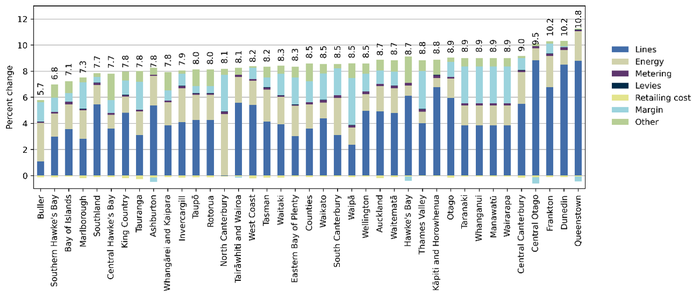
It's important to note the figures compare changes in prices experienced in the first half of 2026, rather than overall price levels. Some retailers may have increased prices more this year after limiting increases in previous years. They may also apply different changes each year across regions.
Keeping a closer watch
Overall, the data received is consistent with network charges, wholesale conditions, and the timing of price-setting.
However, the ambiguity around gentailers’ energy costs and margins reinforces the need for the ‘level playing field’ measures that came into effect on 1 July 2026.
These measures require gentailers to offer hedge contracts to independent retailers on the same terms as they offer to their own retail businesses.
They also allow the Authority to watch retail prices closely and monitor progress through the new Retail Price Consistency Assessment.
This new regime – an Energy Competition Task Force initiative – is designed to improve competition and give retailers confidence they are not being discriminated against when purchasing wholesale electricity. Gentailers must demonstrate compliance twice a year and could face financial penalties for non-compliance.
We are closely watching gentailers’ results for the end of the 2026 financial year. In the half-year results, gentailers reported a combined investment of $1.2 billion in new and upgraded generation. We track the developments of new generation to understand any reasons for delays, and reduce barriers, where possible and appropriate.
Why prices have increased
The increase in lines charges was expected following regulatory decisions by the Commerce Commission in 2024. It approved increased revenue limits for national grid owner, Transpower, and lines companies to recover the costs of upgrading and maintaining the network to meet growing demand and future consumer needs.
To help reduce the initial price rise and impact on consumers, the increases have been spread over five years, rather than be applied all at once in 2025. Lines charges are expected to continue rising, although at a slower pace, through to 2030.
At the same time, prices for electricity contracts for future years have been falling since January this year.
While lower wholesale prices would generally be expected to reduce the energy component of power bills, changes in wholesale prices can take time to flow through to consumers. Retailers may manage these costs over longer periods, meaning retail prices may not immediately reflect movements in the wholesale market.
This smoothing effect prevents consumers from experiencing frequent ‘price shocks’ as wholesale prices rise and fall.
The data shows this lag is still occurring, with many consumers seeing electricity prices increases earlier this year despite a sustained fall in wholesale prices starting at this time.
Consumers are generally notified of price changes once a year by their retailer.
The Authority expects the lower generation costs to benefit consumers shortly and to help offset the higher lines charges next year expected under Commerce Commission price paths.
Supporting consumers
The Authority has an active work programme to address the drivers of rising costs across the electricity system.
This includes initiatives to strengthen competition, improve system efficiency and encourage investment in new electricity generation.
The Authority, with other regulators, also urged lines companies to actively consider lower-cost alternatives to building more expensive infrastructure and supporting more flexible electricity use and supply to improve network efficiency and reduce costs. The Authority is also increasing protections for consumers and options to help people manage their electricity use and costs. Consumers now have better access to pricing plans with cheaper off-peak electricity, and better tools to compare and switch plans through the Authority's comparison website, Billy.
Early reports show people who initiated a switch on Billy saved an average of around $82 for that month.
Further changes will make power bills clearer and easier to understand, protect consumers from unexpected large back bills, and require retailers to check whether customers are on the most suitable plan for their needs.
About the data
The information is based on price change data covering the period from 1 November 2025 to 30 June 2026.
The data was provided by retailers with more than 1% market share and covers approximately 98% of households and small businesses in New Zealand.
The information was requested under section 46 of the Electricity Industry Act as part of the Authority’s function to monitor market behaviour.
Related News
Billy, six months on: there’s power in checking
Electricity is woven into almost every part of our lives. It's there when the alarm clock wakes us in the morning, when we turn on the heater on a cold winter …
Code amendment omnibus #7 decision: Improving undercharging requirements and clarifying retail tariff plans
The Authority has made decisions to assist the smooth implementation of electricity billing and product data obligations that come into force shortly and will …
Authority to progress Standardised Demand Flexibility Product recommendations
The Electricity Authority Te Mana Hiko has welcomed the recent report by the Standardised Demand Flexibility Product Co-design Group and endorsed the products …
Subscribe to Market Brief
Get the latest news, updates and market insights from the Electricity Authority direct to your inbox.