Eye on electricity
Eye on electricity: ASX futures price volatility
- Generation
- Prices
New Zealand has a highly renewable electricity system that uses hydro, geothermal, wind and solar generation. However, high levels of renewable generation contributes to high volatility in wholesale spot prices as electricity generation becomes increasingly reliant on short-term weather patterns. Electricity market participants can buy hedges for baseload (24 hour) hedges and peak (daytime hours only) hedges in the forward market to manage the risk of market volatility.
Standardised hedges are traded on the ASX electricity futures market. The current futures prices (the forward price curve), acts as a consensus of future spot price expectations. These consensus prices are used by participants to make investment decisions and when negotiating prices for energy contracts. However, since electricity spot prices are volatile, futures market prices are also naturally volatile.
This article will explain the causes and extent of ASX futures price volatility.
The influences on futures prices
Short-dated/near-term futures – those that are being traded less than a year before they will be effective – are primarily influenced by current hydro and thermal storage, immediate inflow forecasts and current thermal fuel prices.
Long-dated/longer-term futures – those traded a year or more in advance – take greater consideration of how much new generation is being built, how much demand may increase, probable fuel availability and the share of different types of generation we are likely to have.
Any news that signals changes to the above factors may impact long-dated futures prices. However, due to the nature of trading in a financial market with limited participants and volume, any trade in the futures market is likely to push the futures price around.
On average, each trade of a futures contract immediately changes the best order prices by about $1.50/MWh. This change would be larger for more expensive contracts and smaller for less expensive contracts. When someone buys a contract, the price increases. When someone sells a contract, the price drops.
This trading action leads to market consensus on the appropriate price, because if someone views the current price as low then a participant may buy it while it is low and cause the price to increase and vice versa for when the price seems high. This means the price may be moving due to people’s views on where the price is but may also be moving due to various trading strategies participants may choose to enact regardless of the price.
It is generally better to observe long-term overall trends of the futures market prices or especially large movements, rather than placing emphasis on smaller day-to-day or week-to-week price movements that may be driven by trading strategies.
Closing futures prices change by an average of 6% week-to-week
Using 2025 closing prices, the closing price of a futures contract changed by an average of 2.3% on a day-to-day basis. Futures prices changed by an average of 6.3% over a seven-day period and 13.5% over a 28-day period.
To put that in perspective, if a contract that is usually priced around $200/MWh decreases by $10/MWh over a week following an announcement, that is a 5% decrease in price. This 5% decrease is close to the average amount futures prices tend to fluctuate week-to-week and so it is not necessarily a meaningful price movement. If this $10/MWh decrease persists in the long-term, then we would be more inclined to believe the announcement facilitated a drop in futures prices.
The triggers behind sharp changes in futures prices
Big news events have significantly moved futures prices. A good example of this was in July 2020 when the Tiwai Point aluminium smelter terminated its electricity contract and it seemed likely to close. This caused the futures prices to drop significantly. When the smelter confirmed it was still negotiating with the government in August 2020, the futures prices rose back up. Finally, in January 2021 when a four-year Tiwai deal was announced to keep it open, futures prices rose again. These changes in futures prices are shown in Figure 1.
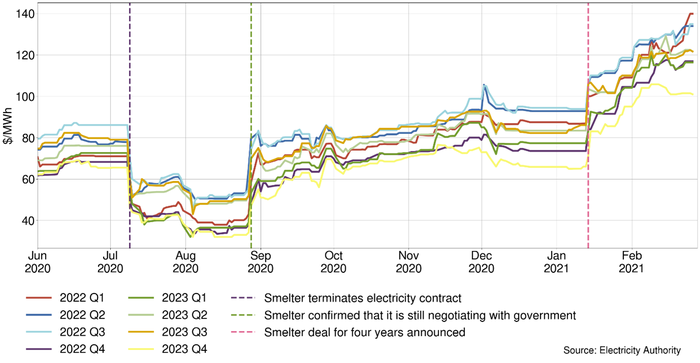
These large movements were because the aluminium smelter comprised 12% of New Zealand’s electricity demand in 2020. This means that whether it remains in the market significantly impacts the future balance of generation and demand. We published an Eye on electricity article about how the Tiwai announcements were impacting futures prices at the time.
Increases in electricity supply are reflected in the long-dated futures price trends
Since futures prices fluctuate day-to-day and week-to-week, it is sustained trends or changes that hold meaning as opposed to short-term fluctuations. This is especially true for the long-dated futures. It is often difficult to understand which changes are meaningful changes in sentiment and which are just usual market volatility without waiting to see the long-term trend.
Figure 2 shows how average long-dated winter futures have been trending down since the start of 2025.
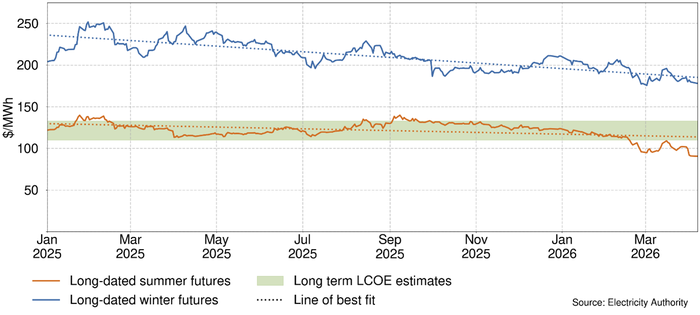
This is likely due to the influx of new renewable generation coming into the generation investment pipeline, lowering expectations of future prices as they contribute cheap energy to the system. More information about incoming generation can be found in the Electricity Authority’s generation investment dashboard.
Related News
Feedback sought on review of security of supply standards
The Electricity Authority Te Mana Hiko is reviewing New Zealand's security of supply standards to ensure they continue to reflect an efficient level of investm…
New publication of standardised super-peak trading data from market making sessions
The Electricity Authority has published a new dataset of prices and traded volumes from the fortnightly market making sessions of standardised super-peak hedge…
Open letter to distributors as low fixed charge regulations come to an end
Electricity retailers and distributors will need to consider the potential impacts on consumers as they re-adjust pricing ahead of 1 April 2027 when the Govern…
Subscribe to Market Brief
Get the latest news, updates and market insights from the Electricity Authority direct to your inbox.